Singapore Interest Rate Outlook 2026: SORA, the Fed and Your Loan
Where Singapore home loan rates stand in Oct 2026, why SORA sits far below US rates after the Fed's hike, what could move it, and how to plan your loan.

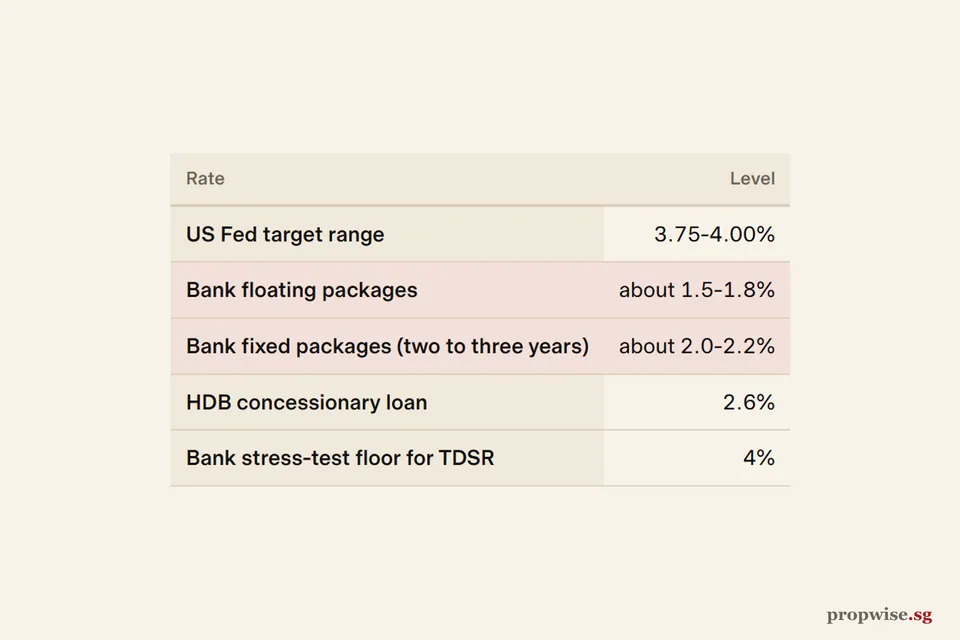
Singapore home loan rates are low in October 2026: the three-month compounded SORA was about 1.24% on 14 Oct 2026, and bank packages cost about 1.5–1.8% floating or 2.0–2.2% fixed. Banks raised their packages after the US Federal Reserve’s September hike, and the Fed expects to go higher. Nobody can tell you where SORA will be in two years, but you can understand what moves it and plan your loan so that a return to 4% does not hurt you.
At a glance
- 3M compounded SORA: about 1.24% (14 Oct 2026). After the Fed hike, floating packages cost about 1.5–1.8% and fixed packages about 2.0–2.2% (late September 2026). The cheaper early-September rates (from about 1.4%) are gone.
- US Fed funds target: 3.75–4.00% after a 0.25-point hike on 16 Sep 2026. The median Fed official expects 4.1% at end-2026 and end-2027.
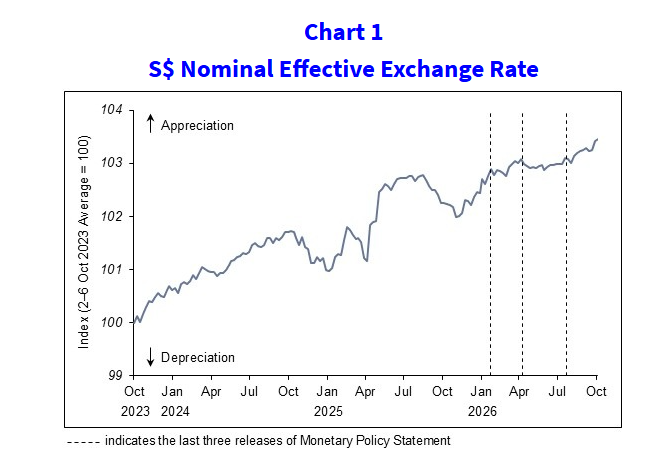
- MAS has tightened twice in 2026 (April and July) by steepening the Singapore dollar’s appreciation path. Its next statement is due in October 2026.
- SORA was above 3.5% in 2023. Banks already test your loan at 4%. Do the same with your own budget.
- SIBOR and SOR are gone. If you read old forecasts based on them (including the 2016 version of this article), treat them as history.
Where rates stand in October 2026
| Benchmark or rate | Level | As at |
|---|---|---|
| 3M compounded SORA | about 1.24% | 14 Oct 2026 |
| Typical floating package | about 1.5–1.8% | late Sep 2026 |
| Typical fixed package (two to three years) | about 2.0–2.2% | late Sep 2026 |
| Floating and fixed packages before the Fed hike (history) | from about 1.4% | 4 Sep 2026 |
| HDB concessionary loan | 2.6% | Oct 2026 |
| US Fed funds target range | 3.75–4.00% | 16 Sep 2026 |
| MAS stress-test rate for bank loans | 4% floor | since 30 Sep 2022 |
SORA figures are MAS data as reported by HousingLoanSG. Current package rates are as reported by The Business Times (2 October 2026) and CNA (18 September 2026); the pre-hike figures are from PropertyNet’s early-September survey. Package rates change often. The HDB loan rate is pegged at 0.1 point above the CPF Ordinary Account rate. The MAS stress-test floor is the rate a bank must use when it checks whether you can afford a loan.
The original 2016 version of this article forecast SIBOR. SIBOR and the Swap Offer Rate (SOR) have since been retired, and the industry declared the switch to SORA complete in early 2025 (ABS). SORA is the volume-weighted average rate of overnight unsecured interbank borrowing in Singapore dollars. It is published by MAS every business day.
Why Singapore rates can stay far below US rates
The 2016 article made one point that still holds: Singapore rates follow US rates, but not one for one. In 2026 the gap is very large. The Fed raised its target range to 3.75–4.00% on 16 September 2026, but 3M SORA rose only from about 1.19% in early September to about 1.23% at the start of October.
- 3-month compounded SORA (Singapore)
- US federal funds rate (effective)
Latest: SORA 1.24% (14 Oct 2026); Fed 3.88% (13 Oct 2026).
SORA is the benchmark for floating-rate home loans in Singapore. The US rate is shown for context: it moves SORA only indirectly, through the Singapore dollar and bank funding costs.
Table view
| Period | 3-month compounded SORA (Singapore) | US federal funds rate (effective) |
|---|---|---|
| Oct 2026 | 1.24% | 3.88% |
| Sep 2026 | 1.23% | 3.88% |
| Aug 2026 | 1.18% | 3.63% |
| Jul 2026 | 1.14% | 3.63% |
| Jun 2026 | 1.08% | 3.63% |
| May 2026 | 1.06% | 3.62% |
| Apr 2026 | 1.03% | 3.64% |
| Mar 2026 | 1.07% | 3.64% |
| Feb 2026 | 1.12% | 3.64% |
| Jan 2026 | 1.15% | 3.64% |
| Dec 2025 | 1.19% | 3.64% |
| Nov 2025 | 1.25% | 3.89% |
| Oct 2025 | 1.32% | 4.11% |
| Sep 2025 | 1.46% | 4.09% |
| Aug 2025 | 1.56% | 4.33% |
| Jul 2025 | 1.86% | 4.33% |
| Jun 2025 | 2.06% | 4.33% |
| May 2025 | 2.27% | 4.33% |
| Apr 2025 | 2.40% | 4.33% |
| Mar 2025 | 2.55% | 4.33% |
| Feb 2025 | 2.73% | 4.33% |
| Jan 2025 | 2.90% | 4.33% |
| Dec 2024 | 3.08% | 4.33% |
| Nov 2024 | 3.21% | 4.58% |
| Oct 2024 | 3.39% | 4.83% |
| Sep 2024 | 3.49% | 4.83% |
| Aug 2024 | 3.57% | 5.33% |
| Jul 2024 | 3.64% | 5.33% |
| Jun 2024 | 3.63% | 5.33% |
| May 2024 | 3.66% | 5.33% |
| Apr 2024 | 3.65% | 5.33% |
| Mar 2024 | 3.68% | 5.33% |
| Feb 2024 | 3.64% | 5.33% |
| Jan 2024 | 3.66% | 5.33% |
| Dec 2023 | 3.70% | 5.33% |
| Nov 2023 | 3.75% | 5.33% |
| Oct 2023 | 3.75% | 5.33% |
| Sep 2023 | 3.70% | 5.33% |
| Aug 2023 | 3.70% | 5.33% |
| Jul 2023 | 3.68% | 5.33% |
| Jun 2023 | 3.65% | 5.07% |
| May 2023 | 3.61% | 5.08% |
| Apr 2023 | 3.61% | 4.83% |
| Mar 2023 | 3.58% | 4.83% |
| Feb 2023 | 3.23% | 4.58% |
| Jan 2023 | 3.12% | 4.33% |
| Dec 2022 | 3.03% | 4.33% |
| Nov 2022 | 2.87% | 3.83% |
| Oct 2022 | 2.45% | 3.08% |
| Sep 2022 | 2.07% | 3.08% |
| Aug 2022 | 1.55% | 2.33% |
| Jul 2022 | 1.27% | 2.32% |
| Jun 2022 | 0.72% | 1.58% |
| May 2022 | 0.52% | 0.83% |
| Apr 2022 | 0.32% | 0.33% |
| Mar 2022 | 0.27% | 0.33% |
| Feb 2022 | 0.25% | 0.08% |
| Jan 2022 | 0.20% | 0.08% |
| Dec 2021 | 0.19% | 0.08% |
| Nov 2021 | 0.16% | 0.08% |
| Oct 2021 | 0.16% | 0.07% |
| Sep 2021 | 0.13% | 0.08% |
| Aug 2021 | 0.13% | 0.08% |
| Jul 2021 | 0.13% | 0.10% |
| Jun 2021 | 0.14% | 0.10% |
| May 2021 | 0.17% | 0.05% |
| Apr 2021 | 0.19% | 0.07% |
| Mar 2021 | 0.23% | 0.07% |
| Feb 2021 | 0.20% | 0.07% |
| Jan 2021 | 0.17% | 0.07% |
| Dec 2020 | 0.17% | 0.09% |
| Nov 2020 | 0.12% | 0.08% |
| Oct 2020 | 0.12% | 0.09% |
| Sep 2020 | 0.10% | 0.09% |
| Aug 2020 | 0.10% | 0.09% |
| Jul 2020 | 0.08% | 0.09% |
| Jun 2020 | 0.14% | 0.08% |
| May 2020 | 0.27% | 0.05% |
| Apr 2020 | 0.53% | 0.05% |
| Mar 2020 | 0.90% | 0.10% |
| Feb 2020 | 1.14% | 1.58% |
| Jan 2020 | 1.20% | 1.55% |
| Dec 2019 | 1.27% | 1.55% |
| Nov 2019 | 1.31% | 1.55% |
| Oct 2019 | 1.46% | 1.83% |
| Sep 2019 | 1.53% | 1.83% |
| Aug 2019 | 1.59% | 2.12% |
| Jul 2019 | 1.67% | 2.40% |
| Jun 2019 | 1.72% | 2.40% |
| May 2019 | 1.68% | 2.38% |
| Apr 2019 | 1.62% | 2.44% |
| Mar 2019 | 1.54% | 2.43% |
| Feb 2019 | 1.59% | 2.40% |
| Jan 2019 | 1.52% | 2.40% |
The reason is how MAS runs monetary policy. MAS does not set an interest rate. It manages the Singapore dollar against a trade-weighted basket of currencies, because in a very open economy the exchange rate has a much stronger effect on inflation than interest rates do. Money moves freely in and out of Singapore. So, in broad terms, SGD interest rates tend to settle near the US rate minus the Singapore dollar appreciation that markets expect. If investors expect the Singapore dollar to keep rising, they accept a lower SGD interest rate, because the currency gain makes up the difference.
That is why MAS “tightening” does not push mortgage rates up the way a Fed hike does in the US. MAS increased the slope of its policy band slightly in April 2026 and very slightly in July 2026. A steeper appreciation path makes the Singapore dollar more attractive to hold, and this tends to keep SGD rates low, not high.
What could push SORA up, and what could pull it down
| Could push SORA and your rate up | Could pull them down |
|---|---|
| More Fed hikes. The Fed’s September projections show a median 4.1% at end-2026, so one more hike is the central case. | Fed cuts. The same projections show the median rate easing to 3.9% in 2028 and 3.2% in the longer run. |
| MAS flattening or easing the S$NEER slope (for example, if growth weakens), which reduces expected appreciation | Further MAS tightening, or strong demand for Singapore dollars as a safe currency |
| Capital flowing out of Singapore in a global shock | Plentiful liquidity in Singapore’s banking system |
| Banks widening their spreads, even if SORA stays flat | Banks competing hard for mortgages with thin spreads |
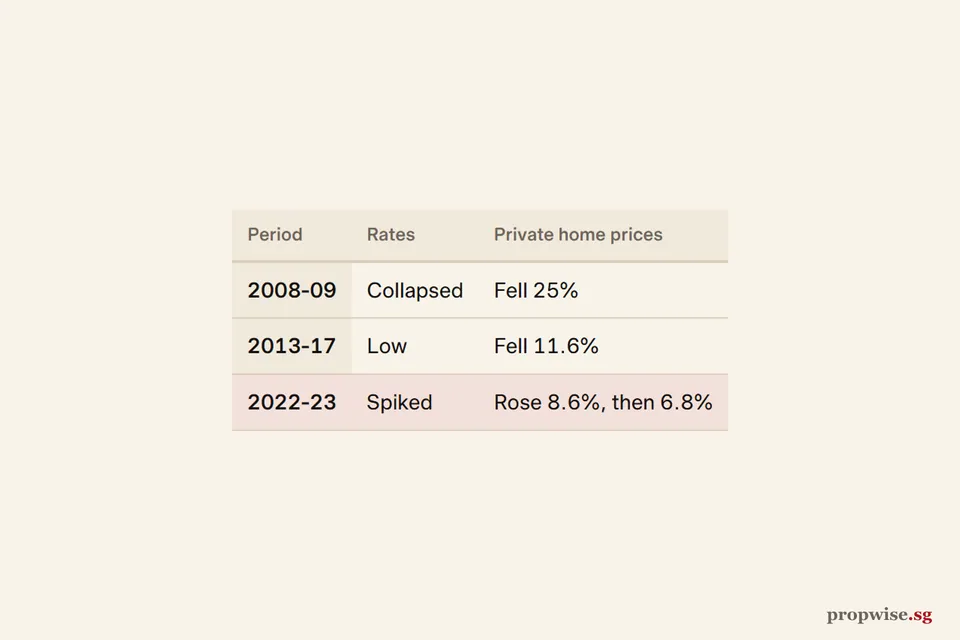
The last row matters more than most buyers think. In 2015 Propwise wrote about borrowers whose rates roughly doubled in about a year. Part of that rise came from the benchmark, and part came from banks raising their spread after lock-in periods ended. With 3M SORA at about 1.24%, today’s floating packages carry spreads of only a few tenths of a point. A package that reverts to a higher spread after two or three years can cost you more than a small SORA move.
The next scheduled triggers are the Fed meetings on 27–28 October and 8–9 December 2026 and the MAS monetary policy statement in October 2026. MAS now issues these statements every quarter.
- 1April 2026MAS tightens slightlyMAS increased the slope of its policy band slightly.
- 2July 2026MAS tightens againMAS increased the slope of its policy band very slightly.
- 316 September 2026Fed raises its target rangeTo 3.75-4.00%. Banks then raised their mortgage packages.
- 4October 2026MAS policy statement dueMAS now issues these statements every quarter.
- 527-28 October 2026Fed meetingThe September projections show a median 4.1% at end-2026.
- 68-9 December 2026Fed meetingScheduled Fed meeting.
Source: Federal Reserve, press release 16 September 2026 (October 2026); MAS, past monetary policy decisions; Federal Reserve, FOMC calendar.
How much a rate rise would cost you
Forecasts are often wrong. Scenarios are more useful. Say you have an S$800,000 loan over 25 years. This is what your monthly instalment looks like at different all-in rates:
| All-in mortgage rate | Monthly instalment | Change vs today |
|---|---|---|
| 1.5% (low end of floating packages now) | S$3,199 | — |
| 2.0% (about where fixed packages start) | S$3,391 | +S$192 |
| 2.5% | S$3,589 | +S$390 |
| 3.0% | S$3,794 | +S$595 |
| 3.5% | S$4,005 | +S$806 |
| 4.0% (MAS stress-test floor) | S$4,223 | +S$1,024 |
Extra S$ a month
Source: Propwise mortgage calculator (standard instalment formula) (October 2026). At 1.5% the instalment is S$3,199 a month. 4.0% is the MAS stress-test floor.
A move from today’s 1.5% to 4% would raise the instalment by about a third. SORA was above 3.5% in 2023, and a 0.25–0.5% spread on top of that gives an all-in rate close to 4%. A return to 4% has already happened once, so it is not an extreme scenario. Use the Propwise mortgage calculator to run your own numbers.
The 2016 forecast in this article assumed that SIBOR would climb to 2.4–3% and stay there. Since then, Singapore rates have been well below that range and well above it (SORA topped 3.5% in 2023). The lesson is not that a particular forecaster was wrong. It is that you should not build your finances on any single forecast, including the cheerful ones you will find online in 2026.
What to do with your loan now
Size the loan for 4%, not for 1.5%. The TDSR rules already cap your total debt repayments at 55% of gross income at a 4% stress rate. That is a regulatory ceiling, not a comfortable budget. Check that you could pay the 4% instalment from your income today and still save. See our guide to TDSR and MSR.
Fixed protection now has a price. Before the Fed hike, fixed and floating packages cost almost the same. Now fixed packages (about 2.0–2.2%) cost roughly 0.3–0.7 point more than floating ones (about 1.5–1.8%). On the S$800,000 loan above, 2.0% fixed against 1.5% floating is about S$190 a month. That is the premium you pay for two to three years of certainty. Floating still suits borrowers who want to keep flexibility, for example to repay early or to sell. Our SORA vs fixed rate guide works through the trade-off.
HDB borrowers: the 2.6% HDB loan is not cheap right now, but it is stable. On an S$400,000 loan over 25 years, 2.6% costs S$1,815 a month against S$1,657 at a 1.8% bank floating rate, a difference of about S$160. But you cannot switch from a bank loan back to an HDB loan, so an HDB-loan borrower who refinances to a bank gives up that safety net for good. See the HDB loan guide.
Source: Propwise calculation (standard monthly-instalment formula). HDB rate per CPF Board, 22 Sep 2026; 4.00% is the MAS test rate. Illustrations, not offers.
Put a review date in your diary. Most packages change after the lock-in, which is often two years. Two to three months before it ends, compare your bank’s repricing offer with other banks’ refinancing offers. Our refinancing guide explains the costs and how to compare offers.
Keep a cash buffer. A rate shock often comes with a weaker job market. Several months of instalments in cash gives you time to act without a forced sale.
Bottom line
Singapore mortgage rates in late 2026 are low because markets expect the Singapore dollar to stay strong, not because US rates are low. That can change quickly if the Fed keeps hiking, if MAS changes direction, or if banks widen their spreads. Enjoy today’s packages of about 1.5–2.2%, but borrow as if you will pay 4%. Then a rate rise is an inconvenience and not a crisis.