Who Controls Land Supply in Singapore? GLS, URA, HDB, SLA
How MND, URA, HDB and SLA plan and sell land in Singapore, how the GLS Confirmed and Reserve Lists work, and the 9,320 homes on the 2026 Confirmed List.
In Singapore, the government decides how much land is released for new homes, and when. The Ministry of National Development (MND) sets the Government Land Sales (GLS) programme every six months. The Urban Redevelopment Authority (URA) plans land use and sells most private housing sites. HDB builds public housing and sells executive condominium (EC) sites. The Singapore Land Authority (SLA) manages state land and land titles. For anyone buying property, this matters: the land the state sells today becomes the supply that competes with your home three to five years from now.
At a glance
- GLS is announced twice a year: in June for the second half and in December for the first half of the next year.
- Confirmed List sites are sold on fixed dates. Reserve List sites are sold only if a developer “triggers” them with an acceptable minimum bid.
- The 2026 Confirmed List will yield 9,320 private homes (including ECs), more than 50% above the 10-year average.
- URA expects about 57,200 private homes (including ECs) to complete in the coming years, 44,738 of them with planning approval at Q3 2026, and about 22,300 by 2028.
- Since 1 August 2022, landowners who intensify or change the use of land pay a Land Betterment Charge, which replaced Differential Premium.
Who does what
| Agency | Parent ministry | Role in land supply |
|---|---|---|
| MND | — | Sets housing and land sales policy; announces the GLS programme |
| URA | MND | Plans land use (Master Plan); sales agent for private residential, commercial, hotel and white sites |
| HDB | MND | Builds and sells public flats; sales agent for EC sites |
| SLA | Ministry of Law | Manages state land and properties, issues land titles, administers leases, appoints and manages the state’s land sales agents, collects Land Betterment Charge |
| JTC | Ministry of Trade and Industry | Industrial land and the Industrial GLS programme |
SLA describes its role as helping the government “achieve optimal returns from the sales of State lands” and managing the state’s land sales agents (URA, HDB and JTC). SLA also handles the land titles and leases for the sites sold.
The 2014 version of this article wondered why HDB owns industrial space. That history is less relevant for home buyers today. What matters is that one system, run by the state, controls nearly all new land for housing, both public and private.
How the Government Land Sales programme works
URA explains that each GLS programme is “planned for and announced every six months”. Sites go on one of two lists.
Confirmed List. These sites are put up for tender on dates set in advance, whatever the market is doing. This is the government’s main supply lever: more Confirmed List units when demand is strong, fewer when it is weak.
Reserve List. These sites are only released when a developer applies with a minimum price the government accepts. Under the Reserve List procedure, a site is triggered when one developer’s minimum price is acceptable, or when more than one unrelated party offers a price close to the government’s reserve price. The applicant must then commit to bid at least that minimum price, backed by a deposit of 3% of the minimum price (capped at S$5 million). The deposit is forfeited if the developer does not bid.
Most sites are sold by tender, usually to the highest bidder. URA publishes all bids when a tender closes, and the award later. That makes GLS results one of the most transparent signals of what developers think future home prices will be.
- 1A developer appliesThe developer offers a minimum price for a Reserve List site.
- 2The site is triggeredThis happens when one developer's minimum price is acceptable, or when more than one unrelated party offers a price close to the government's reserve price.
- 3The applicant commitsIt must bid at least the minimum price, backed by a deposit of 3% of that price, capped at S$5 million.
- 4The tender runsMost sites are sold by tender, usually to the highest bidder. The deposit is forfeited if the developer does not bid.
Source: URA, Reserve List procedure (October 2026).
The 2026 programme in numbers
The 2H 2026 GLS programme, announced on 3 June 2026, puts 4,745 private homes on the Confirmed List, including 735 EC units. That follows 4,575 units in the 1H 2026 programme. Together, the 2026 Confirmed List comes to 9,320 units, which the government says is more than 50% higher than the average of the past 10 years. The 2H 2026 Reserve List can yield another 4,455 homes.
The 2H 2026 Confirmed List sites are:
| Site | Est. units | Planned launch |
|---|---|---|
| Town Hall Link (white site, Jurong Lake District) | 1,200 | Jul 2026 |
| Marina Gardens Lane | 390 | Aug 2026 |
| Orchard Boulevard | 110 | Aug 2026 |
| East Coast Road | 85 | Sep 2026 |
| De Souza Avenue | 415 | Nov 2026 |
| Tanjong Rhu Close | 505 | Nov 2026 |
| Berlayar Close | 695 | Dec 2026 |
| Holland Plain | 610 | Dec 2026 |
| Jurong East Avenue 1 (EC, sold by HDB) | 735 | Dec 2026 |
For comparison, the 2025 Confirmed Lists offered 5,030 units in the first half and 4,725 in the second, close to 10,000 for the year. The government’s stated aim is to meet “resilient demand” and keep the market “stable and sustainable”. The 1H 2027 programme is normally announced in December.
Units on the Confirmed List
Source: URA, 2H 2026 GLS programme (3 June 2026); URA, 1H 2026 GLS programme; URA, 1H 2025; URA, 2H 2025.
What recent land tenders tell you
Land bids tell you what developers expect to sell at three or four years from now. Two 2026 examples:
| Site | Floor area | Bids | Winning bid | Per sq ft of plot ratio |
|---|---|---|---|---|
| New Upper Changi Road (99-year lease) | about 86,154 sqm | 4 | S$1.425 billion | about S$1,537 |
| Lorong Puntong / Sin Ming Avenue | about 11,994 sqm | 7 | S$208.1 million | about S$1,612 |
Source: URA, New Upper Changi Road award (2026); URA, Lorong Puntong / Sin Ming Avenue award. psf ppr = per square foot of plot ratio. The New Upper Changi Road winning bid was about 14% above the next bid.
- New Upper Changi Road (99-year lease, about 86,154 sqm of floor area). The tender drew four bids. The winning bid of S$1.425 billion works out to S$16,544.65 per sqm of floor area, or about S$1,537 psf per plot ratio (psf ppr). It was about 14% above the next bid.
- Lorong Puntong / Sin Ming Avenue (about 11,994 sqm of floor area). The tender drew seven bids, and the site was awarded at S$208.1 million, or about S$1,612 psf ppr.
How to read these numbers:
- Land cost is the floor, not the price. A developer adds construction, financing, stamp duties, marketing and profit. Launch prices therefore end up well above the land price per square foot.
- The number of bids measures confidence. Many bids and a narrow spread suggest developers agree on value. Few bids, or one bid far above the rest, suggest one developer is taking a big bet.
- Your neighbourhood’s future supply is public. If you are buying a resale condo near a newly sold site, expect a new launch next door in a year or two, often priced as a benchmark for your home.
The pipeline: what is already coming
Land sold in past years is now under construction. URA’s Q3 2026 statistics show 44,738 private homes (including ECs) in the pipeline with planning approval, of which 20,300 were unsold. Another 12,508 unsold units had no planning approval yet, including the 2H 2026 Confirmed List sites. In total, URA expects about 57,200 private homes to be completed in the coming years: about 22,300 by 2028 and about 34,900 from 2029.
- Non-landed (condos and apartments)
- Landed
Latest: Non-landed 48,230 (Q3 2026), up 3.1% on Q3 2025; Landed 1,167 (Q3 2026), down 12.6% on Q3 2025. 10-year average 51,289 (Q4 2016 to Q3 2026).
This is a wider count than URA's headline figure of homes with planning approval (42,472 at Q2 2026, which includes ECs): it also counts projects with provisional permission and sites that are only planned.
Table view
| Period | Non-landed (condos and apartments) | Landed |
|---|---|---|
| Q3 2026 | 48,230 | 1,167 |
| Q2 2026 | 51,677 | 1,109 |
| Q1 2026 | 48,111 | 1,332 |
| Q4 2025 | 47,358 | 1,322 |
| Q3 2025 | 46,787 | 1,336 |
| Q2 2025 | 48,474 | 1,316 |
| Q1 2025 | 44,134 | 1,335 |
| Q4 2024 | 45,934 | 1,337 |
| Q3 2024 | 44,997 | 1,368 |
| Q2 2024 | 49,598 | 1,370 |
| Q1 2024 | 46,335 | 1,369 |
| Q4 2023 | 47,191 | 1,370 |
| Q3 2023 | 46,146 | 980 |
| Q2 2023 | 53,472 | 823 |
| Q1 2023 | 51,703 | 887 |
| Q4 2022 | 53,846 | 946 |
| Q3 2022 | 54,171 | 934 |
| Q2 2022 | 53,879 | 962 |
| Q1 2022 | 52,802 | 970 |
| Q4 2021 | 52,602 | 953 |
| Q3 2021 | 51,176 | 925 |
| Q2 2021 | 51,386 | 1,004 |
| Q1 2021 | 49,910 | 996 |
| Q4 2020 | 51,449 | 954 |
| Q3 2020 | 51,514 | 940 |
| Q2 2020 | 52,116 | 939 |
| Q1 2020 | 51,222 | 863 |
| Q4 2019 | 52,514 | 899 |
| Q3 2019 | 53,757 | 788 |
| Q2 2019 | 54,737 | 864 |
| Q1 2019 | 56,130 | 998 |
| Q4 2018 | 56,602 | 1,000 |
| Q3 2018 | 57,156 | 1,034 |
| Q2 2018 | 54,402 | 921 |
| Q1 2018 | 50,907 | 1,180 |
| Q4 2017 | 49,618 | 1,234 |
| Q3 2017 | 41,858 | 1,196 |
| Q2 2017 | 43,465 | 1,199 |
| Q1 2017 | 43,457 | 1,255 |
| Q4 2016 | 47,016 | 1,352 |
| Q3 2016 | 47,702 | 1,383 |
| Q2 2016 | 50,339 | 1,507 |
| Q1 2016 | 56,015 | 1,582 |
| Q4 2015 | 57,867 | 2,292 |
| Q3 2015 | 61,715 | 2,462 |
| Q2 2015 | 64,437 | 2,774 |
| Q1 2015 | 69,520 | 2,823 |
| Q4 2014 | 72,279 | 2,909 |
| Q3 2014 | 76,383 | 2,981 |
| Q2 2014 | 80,476 | 3,157 |
| Q1 2014 | 83,044 | 3,355 |
| Q4 2013 | 86,541 | 3,477 |
| Q3 2013 | 86,981 | 3,744 |
| Q2 2013 | 90,948 | 3,825 |
| Q1 2013 | 91,408 | 3,804 |
| Q4 2012 | 92,370 | 3,860 |
| Q3 2012 | 88,084 | 3,785 |
| Q2 2012 | 89,087 | 3,784 |
| Q1 2012 | 85,954 | 3,885 |
| Q4 2011 | 85,724 | 3,807 |
| Q3 2011 | 82,460 | 3,872 |
| Q2 2011 | 83,241 | 4,001 |
| Q1 2011 | 76,128 | 4,044 |
| Q4 2010 | 75,514 | 3,963 |
| Q3 2010 | 69,054 | 3,933 |
| Q2 2010 | 68,544 | 3,914 |
| Q1 2010 | 63,729 | 3,942 |
| Q4 2009 | 62,240 | 4,186 |
| Q3 2009 | 57,880 | 4,209 |
| Q2 2009 | 58,189 | 4,423 |
| Q1 2009 | 59,880 | 4,614 |
| Q4 2008 | 61,357 | 4,872 |
| Q3 2008 | 62,481 | 4,982 |
| Q2 2008 | 66,516 | 5,127 |
| Q1 2008 | 68,960 | 5,248 |
| Q4 2007 | 69,066 | 5,056 |
| Q3 2007 | 65,868 | 4,853 |
| Q2 2007 | 61,159 | 4,453 |
| Q1 2007 | 53,556 | 4,352 |
| Q4 2006 | 49,053 | 4,452 |
| Q3 2006 | 49,402 | 4,357 |
| Q2 2006 | 47,753 | 4,498 |
| Q1 2006 | 44,665 | 4,397 |
| Q4 2005 | 43,448 | 4,458 |
| Q3 2005 | 42,121 | 4,737 |
| Q2 2005 | 41,227 | 4,684 |
| Q1 2005 | 42,349 | 4,350 |
Source: URA. Data to Q3 2026.
Homes expected to complete (approximate)
Source: URA, Q2 2026 private residential statistics (Q2 2026).
The public housing pipeline is large too. HDB plans to launch about 19,600 BTO flats in 2026, including more than 4,000 with shorter waiting times. Every couple who books a BTO is a couple not buying a resale flat or a small condo. That is one reason HDB resale prices have eased slightly in 2026.
For a buyer, large supply is not automatically bad. It gives you choice and bargaining power, and it is the government’s main tool against runaway prices. The risk is for owners who need to sell or rent in a year when many new homes complete nearby. We look at that risk in Will Singapore property prices crash?
Planning: Master Plan and land betterment
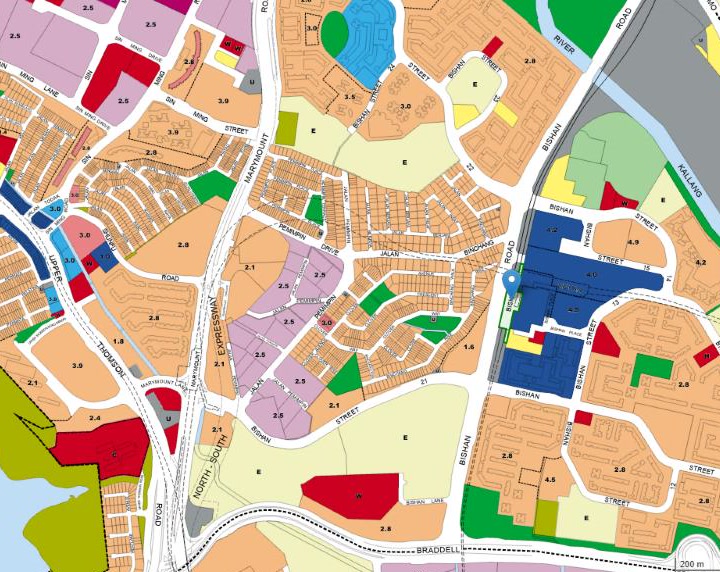
Land supply starts long before a site appears on a GLS list. URA’s Master Plan is “the statutory land use plan which guides Singapore’s development in the medium term over the next 10 to 15 years”. It is reviewed every five years and turns the Long-Term Plan into zoning, plot ratios and building heights. The current version is Master Plan 2025. If you want to know what can be built next to a home you are buying, check the Master Plan map, not the agent’s brochure. Our guide to URA land use planning and development types explains the zoning terms.
Private land can also add supply. When an owner redevelops at a higher plot ratio or changes the use of a site, for example in an en bloc, they pay the state a Land Betterment Charge. SLA describes this as “a tax on the increase in value of land” from planning permission. It replaced Differential Premium, Development Charge and Temporary Development Levy from 1 August 2022. If you read an older article (including the 2014 version of this one) that mentions Differential Premium, that system no longer applies.
How to use this information as a buyer
- Before you buy, check the GLS lists near the home. Both the Confirmed and Reserve Lists are on URA’s website, with site maps.
- Look at the completion year, not the launch year. Supply competes for tenants and buyers when it completes. Ask how many units in your area will complete within a year of your home.
- Follow land bids for the price direction. Rising bids per square foot over several tenders suggest developers expect higher prices. Falling or thin bids are an early warning.
- Don’t overreact to one programme. The government adjusts supply every six months. A large supply year often follows a strong market, and supply is cut when demand fades.
For more on how supply and demand set prices, see The key is to look at demand and supply.
Bottom line
The state controls almost all new housing land in Singapore, through MND, URA, HDB and SLA. It uses the GLS programme as a tap: open in 2025 and 2026, with Confirmed List supply more than 50% above the 10-year average. For buyers, the main points are simple. Supply is public, it arrives with a lag of several years, and land bids are the best early signal of where new launch prices are heading. Check the pipeline near any home before you commit.