Introducing the Singapore Home Buyers Toolkit
A walkthrough of the free Singapore Home Buyers Toolkit on one S$600,000 resale flat: upfront costs, the loan tests, rent vs buy and selling. How to get it.
A couple buying a S$600,000 HDB resale flat, with a S$450,000 loan and S$90,000 in grants, needs S$76,100 of their own money on completion. Their CPF covers all of it, and the loan passes every test. The Singapore Home Buyers Toolkit works this out in one Google Sheet, before you sign anything.
Buying a home means collecting answers from five places. IRAS sets stamp duty, HDB sets grants and its loan, and MAS sets the lending tests. CPF Board says what your savings can pay, and your bank decides the rest.
The toolkit puts them on one screen, so you see the whole picture while you can still change the plan.
You fill in the yellow cells once. The other tabs then show the results: what you pay, whether the loan passes, and how renting compares with buying.
This walkthrough follows one couple through them. Every figure is the example that comes filled in, so you can follow along and then swap in your own numbers.
Fill in the yellow cells
The first tab, Your details, is where you enter your purchase. The cells to change are yellow, with blue text.
The couple are both Singapore citizens, aged 30 and 28, buying their first home. They earn S$4,500 and S$4,000 a month, so the household income is S$8,500.
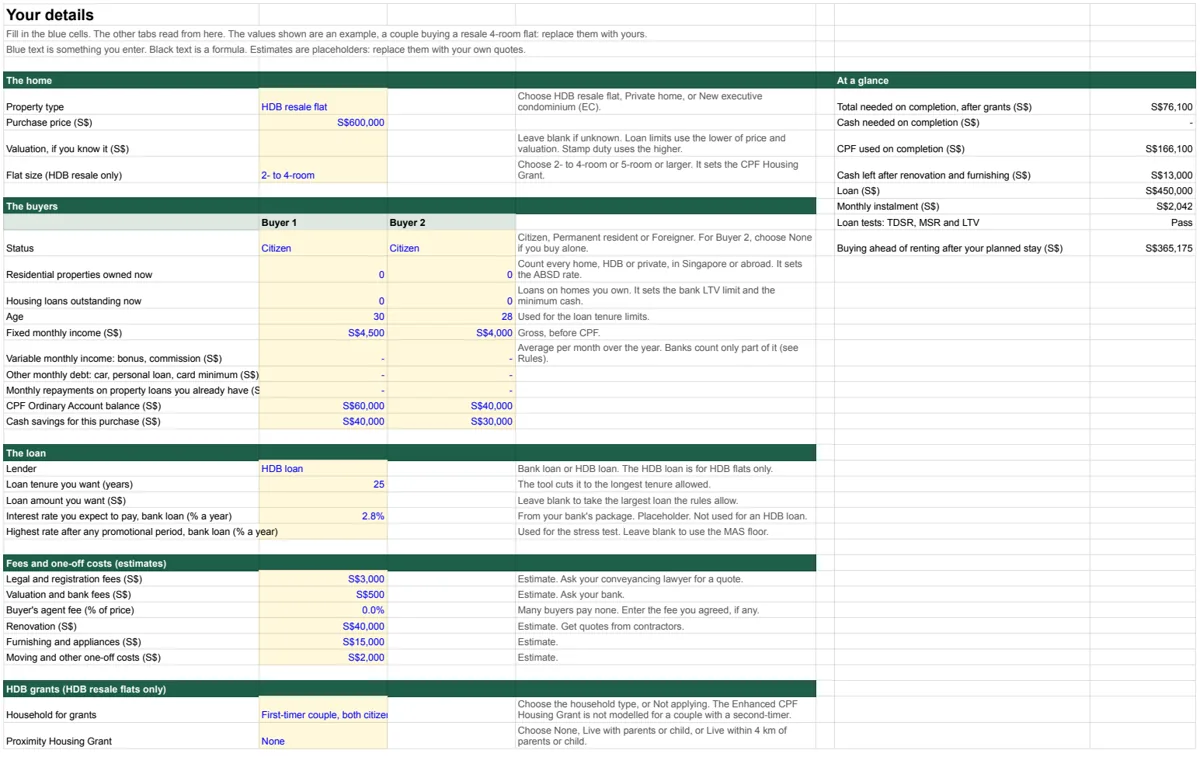
They have S$100,000 in their CPF Ordinary Accounts and S$70,000 in cash.
They plan an HDB loan over 25 years, S$40,000 of renovation, S$15,000 of furnishing and S$2,000 for the move. The grey box on the right, “At a glance”, updates as you type, so a wrong number shows up at once. Every other tab reads from these cells and shows the results.
What you pay on completion
The Upfront costs tab adds up everything due on completion. Buyer’s Stamp Duty (BSD) on S$600,000 comes to S$12,600 under the IRAS rates. That is S$1,800 on the first S$180,000, S$3,600 on the next S$180,000 and S$7,200 on the last S$240,000.
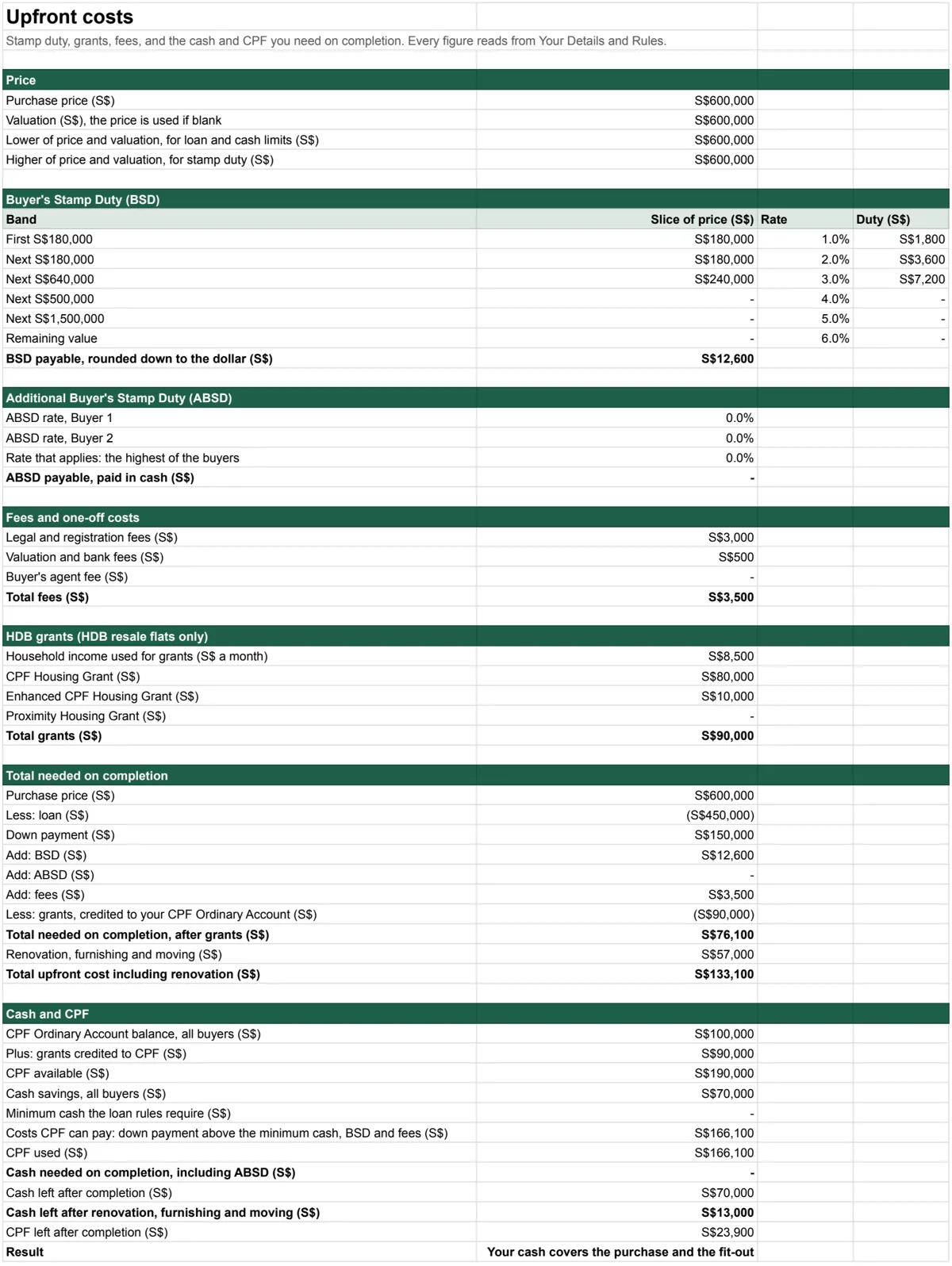
Additional Buyer’s Stamp Duty (ABSD) is nil, because a citizen buying a first home pays none. Fees add S$3,500.
The tab then reads the household income of S$8,500 and finds S$90,000 of HDB grants. The CPF Housing Grant gives S$80,000 and the Enhanced CPF Housing Grant gives S$10,000.
Price, less the S$450,000 loan, plus BSD and fees, less the grants, gives S$76,100. That is the couple’s own money in.
The bottom block splits the costs between CPF and cash. Before grants they total S$166,100.
The couple’s CPF of S$100,000, plus the S$90,000 of grants credited to it, covers that. S$23,900 stays in CPF and their S$70,000 of cash is untouched.
The renovation, furnishing and move add S$57,000. The tab finishes with a plain-language result: “Your cash covers the purchase and the fit-out”, with S$13,000 left.
Whether the loan passes
The Loan check tab applies the lending rules. The couple use an HDB loan, so the tests are the 75% loan-to-value (LTV) limit and the Mortgage Servicing Ratio (MSR). The MSR caps the instalment at 30% of gross monthly income.
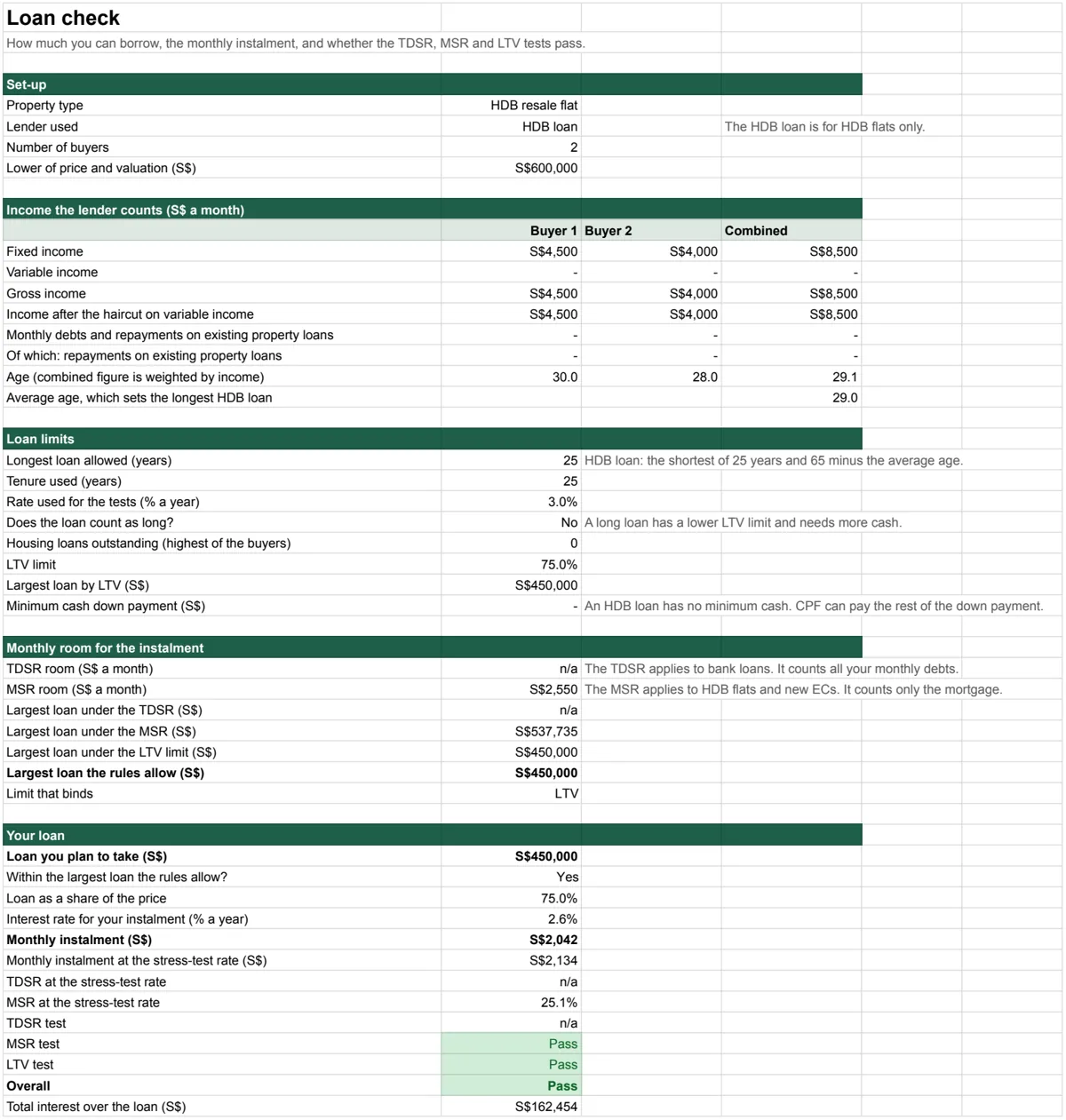
At 75% of S$600,000, the largest loan is S$450,000. The MSR would allow S$537,735, so the LTV limit binds and the tab says so. A bank loan adds a third test, the Total Debt Servicing Ratio (TDSR), which counts every monthly debt.
The instalment is S$2,042 a month at the HDB concessionary rate of 2.6%.
The tab then tests the loan at the HDB assessment rate of 3%, where the instalment is S$2,134. That is 25.1% of income, inside the 30% cap.
The MSR, LTV and overall rows all read Pass. Total interest over 25 years is S$162,454.
Renting or buying
The Rent vs buy tab compares owning with renting the same home for up to 15 years. Its own yellow cells hold the market inputs. These are rent, rent growth, price growth, the years you stay and what spare money earns.
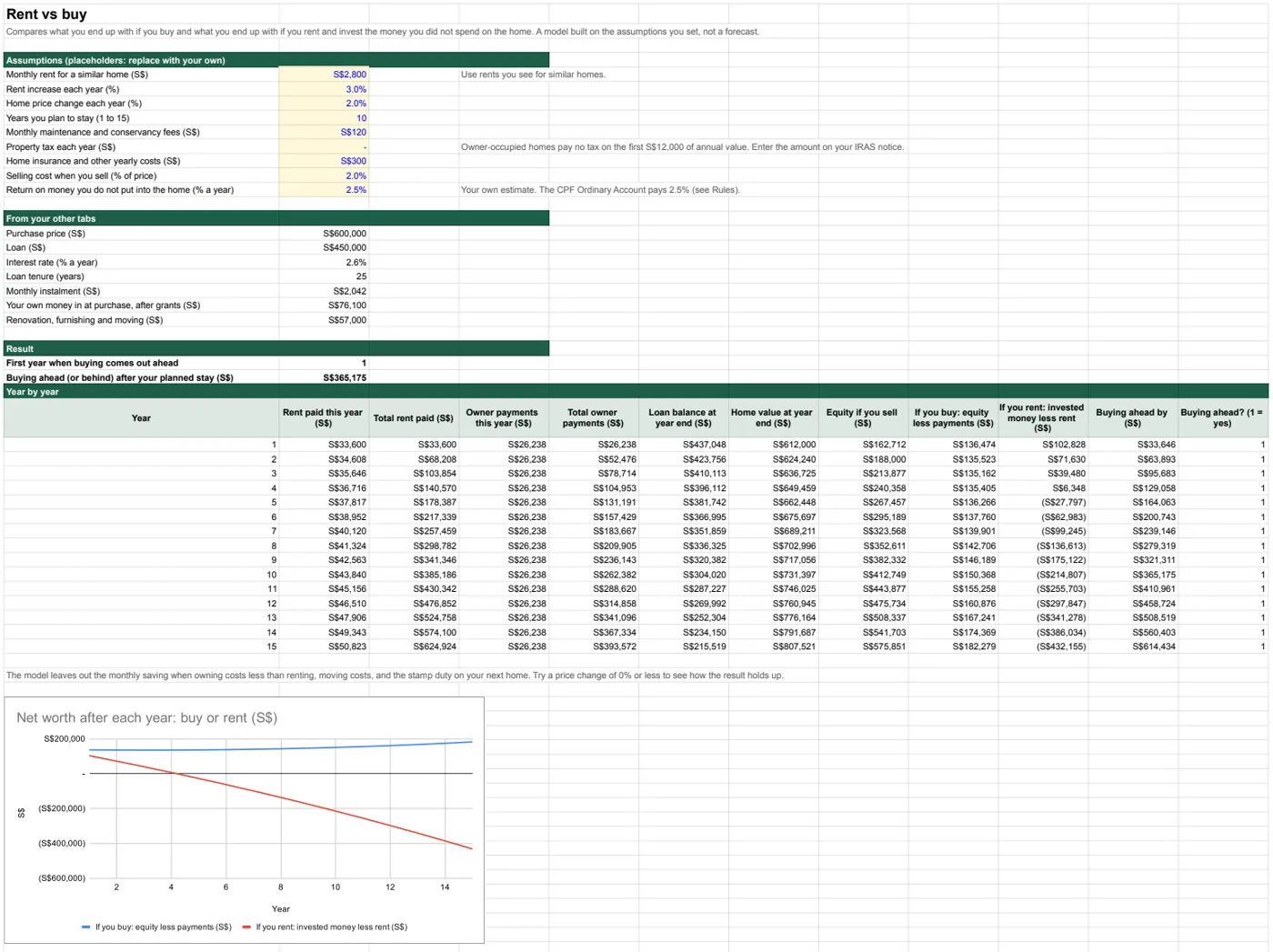
The example assumes S$2,800 monthly rent, rising 3% a year, and a home price rising 2% a year. The couple stay 10 years and earn 2.5% on money not put into the home.
In year one, the owner’s payments are S$26,238 against S$33,600 of rent. After 10 years, the model has buying ahead by S$365,175.
The chart shows the two paths: equity less payments if you buy, and invested money less rent if you rent. Change one assumption and the chart redraws.
The model leaves out the monthly saving when owning costs less than renting, moving costs and the stamp duty on your next home. Try a price change of 0% or less to see how the result holds:
| Home price change each year | Buying ahead after 10 years |
|---|---|
| +2% (the example) | S$365,175 |
| 0% | S$236,406 |
| -2% | S$128,845 |
The lead shrinks as prices fall. It stays positive here, where year-one rent is S$7,362 above the owner’s payments. A flat that rents for less than S$2,800 will give a different answer, so enter the rent you actually see.
Try it: change one number
The toolkit earns its keep when you test a bigger purchase. Raise the price from S$600,000 to S$750,000 and leave everything else as it is.
| Price S$600,000 | Price S$750,000 | |
|---|---|---|
| BSD | S$12,600 | S$17,100 |
| Largest loan the rules allow | S$450,000 | S$537,734 |
| Limit that binds | LTV | MSR |
| Monthly instalment | S$2,042 | S$2,440 |
| Total needed on completion, after grants | S$76,100 | S$142,866 |
| Cash needed on completion | Nil | S$42,866 |
| Cash after renovation and furnishing | S$13,000 left | S$29,866 short |
The 75% LTV limit would allow S$562,500 on a S$750,000 flat. The MSR is the tighter test: 30% of S$8,500 is S$2,550 a month at the 3% assessment rate, which supports a loan of S$537,734. The loan is 71.7% of the price, and the gap lands on the down payment.
CPF is now fully used at S$190,000, so S$42,866 must come from cash. That leaves S$27,134 in cash before the fit-out.
The renovation then turns it into a S$29,866 shortfall. The tab prints “Cash short by S$29,866” in the result line. A couple who read that number before they sign can scale back the renovation, or look at a cheaper flat, with time to spare.
What selling releases
The sixth tab works from the other side. Its yellow cells hold the home you plan to sell. The tab shows what that home releases, so you know the cash and CPF you carry into the next purchase.
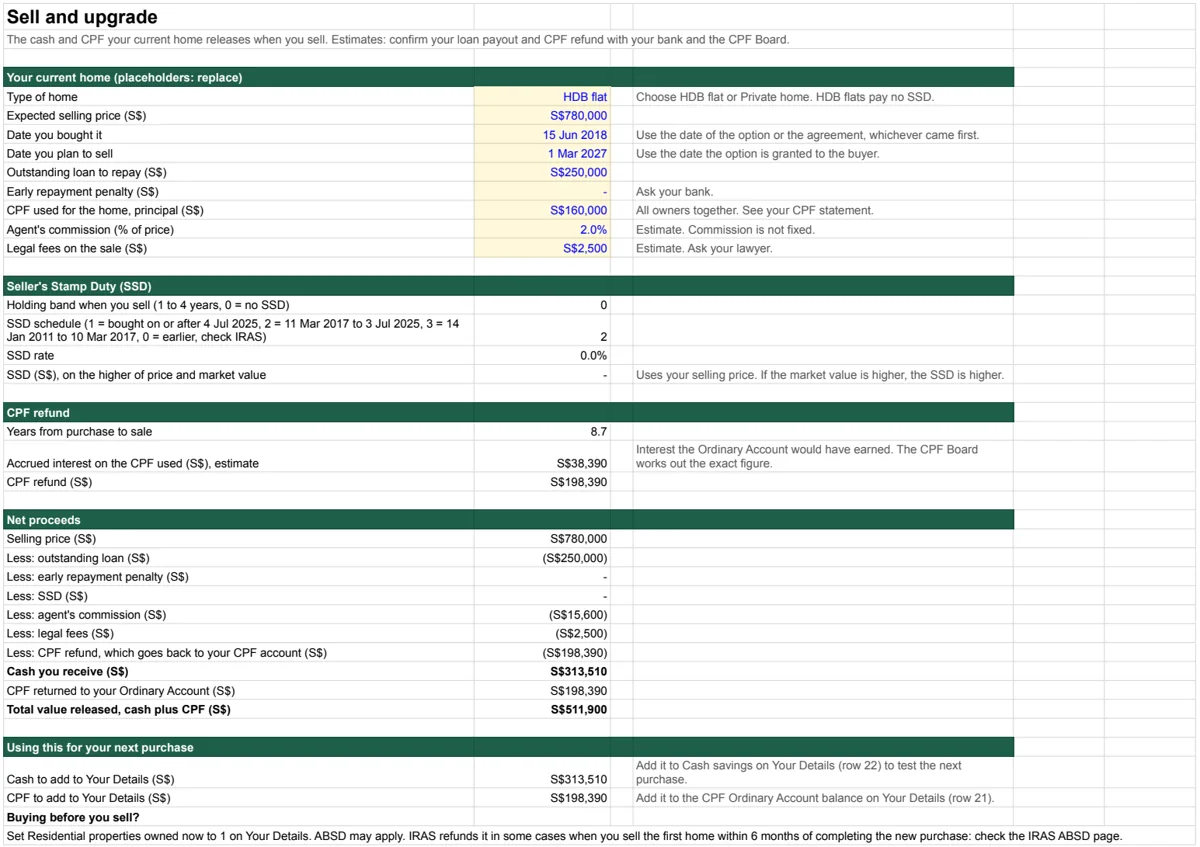
The example is a separate flat, bought in June 2018 and sold in March 2027 for S$780,000, with S$250,000 of loan left and S$160,000 of CPF used.
The seller pays a S$15,600 agent’s commission and S$2,500 in legal fees, and refunds S$198,390 to CPF: the S$160,000 used plus an estimate of accrued interest. That leaves S$313,510 in cash. The refund returns to the Ordinary Account, so S$511,900 is released in all.
The cash and CPF figures feed straight into the next purchase on Your details. Buying before you sell raises the question of ABSD, and the tab points you to the IRAS rules on refunds.
Where the rates come from
Every rate in the toolkit lives on the Rules tab. It holds the stamp duty bands, the lending limits, the tenure limits and the grant amounts. Each rate has a source link and the date it was checked.
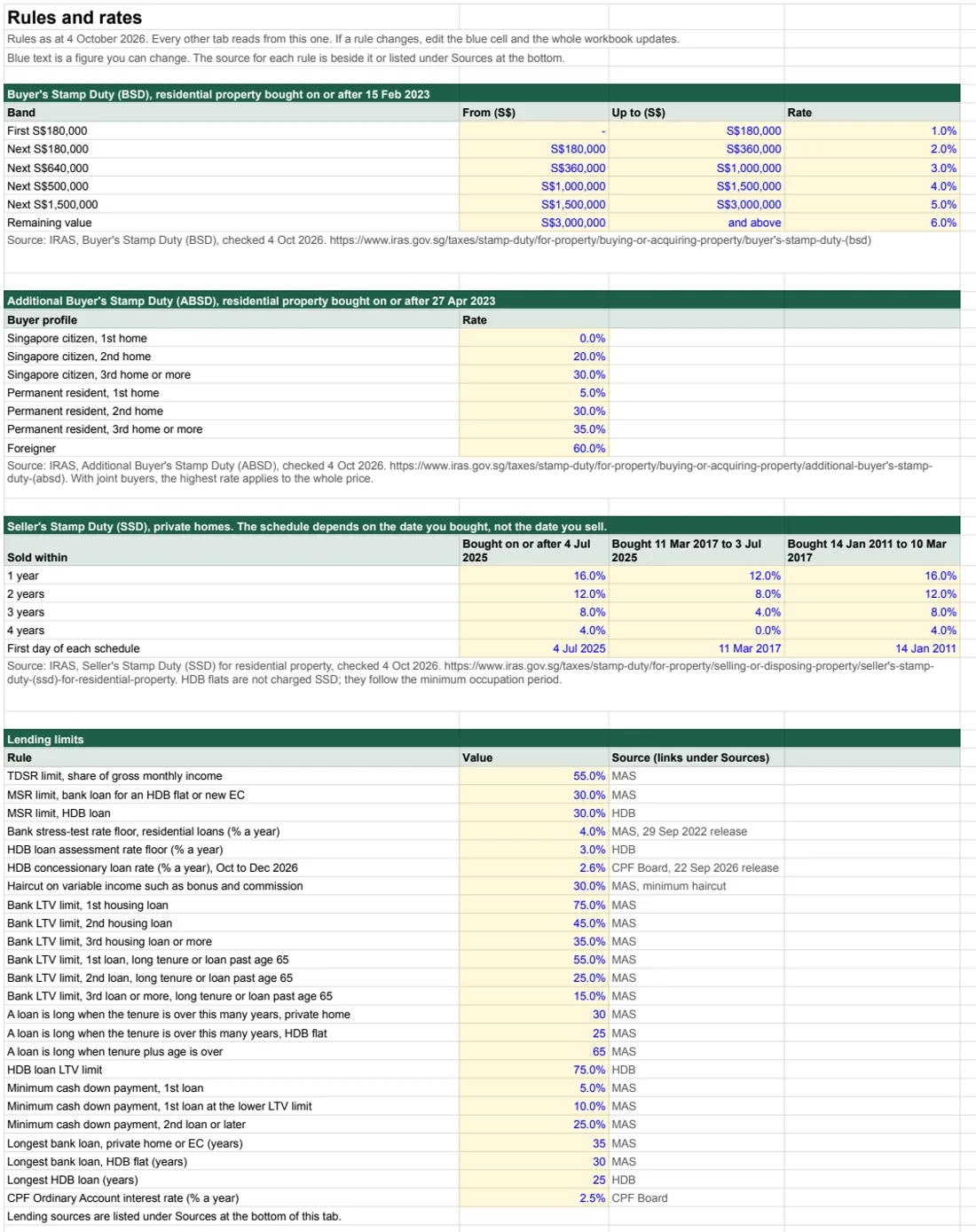
When a rule changes, edit the yellow cell on this tab and every other tab follows. The toolkit covers HDB resale flats, private homes and executive condominiums. Grants are modelled for HDB resale flats.
Why you need the toolkit
A spreadsheet earns its place when it spots a problem early. Here is what this one does for a buyer:
- It shows the cash gap before the bank does. The S$750,000 flat in the example leaves the couple S$29,866 short after the fit-out. Seen on a screen, that gap is a decision. Found after you sign, it is a scramble.
- It names the rule that limits you. At S$600,000 the loan limit is LTV. At S$750,000 it is MSR. When LTV binds, a higher income does not raise the loan. When MSR binds, it does.
- It answers what-if questions in seconds. Change the price, the rent, the tenure or the years you stay, and every tab updates at once.
- It keeps every rate in one place. Stamp duty, lending limits and grants sit on the Rules tab, each with a source link and the date it was checked.
- It stays private. You copy it into your own Google account, where only you can see what you type.
- It costs nothing. You earn it by sharing the Propwise newsletter with three friends.
If you are weighing a flat, a condo or an upgrade, the toolkit turns a stack of rules into one page of numbers you can act on.
Get the toolkit free
Three steps get it to your inbox:
- Join the Propwise newsletter. Confirm your email and you get a personal link at the foot of the daily email.
- Send your link to friends who are thinking of buying, selling or renting.
- When 3 friends sign up through your link and confirm their email, we email you the Singapore Home Buyers Toolkit.
Each friend gets the daily email and the free beginner’s guide. You get the toolkit as a Google Sheet to copy into your own Google account.
Start now: join the newsletter and get your personal link. To see every tab first, visit the toolkit page.
Rules and rates in the toolkit as at 4 October 2026.