HDB Rules: 5 or 10-Year MOP, 30-Month Wait-Out, ABSD at 20%
How BTO, balance and resale flats work, what Plus and Prime mean, the MOP, the 30-month wait-out, the 6-month sell rule, selling steps, and HDB loans.
Your HDB flat decides how long you must stay and when you may rent it out. It also sets the Additional Buyer’s Stamp Duty (ABSD) on your next home.
The Housing and Development Board (HDB) sets a minimum occupation period (MOP) of 5 years for a Standard flat and 10 years for a Plus or Prime flat. A citizen couple who buy a private home as their second home pay 20% ABSD.
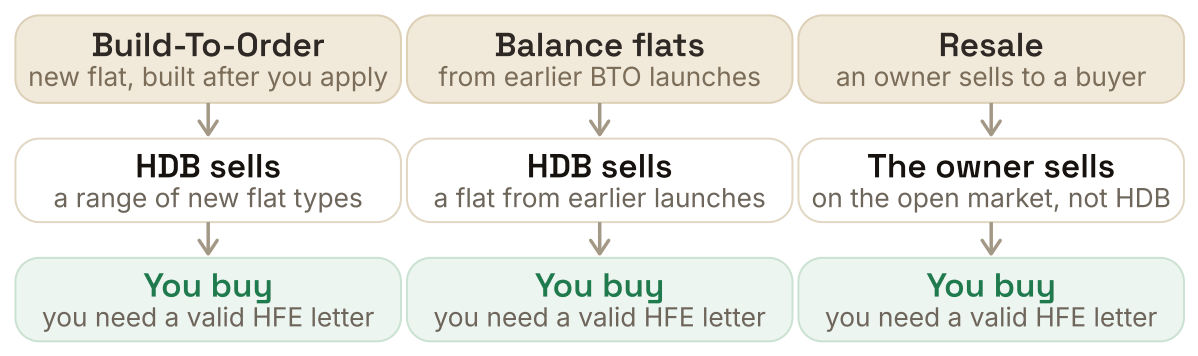
Three ways to get a flat
HDB sells new flats in two ways. In a Build-To-Order (BTO) launch, you apply before HDB builds the flat, while it is still a drawing.
Balance flats are left over from earlier launches. In a resale, you buy from the current owner on the open market.
All three routes need the same document, an HDB Flat Eligibility (HFE) letter. It is valid for 9 months and shows you may buy a flat. Get the letter first, then apply for a new flat or get a resale option to purchase within those 9 months.
Standard, Plus and Prime
From October 2024, HDB launches new flats as Standard, Plus or Prime. Plus and Prime flats have better locations and extra subsidy, and in return they carry tighter rules. Flats sold before October 2024 are called Unclassified, with a 5-year MOP. June 2026 examples: Plus in Ang Mo Kio, Prime in Bishan and Bukit Merah.
| Standard | Plus | Prime | |
|---|---|---|---|
| MOP | 5 years | 10 years | 10 years |
| Rent out the whole flat | Allowed after the MOP | Not allowed | Not allowed |
| Repay HDB part of the resale price | No | Yes, less than Prime | Yes |
Owners of a new Plus or Prime flat repay HDB part of the resale price, to recover the extra subsidy.
In the October 2024 sales exercise, HDB set 6% to 8% for seven Plus projects and 9% for one Prime project. Resale buyers repay nothing but still serve the 10-year MOP. The 2026 change to a 10-year MOP covered only executive condominiums.
The minimum occupation period
The MOP is the time everyone listed on the flat must live in it. It starts when the purchase legally completes. The MOP is 5 years for a Standard or Unclassified flat and 10 years for Plus or Prime.
A flat under the Fresh Start Housing Scheme, for families in public rental flats, has 20 years. Years when the flat is not lived in do not count.
| During the MOP | After the MOP |
|---|---|
| No sale to a buyer | Sell on the open market |
| No renting out the whole flat | Rent out the whole flat, with HDB approval (not Plus or Prime) |
| No private property, in Singapore or overseas | Buy private property, with no limit on the number |
| No other HDB flat or EC |
HDB counts private property as bought on the day you accept the seller’s offer or sign the sale contract.
According to the Ministry of National Development, HDB took back 84 flats from January 2019 to June 2024 for serious breaches. These included renting out the whole flat and buying private property during the MOP. HDB is a landlord with a long memory.
Owning HDB and private at once
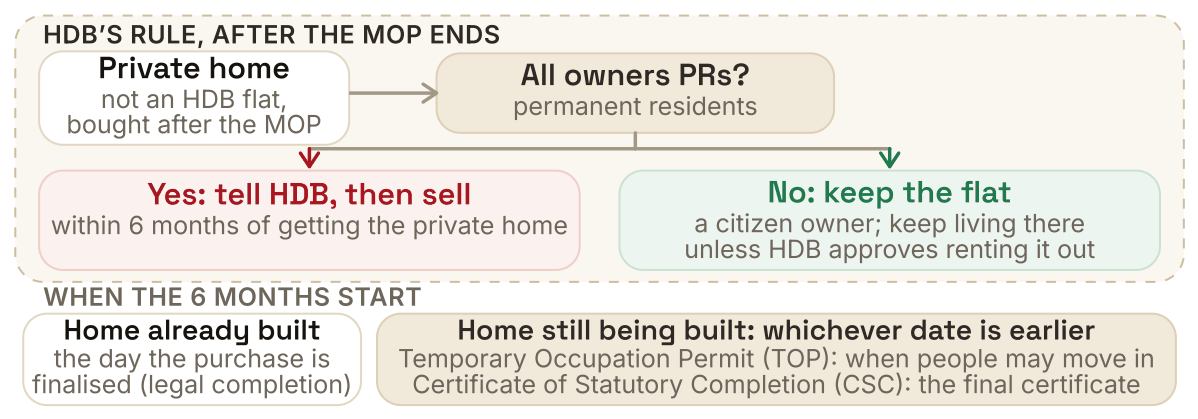
After the MOP, a household with a citizen owner may keep the flat. It must live there unless HDB approves renting it out. If every owner is a permanent resident (PR), they must tell HDB before buying a private home. They must then sell the flat within 6 months of getting the private home.
The 6 months start on legal completion for a finished home. For a home still being built, they start on the earlier of the Temporary Occupation Permit date or the Certificate of Statutory Completion date.
Your flat and ABSD
The Inland Revenue Authority of Singapore (IRAS) counts an HDB flat as a home, even a part share. So a private purchase counts as your second home. The table shows ABSD by buyer profile.
| Buyer | 1st home | 2nd home | 3rd home and later |
|---|---|---|---|
| Singapore citizen | 0% | 20% | 30% |
| Singapore permanent resident | 5% | 30% | 35% |
| Foreigner | 60% on every purchase | ||
| Entity (company, partnership and similar) | 65% | ||
| Trust | 65% | ||
| Housing developer | 40% (35% can be remitted if the project is completed and sold in time) | ||
Take the book’s example of a citizen couple past their MOP who buy a private home at S$1,500,000. At the second-home rate of 20%, ABSD is S$300,000. The rate rose from 17% on 27 April 2023, which added S$45,000 overnight.
A married couple with a citizen may get ABSD back. They must sell the flat within 6 months of buying a completed home, or of TOP for a new one. IRAS sets more conditions.
The 30-month wait-out
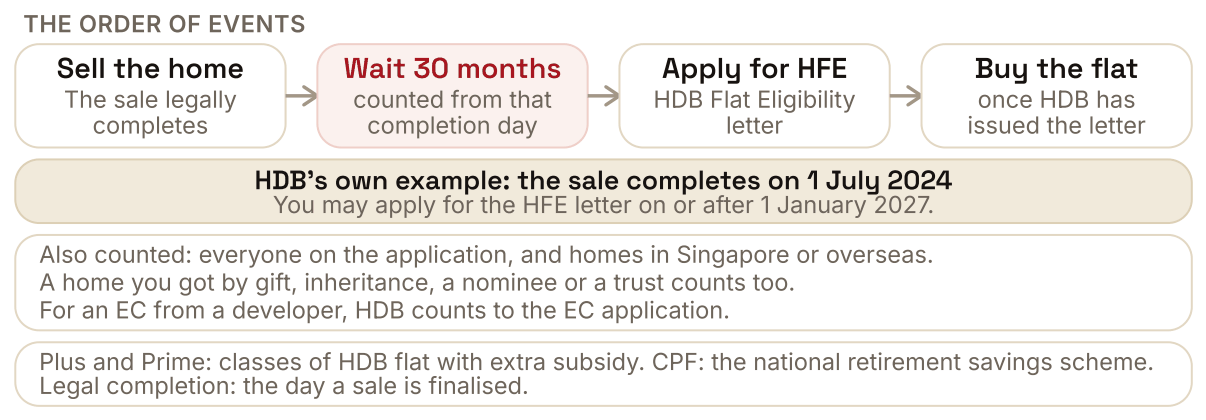
If you own or recently sold a private home, you may have to wait 30 months to buy some HDB flats. The wait covers a new HDB flat, a resale Plus or Prime flat, an EC from a developer, and any flat bought with an HDB housing loan.
It also covers a resale flat bought with a housing grant paid into your CPF savings.
Count the 30 months from the day the sale legally completes. HDB’s own example: a sale completing on 1 July 2024 lets you apply for the HFE letter on or after 1 January 2027. Everyone on the application counts, and so do homes overseas and homes received by gift, inheritance, nominee or trust.
The 6-month sell rule
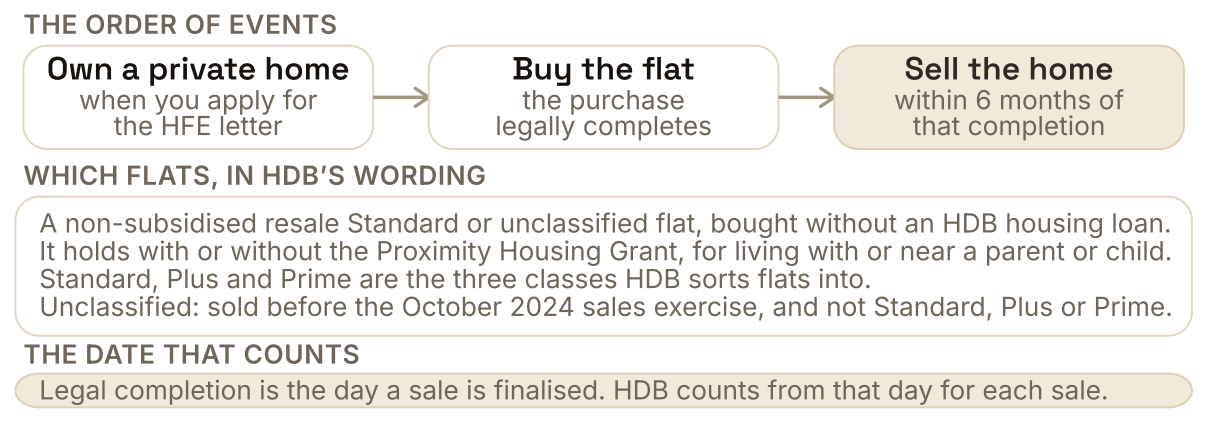
Some buyers may own a private home when they apply for the HFE letter. They must buy a non-subsidised resale Standard or Unclassified flat, without an HDB housing loan. The private home must then be sold within 6 months of the flat purchase completing.
HDB counts from the day each sale legally completes. A flat purchase completing on 1 July 2024 means the home sale must complete by 31 December 2024.
Selling your flat
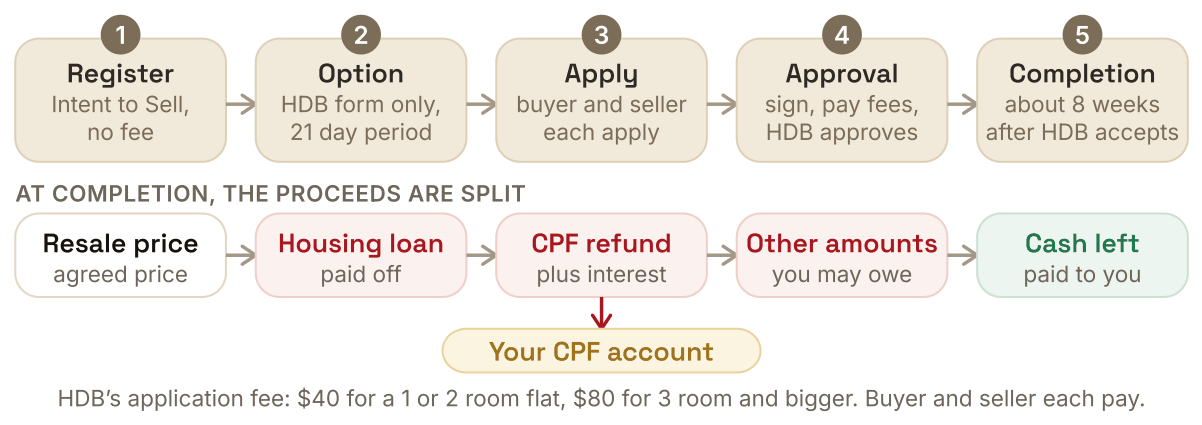
HDB lists five steps to sell.
- Register an Intent to Sell. It costs nothing.
- Grant an option, an offer to sell at a set price, on HDB’s own form. The option period is 21 days. Other agreements are not valid.
- Buyer and seller each apply. HDB’s application fee is S$40 for a 1 or 2-room flat and S$80 for 3-room and bigger.
- Sign, pay fees and wait for HDB approval.
- Completion comes about 8 weeks after HDB accepts.
At completion, the price pays off any housing loan. You then refund the CPF savings you used, plus accrued interest, which is what those savings would have earned in your CPF account. You keep the cash left. Work out that figure before you grant an option.
HDB loans and grants
The HDB loan is for HDB flats only. Its rate is the CPF Ordinary Account rate plus 0.1 percentage points. It covers up to 75% of the price for a new flat, or of the lower of price and valuation for a resale. At least one applicant must be a citizen.
For HFE letters applied for from 24 August 2026, the household income limit for an HDB loan is S$16,000 a month for families and S$8,000 for singles. In August 2024, the top Enhanced CPF Housing Grant for first-time families rose from S$80,000 to S$120,000, according to HDB.
Grants go into your CPF Ordinary Account. When you sell, you repay the grant with accrued interest. Both the loan and the grants share one test: a household that owns private residential property, or sold some in the last 30 months, fails.
Rules and rates as at 18 October 2026.
Get The Ultimate Guide to Singapore Property now
This article covers Part 2, “Public housing and upgrading”, of The Ultimate Guide to Singapore Property by Mr. Propwise. Want the PDF? Buy it at aktive.com.sg. Want it in your hands or on your phone? Order the paperback or the Kindle edition on Amazon.
Buying, selling or investing in Singapore property means dealing with duties, loans, titles, tax and tenants, and each has its own agency and its own rules. This book puts every one of them in 25 Parts, one idea to a page with a diagram, so you know what to ask your agent, lawyer and bank before you sign.