HDB vs Condo vs EC: Who Can Buy What, and the New 10-Year MOP
Singapore has two housing markets with separate rules. See who may buy an HDB flat, EC, condo or landed home, and how leases and regions matter.
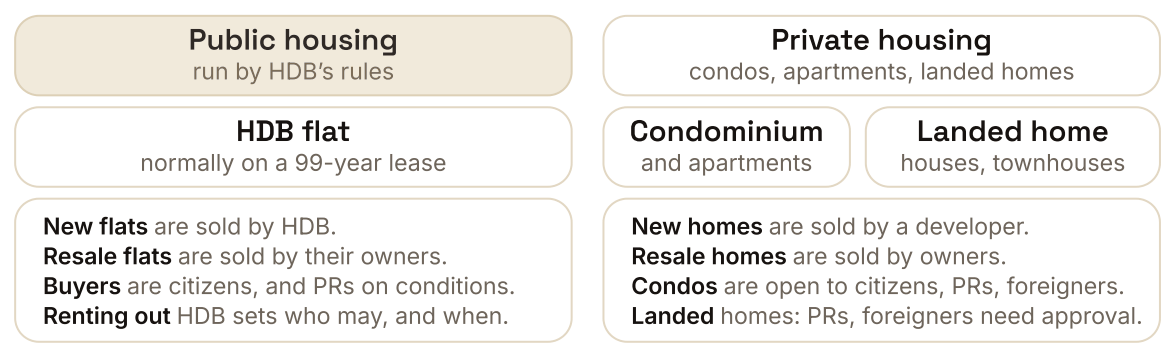
Singapore runs two housing markets side by side, and your residency decides which doors are open. The Housing and Development Board (HDB) runs public housing. The private market has condos, apartments and landed homes, and an executive condominium (EC) sits between the two.
Two markets, one island
HDB flats are normally on a 99-year lease. New flats come from HDB, resale flats come from their owners, and HDB’s rules say who may rent out a flat and when.
New private homes come from a developer, and resale homes come from owners. The market a home sits in decides which rules apply when you buy, sell or rent it out.
Who can buy what
The Singapore Land Authority (SLA) approves some purchases by foreigners. The Residential Property Act treats a permanent resident (PR) as a foreign person. So a PR needs SLA approval for a landed home, such as a terrace, semi-detached or detached house.
| Your status | HDB flat | Executive condo | Private condo | Landed home |
|---|---|---|---|---|
| Citizen | Yes, if eligible | Yes, if eligible | Yes | Yes |
| PR | Conditions; HDB’s rules apply | Conditions; a new EC needs a citizen | Yes, no approval | SLA approval |
| Foreigner | Not allowed | Resale only, 10 or 15 years after TOP | Yes, no approval | SLA approval |
A condo is the one type open to everyone. A foreigner may buy a unit without approval, so the landed column is the one to check first. A PR or foreigner who wants a house should apply to SLA before buying.
Executive condos and their rules
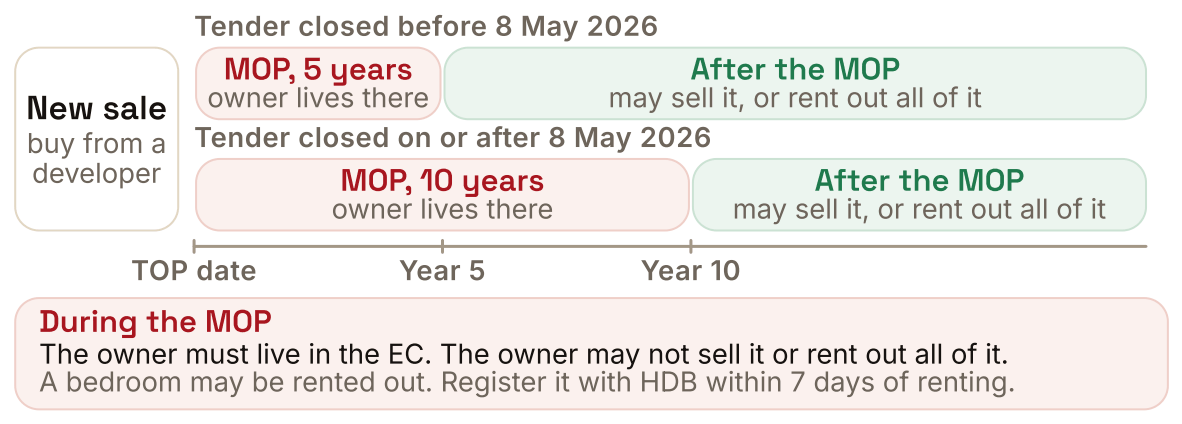
An EC is an apartment that a private developer builds, under some HDB rules. The minimum occupation period (MOP) is how long the owner must live in it. It counts from the Temporary Occupation Permit (TOP) date, when people may move in.
The MOP is 10 years if the land tender closed on or after 8 May 2026, and 5 years if it closed earlier. A standard HDB flat has a 5-year MOP.
During the MOP the owner may not sell the EC or rent out all of it. A bedroom may be rented out if you register it with HDB within 7 days.
Who may buy depends on the sale. A new EC has a monthly household income limit of S$18,000 if the land tender closed on or after 24 August 2026, and S$16,000 if it closed earlier. A resale EC has no income limit.
After the MOP, citizens and PRs may buy a resale EC first. Anyone may buy it from year 10 or 15 after TOP.
A household that owns an HDB flat has extra steps. A new EC buyer must sell the flat within 6 months.
HDB’s conditions page counts from collecting the EC keys. Its eligibility page counts from completing the purchase. For a resale EC, finish the flat’s own MOP first.
What to ask:
- Which date starts my 6 months to sell the flat? Ask HDB in writing.
- When did the land tender close, so I know whether the MOP is 5 or 10 years?
Freehold, leasehold and lease decay
Freehold means you own the land with no end date. Leasehold means you own it for a set number of years. Most HDB flats and many condos are leasehold.
Private land sold since 1967 comes with leases of 99 years or less. Landed homes can be freehold, on 999-year leases (forever, give or take), or on shorter leases.
A leasehold buyer buys only the years left. A lease shrinks by exactly one year every year, the least dramatic form of decay.
The years left affect your loan.
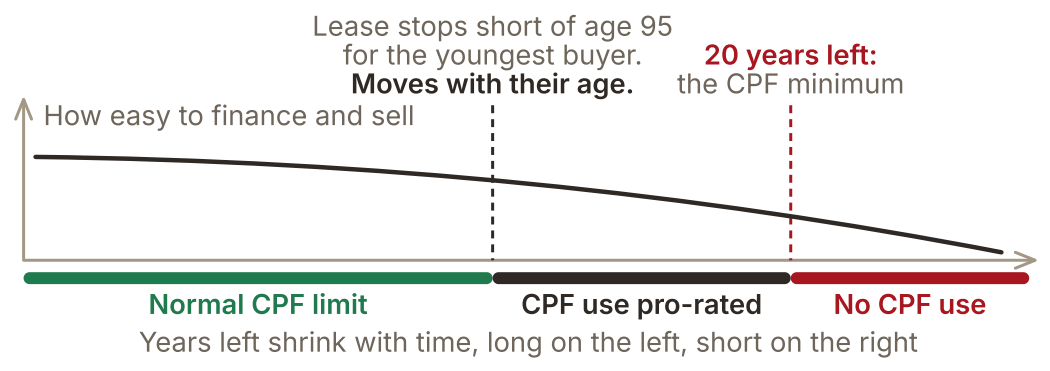
The CPF Board says the lease should cover the youngest buyer until age 95. If it falls short, usable CPF savings are pro-rated.
With fewer than 20 years left, you cannot use CPF savings. On 10 May 2019 the age-95 test started, and the minimum lease for CPF use fell from 30 years to 20. HDB applies the same test and pro-rating to its housing loan limit.
| Lease left | CPF use |
|---|---|
| Covers the youngest buyer to age 95 | Normal limit |
| Stops short of age 95 | Pro-rated |
| Under 20 years | None |
A shorter lease can make a loan harder to get now and a sale harder later. Work out the years left from the start date and the lease length before you make an offer.
Regions: CCR, RCR and OCR
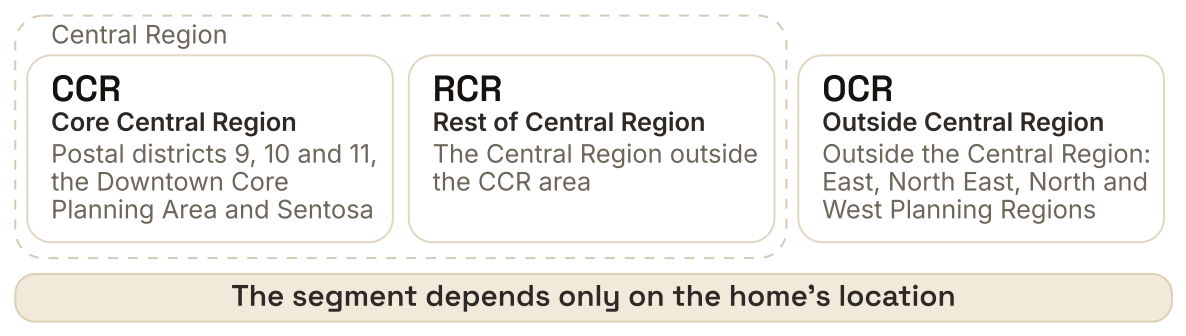
The Urban Redevelopment Authority (URA) splits private homes into three segments for its statistics. The Core Central Region (CCR) covers postal districts 9, 10 and 11, the Downtown Core Planning Area and Sentosa. The Rest of Central Region (RCR) is the rest of the Central Region.
The Outside Central Region (OCR) covers the East, North East, North and West regions.
Each quarter, URA reports price changes for each segment. In the second quarter of 2026, private apartment and condo prices rose 1.8% quarter-on-quarter in the CCR. They fell 1.2% in the RCR and 0.1% in the OCR.
Where new land comes from
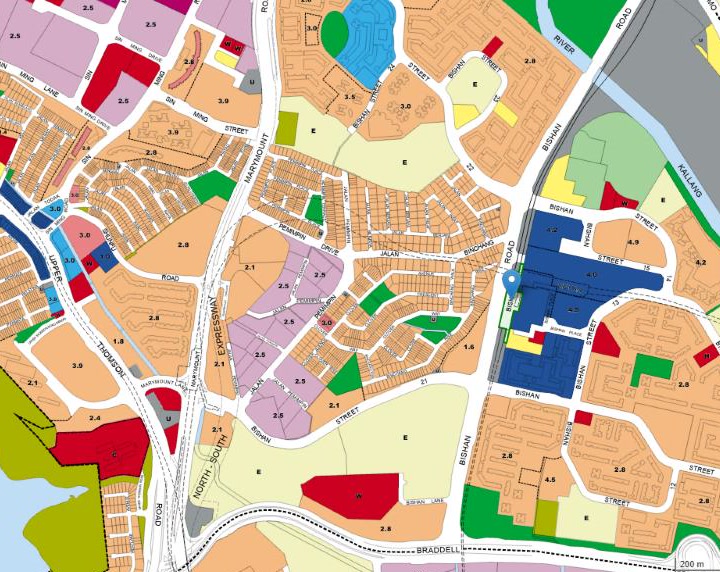
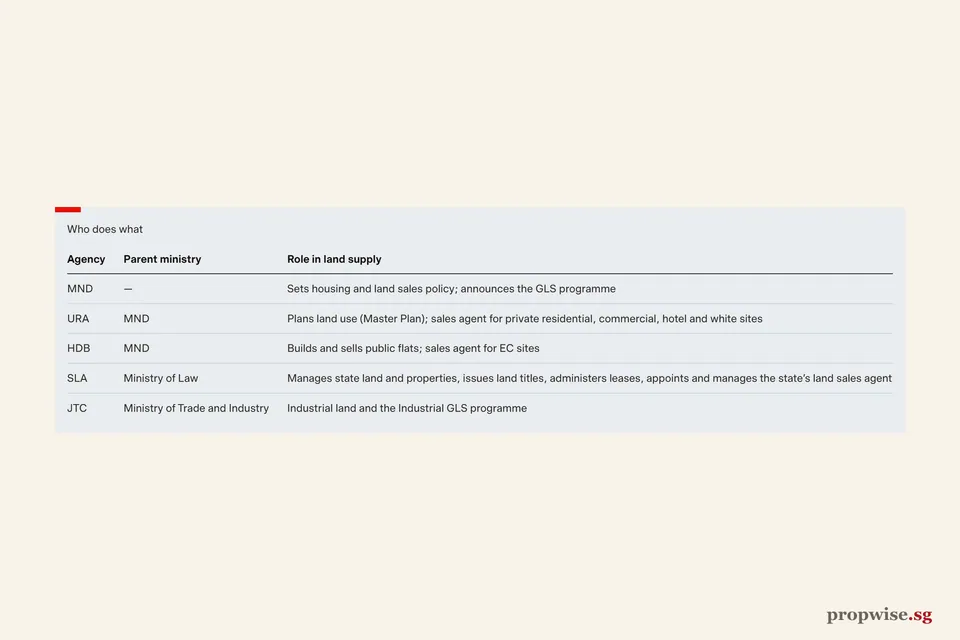
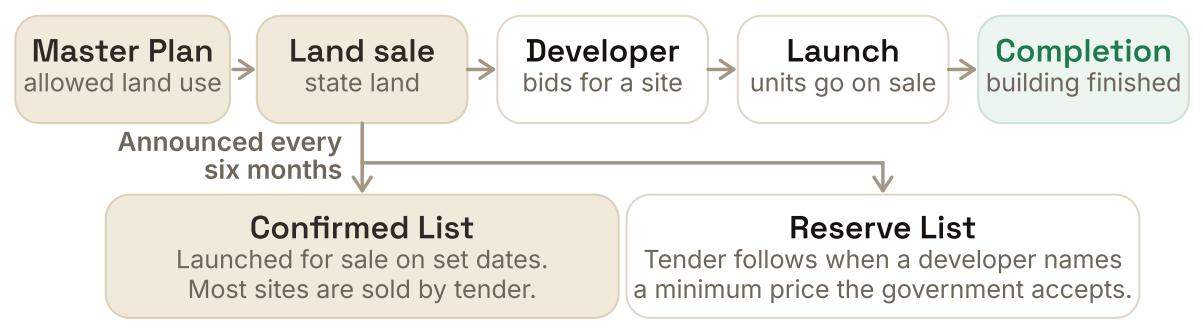
Many new private homes start as state land. The URA Master Plan shows each plot’s allowed use. Under the Government Land Sales programme, the government sells sites to developers from two lists, announced every six months.
Confirmed List sites go on sale on set dates, mostly by tender. Reserve List sites go to tender only after a developer names a minimum price the government accepts. In April 2024, a developer committed to bid at least S$604,567,890 for a Reserve List site at Zion Road, so URA put it to tender.
How prices are measured
Four official sources track prices and rents. Pick the one that matches your type of property.
| Source | Covers | Release |
|---|---|---|
| URA Property Price Index | Private homes | Each quarter, early then full |
| HDB Resale Price Index | HDB resale flats | Each quarter, early then full |
| URA Private Rental Index | Private rents, from rental contracts | Each quarter, in the full release |
| REALIS | Deal records since 1995 | Paid service, up-to-date data |
REALIS misses deals with no caveat lodged. A flash estimate can differ from the final figure. URA’s 2026 third-quarter flash had non-landed CCR prices down 0.1% quarter-on-quarter. The final was up 0.3%.
Why the government steps in
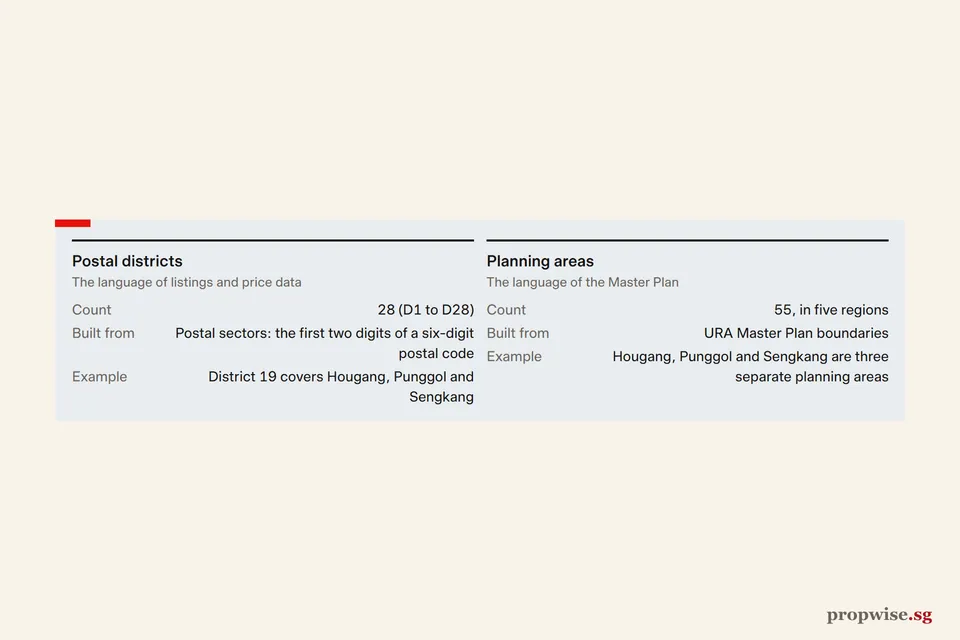
Property policy comes in three kinds. Taxes on buyers and sellers come from the Inland Revenue Authority of Singapore (IRAS). Lending limits come from the Monetary Authority of Singapore (MAS). Land supply comes from URA.
On 26 April 2023, three agencies said they wanted to act early on demand from buyers using homes as investments. They were the Ministry of Finance, the Ministry of National Development and MAS. According to URA, private home prices rose 6.8% year-on-year in 2023, slower than the 8.6% rise in 2022.
On 29 June 2013, MAS began its debt-servicing framework, which limits the share of your income that may go to debt payments. Each measure can tighten or loosen, and each changes your sums. A calculation that works today may need a redo later, so refresh it before you sign.
Rules and rates as at 18 October 2026.
Get The Ultimate Guide to Singapore Property now
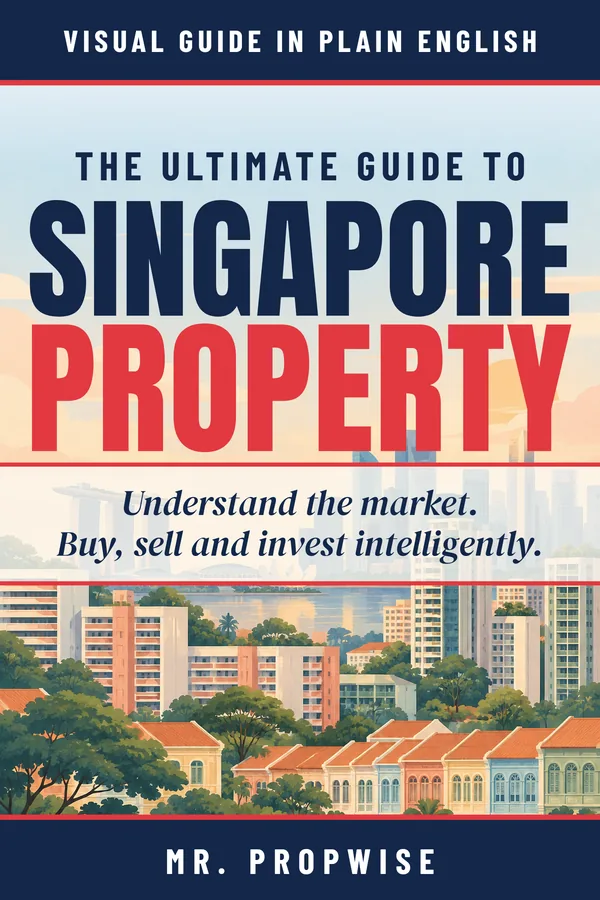
This article covers Part 1, “The market you are entering”, of The Ultimate Guide to Singapore Property by Mr. Propwise. Want the PDF? Buy it at aktive.com.sg. Want it in your hands or on your phone? Order the paperback or the Kindle edition on Amazon.
Buying, selling or investing in Singapore property means dealing with duties, loans, titles, tax and tenants, and each has its own agency and its own rules. This book puts every one of them in 25 Parts, one idea to a page with a diagram, so you know what to ask your agent, lawyer and bank before you sign.