How Much Downpayment Do You Need? Saving for Your First Home (2026)
How much cash and CPF your first home downpayment needs in 2026, how to build it, and where to keep it until you buy, with HDB and condo examples in S$.
For most first-time buyers in Singapore, the downpayment is 25% of the price, but only part of it has to be cash. With an HDB loan, your CPF Ordinary Account (OA) can pay all of it. With a bank loan, at least 5% of the price must be cash. So the real job is to build two pots (cash and CPF), plus a buffer for stamp duty and moving in, and keep the cash safe until you buy.
At a glance
- HDB loan: downpayment of 25%. For a BTO flat, you pay 10% when you sign the Agreement for Lease and 15% at key collection. CPF OA can cover all of it.
- Bank loan (your first): downpayment of 25%, of which at least 5% must be cash.
- Add Buyer’s Stamp Duty: S$13,800 on a S$640,000 flat, S$44,600 on a S$1.5 million condo. Add legal fees, renovation and a cash buffer too.
- Grants can do a lot of the work. A first-timer family buying a resale flat may get up to S$230,000.
- Money you need within about three years should not be in the stock market. With 3-month SORA near 1.2%, safe savings pay little, so how much you save matters far more than the return.
How much downpayment you need in 2026
The rules come from MAS for bank loans and HDB for HDB loans. The HDB loan limit fell from 80% to 75% in August 2024. If you read an older guide that quotes 90% or 80%, those numbers are gone.
| What you buy, and how you borrow | Maximum loan | Downpayment | Minimum in cash |
|---|---|---|---|
| BTO flat, HDB loan | 75% | 25% (10% at signing, 15% at keys) | None |
| BTO flat, bank loan | 75% | 25% (20% at signing, 5% at keys) | 5% |
| Resale flat, HDB loan | 75% | 25% | None (apart from option fees of up to S$5,000) |
| Resale flat or condo, first bank loan | 75% | 25% | 5% |
| Any home, second housing loan | 45% | 55% | 25% |
The BTO payment stages come from the gov.sg BTO buying guide. Some young couples qualify for a Staggered Downpayment Scheme that moves more of the payment to key collection.
The minimum-cash rule is important. It is why a couple with S$300,000 in CPF but S$20,000 in the bank cannot buy a S$1.5 million condo. They have the downpayment on paper, but not the cash.
Two worked examples
A 4-room resale flat with an HDB loan. The median 4-room resale flat in Sengkang sold for about S$640,000 between April and September 2026. On that price:
- Downpayment (25%): S$160,000, from CPF OA, cash or both
- Buyer’s Stamp Duty: S$13,800, due within 14 days
- Option fee and exercise fee: up to S$5,000 in total, paid to the seller in cash (part of the downpayment)
- Sengkang
- Island
Latest: Sengkang S$638,000 (Oct 2026); Island S$635,000 (Oct 2026).
Medians are Propwise calculations from HDB's resale transaction file. Months with fewer than 3 resales are left out. The median moves with the mix of flats sold.
Table view
| Period | Sengkang | Island |
|---|---|---|
| Oct 2026 | S$638,000 | S$635,000 |
| Sep 2026 | S$650,000 | S$628,000 |
| Aug 2026 | S$648,888 | S$628,000 |
| Jul 2026 | S$628,000 | S$625,000 |
| Jun 2026 | S$625,000 | S$620,944 |
| May 2026 | S$650,000 | S$630,000 |
| Apr 2026 | S$640,000 | S$638,000 |
| Mar 2026 | S$650,500 | S$633,500 |
| Feb 2026 | S$626,000 | S$620,000 |
| Jan 2026 | S$635,000 | S$625,000 |
| Dec 2025 | S$641,000 | S$631,000 |
| Nov 2025 | S$656,500 | S$625,888 |
| Oct 2025 | S$621,400 | S$625,000 |
| Sep 2025 | S$645,500 | S$640,000 |
| Aug 2025 | S$658,500 | S$627,000 |
| Jul 2025 | S$650,000 | S$625,000 |
| Jun 2025 | S$640,000 | S$635,000 |
| May 2025 | S$660,000 | S$630,000 |
| Apr 2025 | S$653,888 | S$630,888 |
| Mar 2025 | S$660,000 | S$628,000 |
| Feb 2025 | S$654,444 | S$623,800 |
| Jan 2025 | S$644,444 | S$618,000 |
| Dec 2024 | S$649,444 | S$620,000 |
| Nov 2024 | S$629,000 | S$603,500 |
| Oct 2024 | S$650,000 | S$618,944 |
| Sep 2024 | S$640,000 | S$610,000 |
| Aug 2024 | S$620,000 | S$595,000 |
| Jul 2024 | S$620,888 | S$600,000 |
| Jun 2024 | S$608,000 | S$590,000 |
| May 2024 | S$602,500 | S$580,000 |
| Apr 2024 | S$588,000 | S$569,444 |
| Mar 2024 | S$600,500 | S$570,000 |
| Feb 2024 | S$569,000 | S$570,000 |
| Jan 2024 | S$580,000 | S$565,000 |
| Dec 2023 | S$580,000 | S$564,000 |
| Nov 2023 | S$578,000 | S$560,000 |
| Oct 2023 | S$567,500 | S$558,000 |
| Sep 2023 | S$550,000 | S$555,000 |
| Aug 2023 | S$572,444 | S$559,444 |
| Jul 2023 | S$540,000 | S$550,000 |
| Jun 2023 | S$553,000 | S$545,000 |
| May 2023 | S$570,000 | S$550,000 |
| Apr 2023 | S$561,000 | S$540,000 |
| Mar 2023 | S$565,000 | S$544,400 |
| Feb 2023 | S$530,000 | S$535,000 |
| Jan 2023 | S$562,944 | S$530,000 |
| Dec 2022 | S$545,000 | S$530,000 |
| Nov 2022 | S$550,000 | S$530,000 |
| Oct 2022 | S$545,000 | S$530,000 |
| Sep 2022 | S$550,000 | S$523,888 |
| Aug 2022 | S$531,000 | S$515,000 |
| Jul 2022 | S$530,000 | S$520,000 |
| Jun 2022 | S$520,000 | S$510,000 |
| May 2022 | S$515,000 | S$510,044 |
| Apr 2022 | S$501,444 | S$503,000 |
| Mar 2022 | S$502,000 | S$500,000 |
| Feb 2022 | S$510,000 | S$485,000 |
| Jan 2022 | S$512,000 | S$490,000 |
| Dec 2021 | S$495,000 | S$490,000 |
| Nov 2021 | S$495,000 | S$488,000 |
| Oct 2021 | S$488,500 | S$488,000 |
| Sep 2021 | S$488,000 | S$480,000 |
| Aug 2021 | S$477,000 | S$475,500 |
| Jul 2021 | S$468,000 | S$468,000 |
| Jun 2021 | S$470,000 | S$470,000 |
| May 2021 | S$471,000 | S$470,000 |
| Apr 2021 | S$450,000 | S$460,000 |
| Mar 2021 | S$445,000 | S$455,000 |
| Feb 2021 | S$450,000 | S$448,000 |
| Jan 2021 | S$444,444 | S$448,000 |
| Dec 2020 | S$441,000 | S$440,000 |
| Nov 2020 | S$428,888 | S$430,000 |
| Oct 2020 | S$430,888 | S$436,000 |
| Sep 2020 | S$438,000 | S$420,000 |
| Aug 2020 | S$430,000 | S$418,000 |
| Jul 2020 | S$432,000 | S$410,000 |
| Jun 2020 | S$419,400 | S$409,000 |
| May 2020 | S$418,000 | S$422,000 |
| Apr 2020 | S$435,500 | S$410,000 |
| Mar 2020 | S$425,000 | S$410,000 |
| Feb 2020 | S$430,000 | S$400,000 |
| Jan 2020 | S$420,000 | S$395,000 |
| Dec 2019 | S$419,000 | S$405,000 |
| Nov 2019 | S$424,750 | S$405,000 |
| Oct 2019 | S$434,000 | S$400,000 |
| Sep 2019 | S$414,000 | S$397,000 |
| Aug 2019 | S$420,000 | S$400,000 |
| Jul 2019 | S$419,000 | S$400,000 |
| Jun 2019 | S$430,000 | S$400,000 |
| May 2019 | S$420,000 | S$395,000 |
| Apr 2019 | S$415,000 | S$398,500 |
| Mar 2019 | S$410,000 | S$400,000 |
| Feb 2019 | S$398,000 | S$393,888 |
| Jan 2019 | S$405,000 | S$395,000 |
| Dec 2018 | S$403,000 | S$395,000 |
| Nov 2018 | S$405,000 | S$395,000 |
| Oct 2018 | S$420,000 | S$396,000 |
| Sep 2018 | S$418,000 | S$400,000 |
| Aug 2018 | S$407,500 | S$400,000 |
| Jul 2018 | S$396,000 | S$405,000 |
| Jun 2018 | S$400,000 | S$405,000 |
| May 2018 | S$407,000 | S$400,000 |
| Apr 2018 | S$415,000 | S$405,000 |
| Mar 2018 | S$390,000 | S$410,000 |
| Feb 2018 | S$390,000 | S$400,000 |
| Jan 2018 | S$405,000 | S$410,000 |
| Dec 2017 | S$410,000 | S$405,000 |
| Nov 2017 | S$406,900 | S$407,000 |
| Oct 2017 | S$413,000 | S$400,000 |
| Sep 2017 | S$413,000 | S$410,000 |
| Aug 2017 | S$423,999 | S$414,000 |
| Jul 2017 | S$415,000 | S$400,004 |
| Jun 2017 | S$413,000 | S$408,000 |
| May 2017 | S$410,000 | S$408,000 |
| Apr 2017 | S$420,000 | S$400,000 |
| Mar 2017 | S$415,000 | S$418,000 |
| Feb 2017 | S$415,000 | S$408,000 |
| Jan 2017 | S$415,000 | S$410,000 |
Source: HDB (via data.gov.sg). Data to Oct 2026.
Grants change the picture. A first-timer Singapore Citizen couple can get the S$80,000 CPF Housing Grant for a 4-room resale flat. Depending on their income and where their parents live, they may also get the Enhanced CPF Housing Grant (up to S$120,000) and the Proximity Housing Grant (up to S$30,000). The grants are credited to CPF and go towards the price. With the S$80,000 grant alone, the couple’s own share of the downpayment falls to S$80,000. Note that an HDB loan requires you to use your CPF OA savings first, though each buyer may keep up to S$20,000.
S$, credited to CPF
Source: gov.sg, HDB grants guide (October 2026). The three grants together reach up to S$230,000.
A S$1.5 million condo with a bank loan. For a citizen’s first home:
| Item | Amount | Cash or CPF |
|---|---|---|
| Minimum cash downpayment (5%) | S$75,000 | Cash |
| Rest of the downpayment (20%) | S$300,000 | Cash or CPF OA |
| Buyer’s Stamp Duty | S$44,600 | Cash or CPF OA |
| Total | S$419,600 | At least S$75,000 in cash |
CPF Board allows OA savings for stamp duty and legal fees. But IRAS wants the stamp duty within 14 days, so arrange it early with your lawyer, or hold the cash.
Work back from the target
Once you know the cash figure, the maths is simple. Say you want S$75,000 of cash in four years:
| Return on your savings | Monthly saving needed |
|---|---|
| 0% | S$1,563 |
| 1.5% | S$1,517 |
| 2.5% | S$1,487 |
Interest saves you less than S$80 a month. The habit of saving does the real work. For a couple, S$1,563 a month is about S$780 each. Set up an automatic transfer to a separate account on payday, so you do not have to decide each month.
Your CPF OA builds in the background from your contributions and earns 2.5% a year. Check your balance on the CPF website and project it to your target date. But do not plan to drain it. When you sell, you must refund the CPF you used plus accrued interest to your OA. CPF Board itself suggests a mix of cash and CPF, so that some OA savings keep earning interest for retirement.
Where to keep downpayment money
The rule is simple: the closer you are to buying, the less risk the money can take. A 20% market fall turns S$100,000 into S$80,000. You then need a 25% gain just to get back to where you were, and the option fee will not wait.
| When you plan to buy | Main job of the money | Typical places |
|---|---|---|
| Within about 3 years | Be there in full | Savings accounts, fixed deposits, Singapore Savings Bonds, Treasury bills |
| 3–5 years | Mostly protect capital | Mostly the above; any investment portion small |
| More than 5 years | Grow, then protect | Diversified, low-cost investments, moved to safer places as the date gets closer |
Yields on savings bonds and T-bills follow short-term interest rates. With 3-month SORA at about 1.2% in October 2026, expect low returns. Check the current rates before you commit. This is general information, not advice on any product. Your own mix depends on your timeline and how much risk you can bear.
The 2010 version of this article suggested timing the stock market and buying UK traded endowment policies. We would not repeat that. Market timing is unreliable, and products with currency risk or long lock-ups are a poor fit for money with a fixed date to meet.
Save for the costs people forget
The downpayment is the biggest item, not the only one. Before you sign, have money ready for:
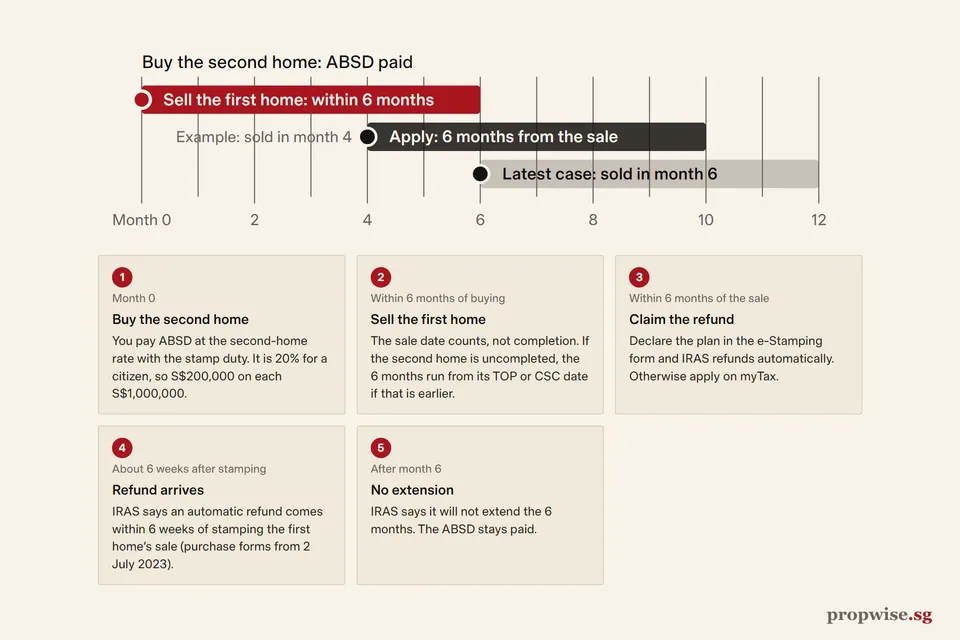
- Stamp duty: BSD runs from 1% to 6% of the price. Add ABSD if you already own a home: 20% for a citizen’s second home.
- Legal and valuation fees, and for an HDB loan, fire insurance and, if you pay with CPF, Home Protection Scheme premiums.
- Renovation and furniture, which often run to tens of thousands of dollars.
- A buffer of about six months of mortgage instalments and living costs, in cash, after everything else is paid.
Propwise calculation from the IRAS ABSD page and MAS (rates from 27 April 2023), as at 6 October 2026. Citizen rates only; other buyers pay more.
Watch your other debts too. Banks size your loan under the TDSR: all debt repayments, tested at 4% interest, must stay within 55% of income. On a S$12,000 monthly income, a S$800 car instalment cuts the maximum 30-year loan from about S$1.38 million to about S$1.21 million. A cheaper car can be worth more to your home budget than a year of savings interest. Try your numbers in the Propwise mortgage calculator.
Maximum loan
Source: MAS, TDSR and MSR rules (October 2026). Propwise calculation. The car instalment is S$800 a month.
Ways to reach the target sooner
- Buy a BTO flat, which spreads the payments. With an HDB loan, you pay 10% at signing and the rest years later at key collection.
- Use the grants you qualify for. Living with or near your parents can add S$20,000–S$30,000 via the Proximity Housing Grant.
- Stay with family while you save. Renting a whole 4-room HDB flat cost about S$3,400 a month at the median in Q2 2026 (HDB data). Every month at home is a month of extra saving.
- Buy a little less home. A S$1.3 million condo instead of a S$1.5 million one cuts the minimum cash by S$10,000 and BSD by S$8,000.
Bottom line
Know your number before you start: 25% of the price, the minimum cash share, and stamp duty plus a buffer. Automate the saving. Keep the money safe in the last few years. Use your CPF, but do not empty it. For more on loan limits, see our guides to LTV and HDB loans. If you are not sure you should buy yet, read rent or buy.
1 reader comment
Jen Y.
This is what I really cant do for how many years now since saving may sound easy but I end up spending it due to much important reasons. But you really have a point so I think that will resolve my issue when it comes to savings. I appreciate the help and the tips.