Costly Home Buying Mistakes in Singapore: Cash, Timing, Tax
Nine costly mistakes Singapore home buyers still make in 2026, from short cash budgets and ABSD timing to the 4-year SSD, with worked examples in S$.
The mistakes that cost Singapore home buyers the most in 2026 are rarely about taste. They are about cash, timing and tax: committing before the loan is confirmed, borrowing to the limit while rates are low, and owning two homes for one day too long. Almost all of them can be avoided with a calculator and a week of patience.
At a glance
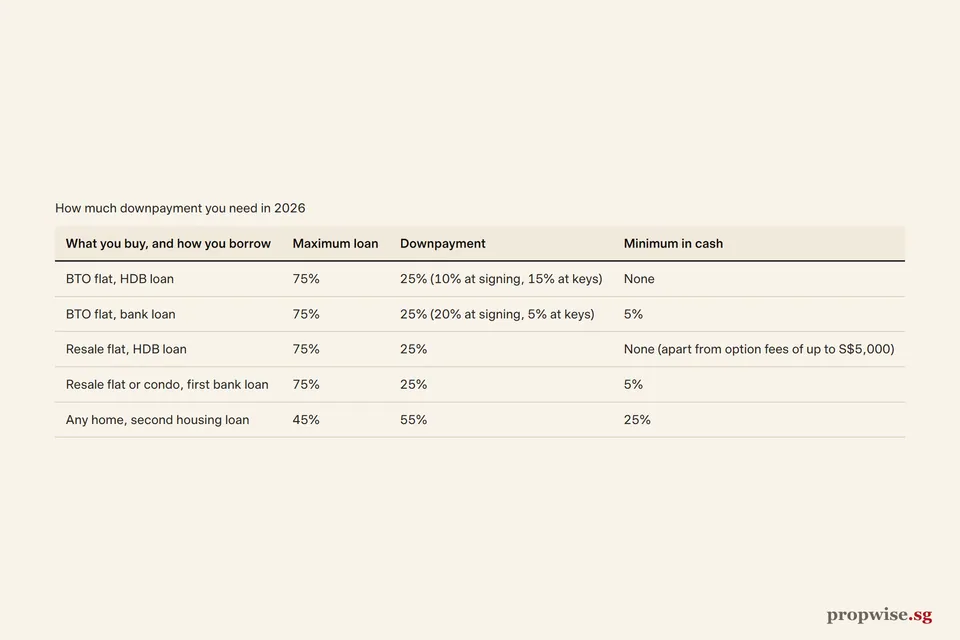
- Budget for more than the downpayment. A S$1.5 million first home needs about S$420,000 of your own money before legal fees and renovation, and at least S$75,000 of it must be cash.
- Get your loan approval in principle before you pay an option fee or booking fee. If you walk away, you lose money.
- Test your mortgage at 3.5–4%, not today’s rates. Packages are about 1.5–2.2% now, but SORA alone was above 3.5% in 2023.
- If you will own two homes, even for a short time, check ABSD (20% for a citizen’s second home) and the 4-year Seller’s Stamp Duty before you sign.
- Inspect for defects within the 12-month defects liability period on a new home. A resale home comes “as is”.
Mistake 1: budgeting for the downpayment only
Most first-time buyers know the loan covers 75% at most. Fewer add up everything else. Say you are a Singapore Citizen buying your first home, a S$1.5 million condo, with a bank loan:
| Item | Amount | How you can pay |
|---|---|---|
| Minimum cash downpayment (5%) | S$75,000 | Cash only |
| Rest of the downpayment (20%) | S$300,000 | Cash or CPF Ordinary Account (OA) |
| Buyer’s Stamp Duty | S$44,600 | Due within 14 days; CPF OA can be used |
| ABSD (first home, citizen) | S$0 | — |
| Total before fees and renovation | S$419,600 |
The loan limits come from MAS, and the BSD rates (1% rising to 6% above S$3 million) and the 14-day deadline come from IRAS. CPF Board lets you use OA savings for the downpayment, stamp duty and legal fees, but it does not pay the minimum 5% cash.
Then there is the valuation gap. Banks lend on the lower of the price or the valuation, and CPF usage is capped the same way unless you have set aside your Basic Retirement Sum. If you pay S$1.5 million for a unit valued at S$1.45 million, the loan falls to S$1,087,500 and your share rises by S$37,500.
After you move in, the bills continue: maintenance fees, renovation and property tax. Property tax is modest for an owner-occupier (S$960 a year on an annual value of S$36,000, before rebates). It rises to S$4,800 if you move out and rent the unit out.
Mistake 2: committing before the loan is confirmed
An option to purchase (OTP) is cheap to get and expensive to drop. On a private resale home, you usually pay about 1% for the option. Under the standard CEA template you get two weeks to exercise it, and you forfeit the option money if you do not. On a new launch you pay a booking fee of 5–10%. According to URA’s home buyers’ guide, the developer may keep 25% of that fee if you do not exercise. On a S$1.5 million unit with a 5% booking fee, that is S$18,750.
So get a bank’s approval in principle (IPA) first, ideally with an indicative valuation. For an HDB flat, you need a valid HDB Flat Eligibility (HFE) letter before you take an OTP. Between the IPA and the actual loan, do not change jobs, take a car loan or miss card payments. Your total debt servicing ratio (TDSR) is measured on the day the bank decides.
Compare packages yourself or through a broker. The seller’s agent is paid by the seller, and the developer’s agents represent the developer. Under CEA rules, an agent cannot collect commission from both sides of a deal, and there are no fixed commission rates. Everything is negotiable, so put it in writing.
- 1Week 0Option grantedYou pay the option fee, usually 1% of the price. The seller signs the option.
- 2Weeks 0 to 2Option periodOften 14 days, up to about 3 weeks. Arrange the loan, hire a lawyer and run the legal checks.
- 3End of the optionYou exerciseSign the acceptance and pay about 4% more. Fee and payment together are the 5% deposit. The sale is now binding.
- 4Within 14 days of signingStamp dutyIRAS charges no penalty if you stamp within 14 days. For an HDB flat, count from HDB’s approval letter.
- 58 to 12 weeks after exerciseCompletion periodLoan processing, CPF steps and legal checks, handled by the lawyers.
- 6About week 10 to 15CompletionYou pay the balance, the title transfers and you collect the keys.
Schematic. Terms from IRB Law LLP (updated 20 January 2026) and EdgeProp; stamp duty timing from IRAS. HDB resale and new launches use different periods, set out in the table above.
Mistake 3: borrowing to the limit because rates are low
Three-month compounded SORA was about 1.24% on 14 Oct 2026. Bank packages rose after the US Federal Reserve raised rates on 16 September 2026. Floating packages are now about 1.5–1.8% and fixed packages about 2.0–2.2% (The Business Times, 2 October 2026; CNA, 18 September 2026). In 2023, SORA was above 3.5%. Take a S$1,125,000 loan over 30 years (75% of S$1.5 million):
| Interest rate | Monthly instalment |
|---|---|
| 1.8% (top of the floating range, Oct 2026) | S$4,047 |
| 2.1% (a typical fixed package, Oct 2026) | S$4,215 |
| 3.8% (2023-style rates) | S$5,242 |
| 4.0% (the MAS stress-test rate) | S$5,371 |
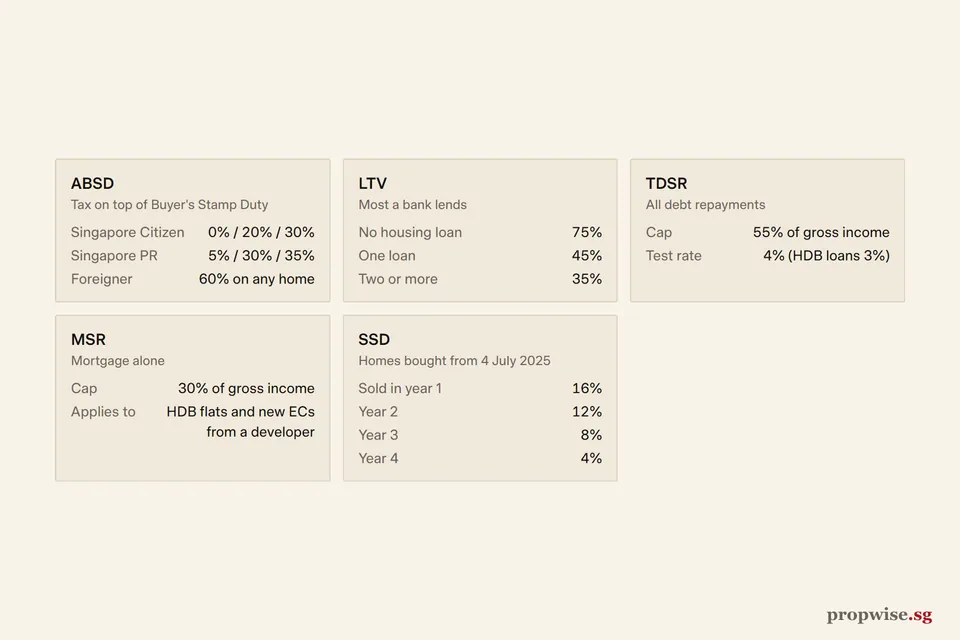
If rates return to 2023 levels, that is S$1,195 a month more than at 1.8%. The TDSR rule already tests you at 4%: all your debt repayments must stay within 55% of gross income. This loan needs at least S$9,765 a month if you have no other debts. But passing TDSR is the legal maximum, not a comfortable level. Run your own numbers with the Propwise mortgage calculator, and read our guide to TDSR and the 3-3-5 affordability rule.
- 3-month compounded SORA (Singapore)
- US federal funds rate (effective)
Latest: SORA 1.24% (14 Oct 2026); Fed 3.88% (13 Oct 2026).
SORA is the benchmark for floating-rate home loans in Singapore. The US rate is shown for context: it moves SORA only indirectly, through the Singapore dollar and bank funding costs.
Table view
| Period | 3-month compounded SORA (Singapore) | US federal funds rate (effective) |
|---|---|---|
| Oct 2026 | 1.24% | 3.88% |
| Sep 2026 | 1.23% | 3.88% |
| Aug 2026 | 1.18% | 3.63% |
| Jul 2026 | 1.14% | 3.63% |
| Jun 2026 | 1.08% | 3.63% |
| May 2026 | 1.06% | 3.62% |
| Apr 2026 | 1.03% | 3.64% |
| Mar 2026 | 1.07% | 3.64% |
| Feb 2026 | 1.12% | 3.64% |
| Jan 2026 | 1.15% | 3.64% |
| Dec 2025 | 1.19% | 3.64% |
| Nov 2025 | 1.25% | 3.89% |
| Oct 2025 | 1.32% | 4.11% |
| Sep 2025 | 1.46% | 4.09% |
| Aug 2025 | 1.56% | 4.33% |
| Jul 2025 | 1.86% | 4.33% |
| Jun 2025 | 2.06% | 4.33% |
| May 2025 | 2.27% | 4.33% |
| Apr 2025 | 2.40% | 4.33% |
| Mar 2025 | 2.55% | 4.33% |
| Feb 2025 | 2.73% | 4.33% |
| Jan 2025 | 2.90% | 4.33% |
| Dec 2024 | 3.08% | 4.33% |
| Nov 2024 | 3.21% | 4.58% |
| Oct 2024 | 3.39% | 4.83% |
| Sep 2024 | 3.49% | 4.83% |
| Aug 2024 | 3.57% | 5.33% |
| Jul 2024 | 3.64% | 5.33% |
| Jun 2024 | 3.63% | 5.33% |
| May 2024 | 3.66% | 5.33% |
| Apr 2024 | 3.65% | 5.33% |
| Mar 2024 | 3.68% | 5.33% |
| Feb 2024 | 3.64% | 5.33% |
| Jan 2024 | 3.66% | 5.33% |
| Dec 2023 | 3.70% | 5.33% |
| Nov 2023 | 3.75% | 5.33% |
| Oct 2023 | 3.75% | 5.33% |
| Sep 2023 | 3.70% | 5.33% |
| Aug 2023 | 3.70% | 5.33% |
| Jul 2023 | 3.68% | 5.33% |
| Jun 2023 | 3.65% | 5.07% |
| May 2023 | 3.61% | 5.08% |
| Apr 2023 | 3.61% | 4.83% |
| Mar 2023 | 3.58% | 4.83% |
| Feb 2023 | 3.23% | 4.58% |
| Jan 2023 | 3.12% | 4.33% |
| Dec 2022 | 3.03% | 4.33% |
| Nov 2022 | 2.87% | 3.83% |
| Oct 2022 | 2.45% | 3.08% |
| Sep 2022 | 2.07% | 3.08% |
| Aug 2022 | 1.55% | 2.33% |
| Jul 2022 | 1.27% | 2.32% |
| Jun 2022 | 0.72% | 1.58% |
| May 2022 | 0.52% | 0.83% |
| Apr 2022 | 0.32% | 0.33% |
| Mar 2022 | 0.27% | 0.33% |
| Feb 2022 | 0.25% | 0.08% |
| Jan 2022 | 0.20% | 0.08% |
| Dec 2021 | 0.19% | 0.08% |
| Nov 2021 | 0.16% | 0.08% |
| Oct 2021 | 0.16% | 0.07% |
| Sep 2021 | 0.13% | 0.08% |
| Aug 2021 | 0.13% | 0.08% |
| Jul 2021 | 0.13% | 0.10% |
| Jun 2021 | 0.14% | 0.10% |
| May 2021 | 0.17% | 0.05% |
| Apr 2021 | 0.19% | 0.07% |
| Mar 2021 | 0.23% | 0.07% |
| Feb 2021 | 0.20% | 0.07% |
| Jan 2021 | 0.17% | 0.07% |
| Dec 2020 | 0.17% | 0.09% |
| Nov 2020 | 0.12% | 0.08% |
| Oct 2020 | 0.12% | 0.09% |
| Sep 2020 | 0.10% | 0.09% |
| Aug 2020 | 0.10% | 0.09% |
| Jul 2020 | 0.08% | 0.09% |
| Jun 2020 | 0.14% | 0.08% |
| May 2020 | 0.27% | 0.05% |
| Apr 2020 | 0.53% | 0.05% |
| Mar 2020 | 0.90% | 0.10% |
| Feb 2020 | 1.14% | 1.58% |
| Jan 2020 | 1.20% | 1.55% |
| Dec 2019 | 1.27% | 1.55% |
| Nov 2019 | 1.31% | 1.55% |
| Oct 2019 | 1.46% | 1.83% |
| Sep 2019 | 1.53% | 1.83% |
| Aug 2019 | 1.59% | 2.12% |
| Jul 2019 | 1.67% | 2.40% |
| Jun 2019 | 1.72% | 2.40% |
| May 2019 | 1.68% | 2.38% |
| Apr 2019 | 1.62% | 2.44% |
| Mar 2019 | 1.54% | 2.43% |
| Feb 2019 | 1.59% | 2.40% |
| Jan 2019 | 1.52% | 2.40% |
Mistake 4: getting the ABSD timing wrong when you upgrade
ABSD depends on what you own on the day you buy. A citizen pays 0% on a first home, 20% on a second and 30% on a third. Permanent residents pay 5% / 30% / 35%. Joint buyers pay the highest rate among them, on the whole price.
| Buyer | 1st home | 2nd home | 3rd home and later |
|---|---|---|---|
| Singapore citizen | 0% | 20% | 30% |
| Singapore permanent resident | 5% | 30% | 35% |
| Foreigner | 60% on every purchase | ||
| Entity (company, partnership and similar) | 65% | ||
| Trust | 65% | ||
| Housing developer | 40% (35% can be remitted if the project is completed and sold in time) | ||
Upgraders get caught in three ways:
- Singles who buy before selling. A single citizen who still owns an HDB flat and buys a S$1.5 million condo pays S$300,000 in ABSD, with no refund. (The only exception is citizens aged 55 and above buying a lower-value home.) To avoid it, contract the sale of the first home before you accept the OTP on the second.
- Married couples who miss the deadline. A couple with at least one citizen pays the ABSD upfront, then gets it refunded only if they sell the first home within six months. For a completed home, the six months run from the purchase. For a new launch, they run from TOP. There are no extensions.
- Owners of HDB flats or ECs who have not met the minimum occupation period (MOP). You must meet the MOP before you can buy private property at all. For Plus and Prime flats, the MOP is 10 years, not 5.
- 1Month 0Buy the second homeYou pay ABSD at the second-home rate with the stamp duty. It is 20% for a citizen, so S$200,000 on each S$1,000,000.
- 2Within 6 months of buyingSell the first homeThe sale date counts, not completion. If the second home is uncompleted, the 6 months run from its TOP or CSC date if that is earlier.
- 3Within 6 months of the saleClaim the refundDeclare the plan in the e-Stamping form and IRAS refunds automatically. Otherwise apply on myTax.
- 4About 6 weeks after stampingRefund arrivesIRAS says an automatic refund comes within 6 weeks of stamping the first home’s sale (purchase forms from 2 July 2023).
- 5After month 6No extensionIRAS says it will not extend the 6 months. The ABSD stays paid.
Schematic. Terms from the IRAS page on ABSD remission for a married couple (updated 13 August 2026). The senior concession for single citizens has its own conditions, set out in the text.
“Decoupling” or 99-to-1 schemes are not automatically illegal. But IRAS can disregard an arrangement made to reduce ABSD, with a 50% surcharge. By April 2024 it had found avoidance in 166 of 187 cases it reviewed. Get specific legal advice before you try one.
Mistake 5: forgetting the four-year SSD
For homes bought from 4 July 2025, Seller’s Stamp Duty applies if you sell within four years: 16% in year one, then 12%, 8% and 4%. Sell that S$1.5 million condo 18 months after you buy it and you owe S$180,000. Buyers rarely plan to sell early. But job moves, a second child or a divorce do happen. If there is a real chance you will move within four years, renting may cost less. Our rent-or-buy guide shows the maths.
Propwise calculation, as at 6 October 2026, using S$1,500,000 as the selling price. Rates: MAS, 3 July 2025 and the IRAS SSD page.
Mistake 6: buying the showflat, not the unit
URA’s guide spells out what showflats can and cannot show. Wallpaper, lighting, curtains and loose appliances are often decoration only. Some walls may be left out “to facilitate visitor movement”. The unit you buy may also differ from the show unit. Read the floor-area breakdown: the strata area you pay for can include air-con ledges and void space. Check how parking lots are allocated if there are fewer lots than units. Ask for any freebies (a washing machine, a cooker) in writing. And a “blank cheque” given at a launch to show interest is not a commitment to buy. Ask for it back if you do not go ahead.
Mistake 7: following the crowd
Full car parks and “last few units” talk at a launch are marketing, not market data. Wait 48 hours before you commit. Then check what similar units actually sold for on URA’s private transaction search, or HDB resale prices on data.gov.sg.
The 2026 market gives you no reason to panic-buy. Private prices moved a modest +1.4% in Q3 2026 (flash estimate), and HDB resale prices dipped for a third straight quarter. The 2026 Government Land Sales programme confirms 9,320 private homes, more than 50% above the 10-year average.
- Private homes (URA price index)
- HDB resale flats (HDB Resale Price Index)
- Policy measures (select one for details)
Latest: Private 219.4 (Q2 2026); HDB 202.8 (Q2 2026).
Table view
| Period | Private homes (URA price index) | HDB resale flats (HDB Resale Price Index) |
|---|---|---|
| Q2 2026 | 219.4 | 202.8 |
| Q1 2026 | 218.3 | 203.4 |
| Q4 2025 | 216.4 | 203.6 |
| Q3 2025 | 215.1 | 203.7 |
| Q2 2025 | 213.2 | 202.9 |
| Q1 2025 | 211.1 | 201.0 |
| Q4 2024 | 209.4 | 197.9 |
| Q3 2024 | 204.7 | 192.9 |
| Q2 2024 | 206.1 | 187.9 |
| Q1 2024 | 204.3 | 183.7 |
| Q4 2023 | 201.5 | 180.4 |
| Q3 2023 | 196.0 | 178.5 |
| Q2 2023 | 194.4 | 176.2 |
| Q1 2023 | 194.8 | 173.6 |
| Q4 2022 | 188.6 | 171.9 |
| Q3 2022 | 187.8 | 168.1 |
| Q2 2022 | 180.9 | 163.9 |
| Q1 2022 | 174.8 | 159.5 |
| Q4 2021 | 173.6 | 155.7 |
| Q3 2021 | 165.3 | 150.6 |
| Q2 2021 | 163.5 | 146.4 |
| Q1 2021 | 162.2 | 142.2 |
| Q4 2020 | 157.0 | 138.1 |
| Q3 2020 | 153.8 | 133.9 |
| Q2 2020 | 152.6 | 131.9 |
| Q1 2020 | 152.1 | 131.5 |
| Q4 2019 | 153.6 | 131.5 |
| Q3 2019 | 152.8 | 130.9 |
| Q2 2019 | 150.8 | 130.8 |
| Q1 2019 | 148.6 | 131.0 |
| Q4 2018 | 149.6 | 131.4 |
| Q3 2018 | 149.7 | 131.6 |
| Q2 2018 | 149.0 | 131.7 |
| Q1 2018 | 144.1 | 131.6 |
| Q4 2017 | 138.7 | 132.6 |
| Q3 2017 | 137.6 | 132.8 |
| Q2 2017 | 136.6 | 133.7 |
| Q1 2017 | 136.7 | 133.9 |
| Q4 2016 | 137.2 | 134.6 |
| Q3 2016 | 137.9 | 134.7 |
| Q2 2016 | 140.0 | 134.7 |
| Q1 2016 | 140.6 | 134.7 |
| Q4 2015 | 141.6 | 134.8 |
| Q3 2015 | 142.3 | 134.6 |
| Q2 2015 | 144.2 | 135.0 |
| Q1 2015 | 145.5 | 135.6 |
| Q4 2014 | 147.0 | 137.0 |
| Q3 2014 | 148.6 | 139.1 |
| Q2 2014 | 149.7 | 141.5 |
| Q1 2014 | 151.3 | 143.5 |
| Q4 2013 | 153.2 | 145.8 |
| Q3 2013 | 154.6 | 148.1 |
| Q2 2013 | 154.0 | 149.4 |
| Q1 2013 | 152.4 | 148.6 |
| Q4 2012 | 151.5 | 146.7 |
| Q3 2012 | 148.8 | 143.1 |
| Q2 2012 | 147.9 | 140.3 |
| Q1 2012 | 147.2 | 138.5 |
| Q4 2011 | 147.4 | 137.7 |
| Q3 2011 | 147.0 | 135.4 |
| Q2 2011 | 145.1 | 130.4 |
| Q1 2011 | 142.3 | 126.4 |
| Q4 2010 | 139.2 | 124.4 |
| Q3 2010 | 135.5 | 121.3 |
| Q2 2010 | 131.7 | 116.6 |
| Q1 2010 | 125.1 | 112.1 |
| Q4 2009 | 118.4 | 109.0 |
| Q3 2009 | 110.3 | 105.0 |
| Q2 2009 | 95.3 | 101.4 |
| Q1 2009 | 100.0 | 100.0 |
| Q4 2008 | 116.4 | 100.8 |
| Q3 2008 | 123.9 | 99.4 |
| Q2 2008 | 126.9 | 95.4 |
| Q1 2008 | 126.7 | 91.3 |
| Q4 2007 | 122.1 | 88.0 |
| Q3 2007 | 114.4 | 83.2 |
| Q2 2007 | 105.6 | 78.1 |
| Q1 2007 | 97.6 | 75.8 |
| Q4 2006 | 93.1 | 74.9 |
| Q3 2006 | 89.6 | 74.2 |
| Q2 2006 | 87.3 | 74.3 |
| Q1 2006 | 85.8 | 73.6 |
| Q4 2005 | 84.5 | 73.5 |
| Q3 2005 | 83.3 | 73.2 |
| Q2 2005 | 82.3 | 73.5 |
| Q1 2005 | 81.9 | 77.2 |
| Q4 2004 | 81.3 | 77.1 |
| Q3 2004 | 80.7 | 76.3 |
| Q2 2004 | 80.4 | 76.2 |
| Q1 2004 | 80.3 | 75.3 |
| Q4 2003 | 80.6 | 75.1 |
| Q3 2003 | 80.7 | 74.3 |
| Q2 2003 | 81.1 | 72.5 |
| Q1 2003 | 81.6 | 71.0 |
| Q4 2002 | 82.3 | 69.9 |
| Q3 2002 | 82.6 | 69.9 |
| Q2 2002 | 82.2 | 69.2 |
| Q1 2002 | 82.8 | 69.1 |
| Q4 2001 | 83.8 | 69.6 |
| Q3 2001 | 87.6 | 70.6 |
| Q2 2001 | 90.3 | 72.1 |
| Q1 2001 | 91.1 | 73.2 |
| Q4 2000 | 94.9 | 75.8 |
| Q3 2000 | 97.6 | 77.6 |
| Q2 2000 | 100.4 | 79.3 |
| Q1 2000 | 98.9 | 80.3 |
| Q4 1999 | 95.9 | 79.8 |
| Q3 1999 | 91.1 | 78.1 |
| Q2 1999 | 84.3 | 72.2 |
| Q1 1999 | 75.4 | 71.2 |
Policy measures marked on this chart (23)
- 2025-07-03 Seller's Stamp Duty holding period back to four years, rates raised by 4 pp
- 2024-08-19 HDB loan LTV cut to 75% and Enhanced CPF Housing Grant raised
- 2023-04-26 ABSD rates raised, April 2023
- 2023-02-14 CPF Housing Grant raised for first-time resale buyers, Budget 2023
- 2023-02-14 Buyer's Stamp Duty raised for higher-value properties, Budget 2023
- 2022-09-29 Property measures, September 2022: higher TDSR and MSR rate floor, HDB loan LTV 80%, 15-month wait-out
- 2021-12-15 Property cooling measures, December 2021: higher ABSD, TDSR 55%, HDB loan LTV 85%
- 2018-07-05 Property cooling measures, July 2018: higher ABSD and lower LTV limits
- 2018-02-19 Budget 2018: Proximity Housing Grant enhanced
- 2018-02-19 Budget 2018: top BSD rate raised to 4% above S$1m
- 2017-03-10 SSD holding period cut to 3 years; TDSR relaxed for equity withdrawal
- 2013-08-27 HDB loan and resale measures, August 2013
- 2013-06-28 MAS introduces the Total Debt Servicing Ratio (TDSR) framework
- 2013-01-11 Property cooling measures, January 2013
- 2012-10-05 Maximum loan tenure of 35 years and tighter LTV limits, October 2012
- 2011-12-07 Additional Buyer's Stamp Duty introduced, December 2011
- 2011-01-13 Property cooling measures, January 2011
- 2010-08-30 HDB measures after National Day Rally 2010: DBSS income ceiling, 5-year MOP for non-subsidised flats
- 2010-08-30 Property cooling measures, August 2010
- 2010-02-19 Seller's Stamp Duty introduced and LTV limit cut to 80%, February 2010
- 2009-09-14 Interest-only loans and Interest Absorption Scheme disallowed, September 2009
- 2005-07-19 Property policy review, July 2005: LTV limit raised to 90%, CPF housing rules eased, foreign ownership rules eased
- 2001-10-12 Second off-budget package, October 2001: property tax rebate, stamp duty cut, gains tax removed, land sales eased
Mistake 8: ignoring the lease and the exit
Before you buy, ask two questions. Who will buy this home from you in 15 years? And can you use your CPF for it? If the remaining lease does not cover the youngest buyer to age 95, CPF usage is pro-rated. The next buyer of an ageing flat faces the same limit, so fewer people can afford it. Do not pay extra for en bloc potential. Lower consent thresholds for older condos are on the way, but no start date has been announced, and a sale still needs a buyer at the right price. For new HDB flats, check the classification: Plus and Prime flats carry a 10-year MOP, can never be rented out whole, and must repay a subsidy recovery of 6–14% of the resale price or valuation when sold.
Mistake 9: skipping the defects inspection and the legal checks
On a new launch, the developer must fix defects that appear within 12 months of vacant possession (or of the TOP notice, if earlier), and must make them good within one month of your notice. Book a professional inspection early in that window, rather than discover leaks after it ends. Our guide to developer defects explains the process. A resale home has no defects liability period, so inspect before you exercise the OTP. Let your lawyer check the title, any caveats and government schemes that affect the property.
Bottom line
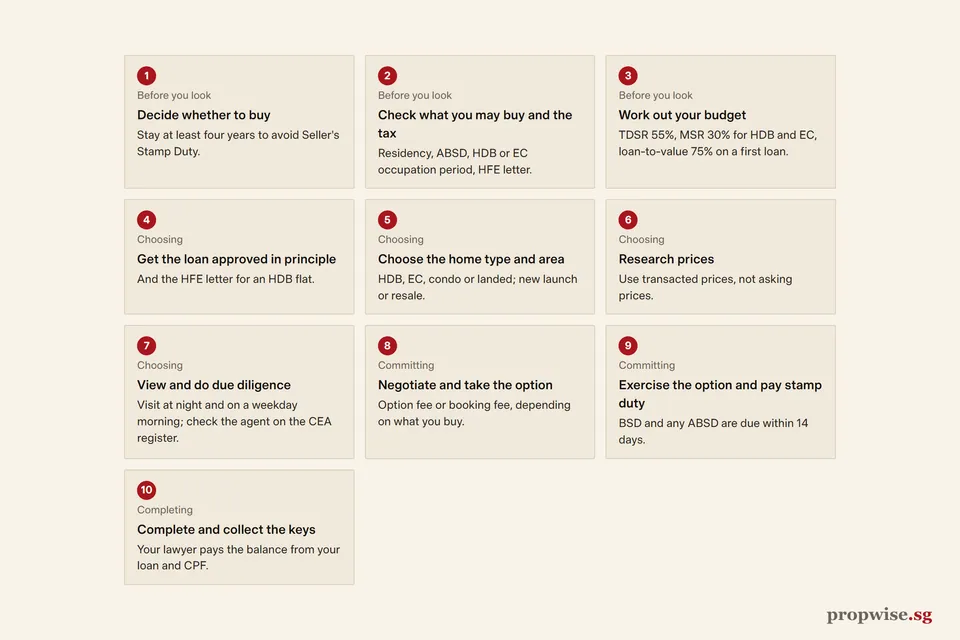
Good home purchases are boring. Know your full cash need, get the loan approved first, borrow less than the maximum, and map out ABSD and SSD before you sign anything. Above all, do not let a sales gallery set your timetable. Our 10-step buying process puts these checks in order.