Decoupling a Condo: S$69,200 Stamp Duty Against S$344,600 Jointly
How decoupling works in Singapore, the Buyer's Stamp Duty on the share, when ABSD applies and a worked S$2 million example.
Decoupling means one co-owner of a private home buys out the other’s share and pays Buyer’s Stamp Duty (BSD) on it. A citizen who owns only that home pays no Additional Buyer’s Stamp Duty (ABSD), per IRAS. The spouse who sold out can then buy at the first-home ABSD rate of 0%.
How does decoupling work?
Couples often buy a condo in joint names. If they later buy a second home in joint names, a citizen pays 20% ABSD on it. Decoupling moves the first home into one name, so the other spouse owns nothing and buys the next home as a first-time owner.
- 1BeforeCheck the holding periodA share sold within 4 years of purchase carries Seller's Stamp Duty for homes bought from 4 July 2025.
- 2Step 1Transfer the shareThe buying spouse pays Buyer's Stamp Duty on the higher of the price or the market value of the share.
- 3Step 2RefinanceThe remaining owner takes over the loan alone and must pass the bank's income tests alone.
- 4Step 3Refund CPFThe selling spouse's CPF used for the home goes back to their CPF account, with accrued interest.
- 5Step 4Buy the next homeThe spouse who sold the share now owns no home and pays ABSD at the first-home rate.
Source: IRAS, Additional Buyer's Stamp Duty (October 2026); CPF Board, refund when selling or transferring property.
Each step has its own cost: a stamp duty, a refinancing, a CPF refund. The sum of them decides whether the move is worth it, so work through all four before you sign.
What stamp duty does the buying spouse pay?
The spouse who takes over the share pays BSD. IRAS charges it on the higher of the price and the market value of the share, so a gift or a low price does not reduce it. These are the rates in force:
| Portion of price or market value | Rate | Duty on that portion | Cumulative duty |
|---|---|---|---|
| First S$180,000 | 1% | S$1,800 | S$1,800 |
| Next S$180,000 | 2% | S$3,600 | S$5,400 |
| Next S$640,000 | 3% | S$19,200 | S$24,600 |
| Next S$500,000 | 4% | S$20,000 | S$44,600 |
| Next S$1,500,000 | 5% | S$75,000 | S$119,600 |
| Above S$3,000,000 | 6% | — | — |
ABSD depends on what the buying spouse already owns. IRAS treats a larger share in a home you already part-own as an extra property. It then makes an exception: a citizen who owns only that one home and buys more of it from the co-owner pays no ABSD.
A buyer who already owns other homes pays ABSD on the share. A citizen with two homes can get partial remission that cuts the rate from 30% to 20%. Permanent residents have their own remission rates on the same page.
Does the selling spouse pay Seller’s Stamp Duty?
Only if the share is sold within the holding period. For homes bought on or after 4 July 2025, that period is 4 years:
| When you sell | Seller’s Stamp Duty |
|---|---|
| Within 1 year of purchase | 16% |
| More than 1 year, up to 2 years | 12% |
| More than 2 years, up to 3 years | 8% |
| More than 3 years, up to 4 years | 4% |
A couple who bought before 4 July 2025 is on the older 3-year schedule. IRAS dates the share by when the selling spouse bought it.
How much does decoupling save? A worked example
A citizen couple owns a condo worth S$2 million in equal shares. The husband sells his half to his wife at market value, then buys a S$1.5 million condo in his own name. The other route is to keep the first condo and buy the second jointly.
| Stamp duty | Decouple first | Buy jointly |
|---|---|---|
| BSD on the S$1 million share | S$24,600 | — |
| BSD on the S$1.5 million condo | S$44,600 | S$44,600 |
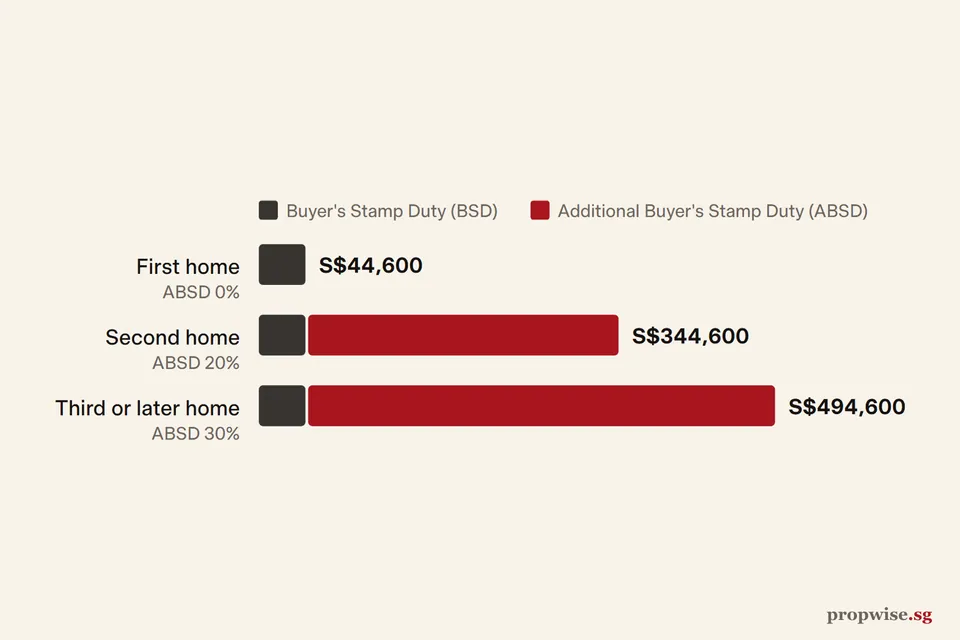
| ABSD on the S$1.5 million condo | S$0 (first home, 0%) | S$300,000 (second home, 20%) |
| Total | S$69,200 | S$344,600 |
Source: IRAS, stamp duty rates for residential property (October 2026). Legal, valuation and refinancing costs are left out. The joint route assumes the couple keeps the first home.
Decoupling costs S$69,200 in stamp duty against S$344,600 for the joint purchase. The gap is the S$300,000 of ABSD at 20%. The BSD on the share is the price of the ticket; the ABSD is the fine the ticket avoids.
The figures cover stamp duty only. Add legal fees, a valuation and the cost of refinancing. The husband also refunds to his CPF account the CPF he used for the first home, with accrued interest.
Can the remaining owner keep the loan?
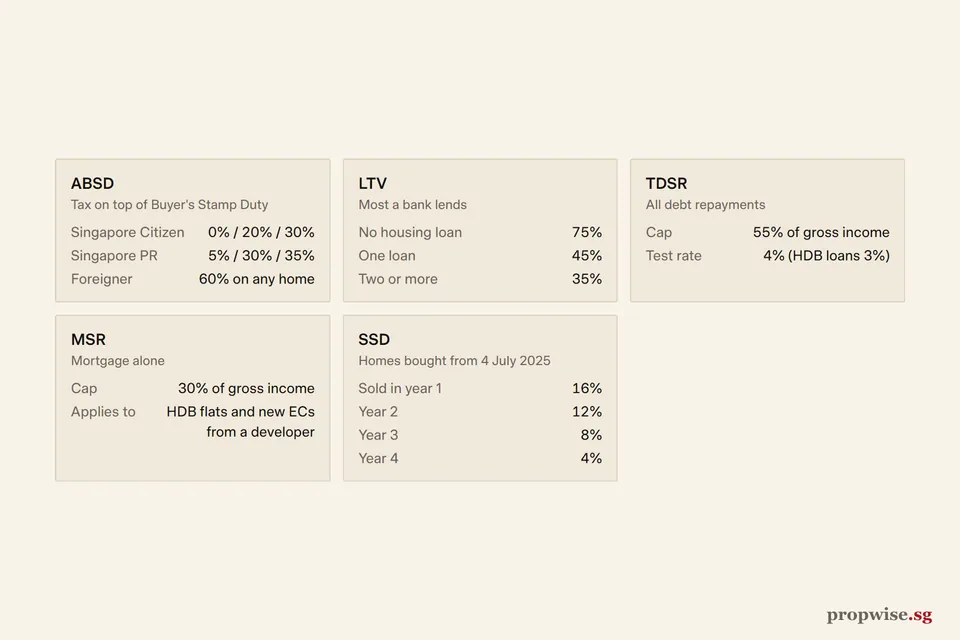
The wife now carries the whole loan. The bank will test her alone against the Total Debt Servicing Ratio (TDSR): all monthly debt repayments may take at most 55% of gross monthly income (rule history). If her income alone falls short, the plan stops at the bank.
Test the numbers first in the mortgage calculator. Our TDSR guide explains the test.
Can you decouple an HDB flat?
HDB allows a change in flat ownership without a sale only for set life events, such as marriage, divorce or the death of an owner. The HDB page on keeping a flat after life events lists them. Buying a second home is not on the list.
HDB owners who have met the minimum occupation period may buy a private home while keeping the flat. They pay ABSD on it as a second property, per our stamp duty guide. Flat prices by town are on the HDB town pages.
Is decoupling legal?
A genuine sale of a share between spouses at market value is a normal property deal under IRAS rules. Arrangements built only to cut tax are a different matter. In May 2024, the Ministry of Finance said IRAS had reviewed 187 “99-to-1” purchases and found tax avoidance in 166.
About S$60 million in ABSD and surcharges was to be clawed back in those cases, the ministry said. Section 33A of the Stamp Duties Act lets IRAS treat linked deals as one joint purchase. Take advice from a conveyancing lawyer on your own facts before you sign.
Is there an option without decoupling?
A married couple with at least one citizen spouse who buys a second home jointly can claim the ABSD back if they sell the first home in time. The IRAS remission for married couples sets the deadline. That route suits a couple who will move, while decoupling suits one who plans to keep both homes.
Related reading: stamp duty rates in full, what you refund to CPF when you sell and how much ABSD you need to pay.
Rules and rates as at 31 October 2026.