6 Gimmicks Agents Use to Sell Foreign Properties (2026)
Six sales tactics used to sell overseas property to Singaporeans and how to test each: cherry-picked growth, rental guarantees, 'next to Singapore' claims.
Overseas property sales events follow a script. The seller tells a story about a growing economy, rising prices, a guaranteed rent and a low price per square foot. Each claim can be true in a narrow sense and still mislead. Below are six gimmicks that Singapore buyers meet, in the Australian, Malaysian and other markets, and a test for each. The tests cost you an afternoon, not a fee.
At a glance
- Ask for the base year, the end year and the currency behind any growth figure.
- A rental guarantee is usually priced into the purchase price, and it ends.
- A cheap price per sq ft hides taxes, agent fees and a thin resale market.
- “Next to Singapore” or “5 minutes to the CBD” should be tested on a map, at peak hour.
- If the seller says “no tax” or “exclusive for Singapore buyers”, ask the host country’s tax office and your own lawyer.
| Gimmick | What you hear | The test |
|---|---|---|
| 1. Rosy economy | A young, growing country. A World Heritage city. | What drives demand for this project? Who rents it, and who would buy it from you? |
| 2. Growth and guaranteed yields | Prices up 75% in six years. Rental guaranteed at 6%. | Ask for resale price and rent history of the same building, who pays the guarantee and what backs it. |
| 3. Future promises | A rail link, a free-trade zone, 700,000 residents by 2050. | Is the infrastructure funded, contracted and scheduled? |
| 4. So affordable | For the price of a 3-room HDB flat, a seafront condo. | Add all purchase, holding, tax and exit costs. |
| 5. Location upgrade | Next to Singapore. Close to KLCC. | Check the route and travel time on a map at the hour you would use it. |
| 6. Simple tax, exclusive offer | No stamp duty, one simple tax, special price for Singapore buyers. | Get a written list of every tax and fee. Use your own lawyer in that country. |
Source: Propwise summary of the guide, with CEA and MAS rules as cited in it (October 2026).
1. The rosy economy and the halo
What you hear: “A young, growing country. A World Heritage city. Foreign companies are moving in.”
Macro stories sell because they are easy to believe. But a country’s GDP growth is not the return on one apartment. Heritage status protects buildings. It does not protect the price of a new tower nearby. And a country’s debt, its currency and its politics are part of the same picture, yet they rarely appear on the slide.
The test: Ask what drives demand for this specific project. Who rents it, and who would buy it from you? If the answer is “foreign investors”, you have found the problem.
2. Cherry-picked growth and guaranteed yields
What you hear: “Prices up 75% in six years. Rental guaranteed at 6%.”
Look at the start and end dates. A series that begins in a crisis trough and ends at a peak makes any market look like a winner. Then look at the currency. Say a project’s prices rise 75% in six years, in the local currency. That is about 9.8% a year. If the local currency falls 20% against the Singapore dollar in the same period, you hold 1.75 × 0.8 = 1.40 times your money in Singapore dollars. That is a 40% gain, or about 5.8% a year, before costs.
% a year
Source: Propwise worked example in the guide (arithmetic only) (October 2026). 1.75 x 0.8 = 1.40 times your money in Singapore dollars.
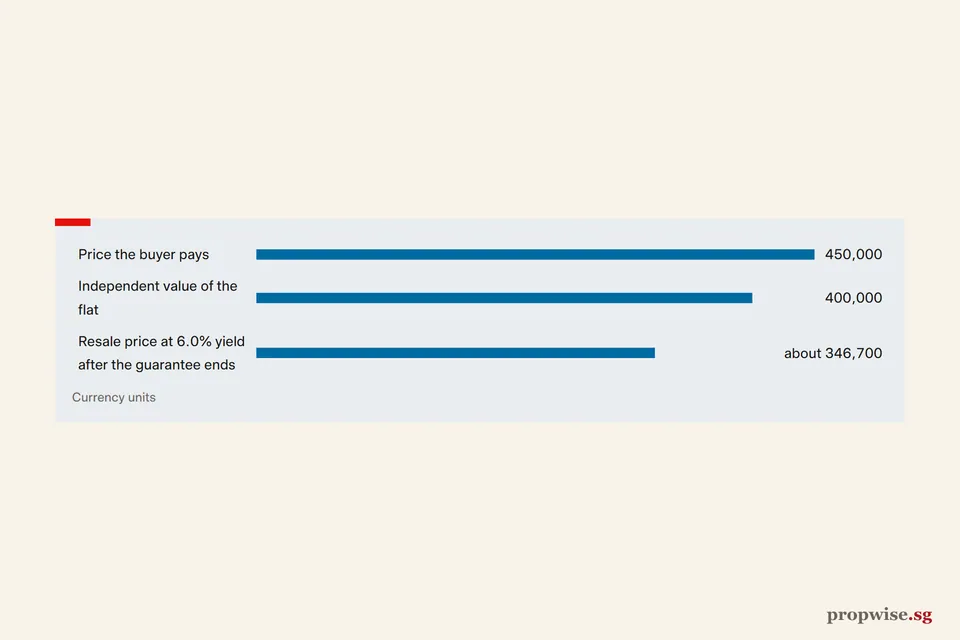
A guarantee deserves more suspicion. Say a developer sells you a flat for S$600,000 with 6% guaranteed rent for two years. That is S$36,000 a year. If the fair price is S$540,000, you paid S$60,000 extra, and the guarantee returns S$72,000 over two years. The seller’s money is your money. When the guarantee ends, the rent becomes the market rent. At 4% gross, S$24,000 a year, your income falls by a third, and costs and vacancy come out of that. Read our guide to rental guarantees.
S$ a year
Source: Propwise worked example in the guide (illustrative) (October 2026). The buyer paid S$60,000 above the assumed fair price. The guarantee returns S$72,000 over two years.
The test: Ask for the independent rent and price history of resales in the same building, not the developer’s chart. Ask who pays the guarantee and what backs it if the developer fails.
3. Promises about the future
What you hear: “A new rail link, a free-trade zone, an Olympic Games, 700,000 residents by 2050.”
Future plans sell empty land. Forest City in Johor is the standard warning. A Foreign Policy report in November 2019 said the project aimed to house 700,000 people. The developer reported more than 5,000 signed sales, and the author’s estimate was about 500 actual residents, which the author thought was optimistic. The project was also marketed to Chinese buyers as a place across the border from Singapore. Buyers paid for the plan, and the plan was slow.
| Item | Figure |
|---|---|
| Planned residents | 700,000 |
| Signed sales reported by the developer | more than 5,000 |
| Actual residents (author's estimate) | about 500 |
Source: Foreign Policy, Forest City report (21 November 2019). The 500 figure is the report author's estimate, which the author thought optimistic.
The test: Has the infrastructure been funded, contracted and scheduled? Who is paying? What do residents there do for work today? A plan that exists only on a brochure has no value to a landlord.
4. “So affordable” price comparisons
What you hear: “For the price of a 3-room HDB flat, you get a seafront condo with a pool.”
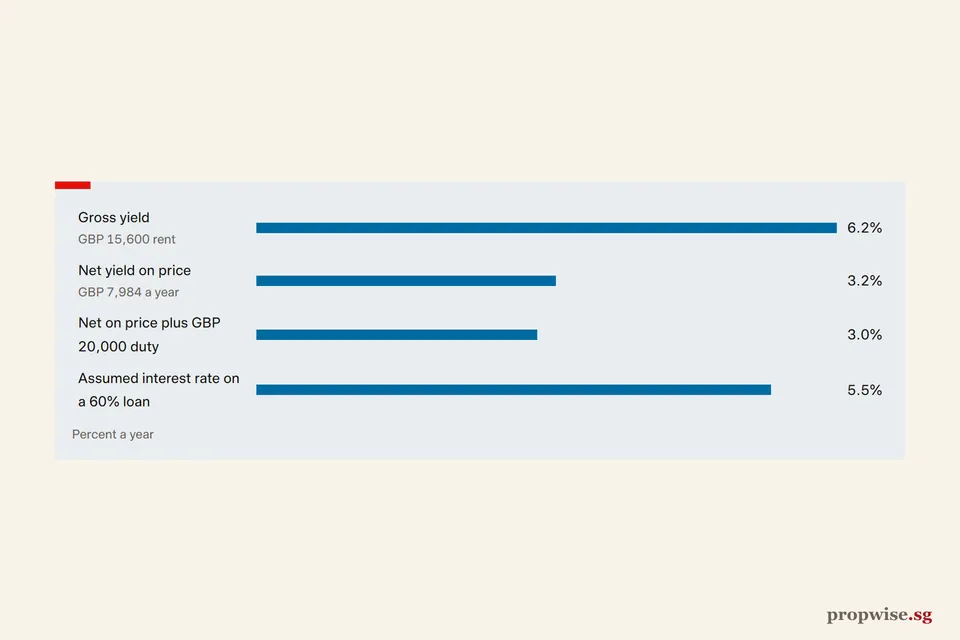
A low price per sq ft is not the same as a good deal. Compare the whole cost of owning, not the headline price. The UK shows how much the buyer’s costs add. Say you are a Singapore resident who owns a flat here, and you buy a £300,000 London flat. Standard SDLT is £5,000 (2% on £125,000 to £250,000, and 5% on the next £50,000). Because the flat will not be your only home worth £40,000 or more, higher rates apply. They add 5 points to each band, and homes you own anywhere in the world count, so your Singapore flat counts. On £300,000 that adds £15,000. The 2% surcharge for non-UK residents adds £6,000. The total is £26,000, or 8.7% of the price, before legal fees and agent fees.
| Part | Amount |
|---|---|
| Standard SDLT (2% on GBP 125,000 to 250,000, 5% on the next GBP 50,000) | GBP 5,000 |
| Higher rates for an additional home (5 points on each band; the Singapore flat counts) | GBP 15,000 |
| Surcharge for non-UK residents (2%) | GBP 6,000 |
| Total (8.7% of the price) | GBP 26,000 |
Source: GOV.UK, SDLT residential rates (October 2026); GOV.UK, SDLT on an additional residential property. Before legal fees and agent fees.
Resale is the other cost. In Australia, from 1 April 2025 to 30 June 2029, foreign investors are generally prohibited from buying established homes. Foreign buyers are channelled to new dwellings. A pitch of “buy where the locals buy” is hard to square with that rule. If your buyer has to be another foreigner who needs approval, your pool of buyers is smaller.
The test: Add all purchase costs, holding costs, taxes and exit costs. Then compare the net yield and the resale route with a Singapore alternative.
5. The location upgrade
What you hear: “Next to Singapore.” “Close to KLCC.” “Walk to the harbour.”
Names are borrowed. A development can be described by the famous place that is nearest, even when the route is long. Forest City, for example, was positioned as across the border from Singapore, but a border crossing is a journey in its own right.
The test: Open a map. Check the route and travel time at the hour you would use it, on the day of the week you would use it. Visit on a weekday and a weekend. Look at what is actually next door.
6. “Simple tax” and “exclusive for Singapore buyers”
What you hear: “No stamp duty, no ABSD, one simple tax. Special price for Singapore buyers only.”
Singapore’s rules and the host country’s rules are separate. A purchase abroad is not counted for Singapore’s ABSD, and that is a real feature. But the host country has its own taxes, as the UK example shows. Your loans also still count: MAS says the TDSR covers properties in and outside Singapore. And foreign owners can lose their footing when rules change. In August 2018, Malaysia’s prime minister declared a ban on foreigners buying units at Forest City, while the developer said it complied with all laws. Foreign buyers have no vote and little say.
“Exclusive” offers are a form of urgency. A discount for one nationality, fee waivers and free furniture are all part of the price.
The test: Ask for a written list of every tax and fee in the host country at purchase, during ownership and at sale. Take it to a lawyer in that country whom you hired. Do not use the developer’s lawyer.
Verify the seller
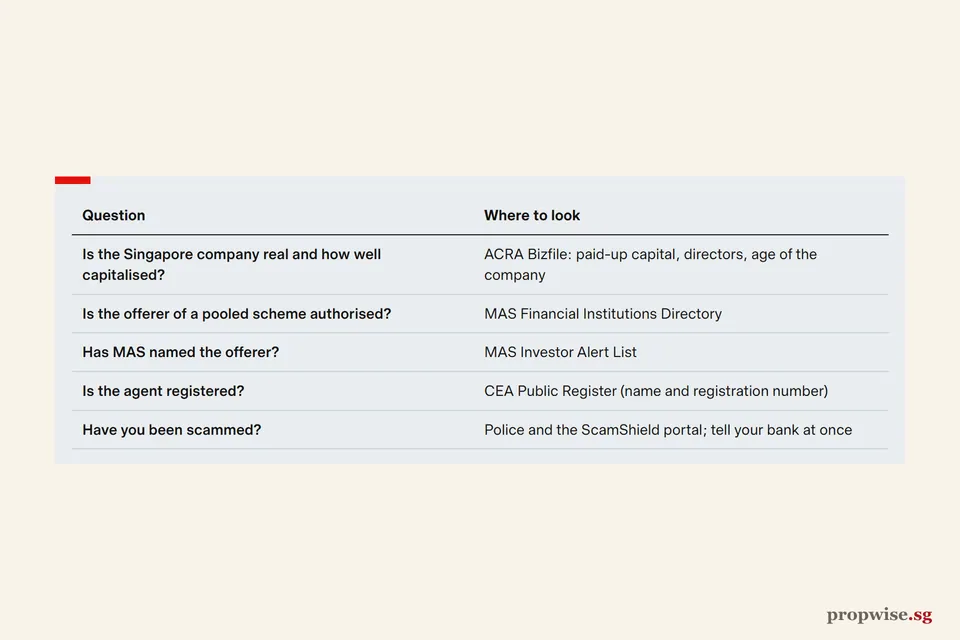
CEA regulates estate agency work for properties in and outside Singapore. So check any agent on the CEA Public Register before you sign. For more warning signs, see our guide to how to spot overseas property scams, and the broader checklist in 5 things to know about overseas property.
Bottom line
None of these gimmicks is a lie on its own. Each is a true statement placed where it does the most work. Your defence is a routine: check the start and end dates and the currency, price the guarantee, find out how the plan is funded, add every cost, test the location, and read the tax rules in the host country. If a project is as good as the pitch, it can survive that scrutiny.
1 reader comment
Frederick
Foreigners are subjected to a minimum price tag of a million Ringgit in Johor unless it is gazetted as economic zone, and in Selangor and Penang two million. There is also an income tax of 20% for rental collections of gross value for foreigners.
Under the old Malaysian BN Govt, yes, the Chinese really had a wild run on the country, building anywhere and with impunity. The ghost cities of China were duplicated and imported into Malaysia. Now with the new Malaysian Govt, things will be vastly different. Iskander Investment properties without tenants now, are turning to Airbnb tourists; lucky if occupancy rate can 5/30 days a month. HSR is dead for now, Forest City will be forested again, and many investors esp the Sporeans in Iskander are rueful of their investments. Penang has excess capacity and won’t go away in the next few years. The locals find their condos expensive, so their agents try their luck overseas esp in the midst of turmoil in HongKong. Good luck to the naive and the gullible.