What Is a Caveat, and Why Do Property Transaction Records Use It?
A caveat is a notice a buyer lodges to claim an interest in a property. URA builds resale records from caveats, so the data has gaps. What it shows.
A caveat is a notice, lodged with the land registry, that claims an interest in a property and stops other dealings in it. URA builds its private resale and sub-sale records from caveats. So a transaction record is really a record of a caveat lodged, not a count of every sale.
What a caveat is
The word is Latin for “let him beware”. Think of it as a “reserved” sign on a table at a hawker centre, but one the law takes seriously.
Under section 115 of the Land Titles Act 1993, a person who claims an interest in land may lodge a caveat with the Registrar. The caveat names the caveator and the owner (the caveatee). It states the interest claimed and the grounds.
If the caveator is a purchaser, it also states the purchase price and the date of the contract or option exercise.
While a caveat is effective, section 119 generally bars the Registrar from registering a dealing that the caveat prohibits. That is how a caveat protects the buyer’s interest after signing. A caveat can lapse after 5 years unless it is extended (section 121).
Who lodges it
The buyer usually does. URA says buyers lodge caveats with the Singapore Land Authority (SLA) after the option to purchase is exercised or the sale and purchase agreement is signed. It also says lodging is not mandatory, so some sales have no caveat.
Why the data says “caveats lodged”
URA’s methodology page says resale and sub-sale records come from caveats lodged with SLA. Copies reach URA twice a week. Since 25 May 2015, new-sale records come from developers’ weekly returns instead.
Schematic. A sale with no caveat does not appear in the resale record. Source: URA, REALIS coverage and methodology; URA, private residential transactions.
URA says its database may miss deals with no caveat. Its price indices still count them, since contracts go to IRAS for stamp duty. URA may also drop a few outlier prices.
What a record shows, and what it does not
- Price as lodged. URA says it is the agreed purchase price in the contract. It excludes stamp duties, legal fees and agency fees.
- Contract month, not day. The data we hold has month precision only.
- Bulk deals. One caveat can cover many units. We count it once, and it has no price or price per sq ft, so it stays out of our rankings.
- No promise of completion. A caveat is a claim, not proof that the sale completed. Our refresh drops rows that URA cancels.
How our tables use caveats
URA’s totals count records, not units, and so do ours. In Sep 2026, the URA data we hold shows 1,170 private resale records, executive condominiums excluded.
- New sales (from developers)
- Resales
- Sub-sales
Latest: New 299 (Sep 2026); Resale 1,170 (Sep 2026); Sub-sale 36 (Sep 2026).
Counts are caveats, as in URA's own quarterly totals, not units. A month appears once it is complete: URA adds late-lodged caveats for about two weeks.
Table view
| Period | New sales (from developers) | Resales | Sub-sales |
|---|---|---|---|
| Sep 2026 | 299 | 1,170 | 36 |
| Aug 2026 | 166 | 1,171 | 44 |
| Jul 2026 | 733 | 1,272 | 45 |
| Jun 2026 | 163 | 1,257 | 57 |
| May 2026 | 438 | 1,215 | 72 |
| Apr 2026 | 1,542 | 1,298 | 51 |
| Mar 2026 | 1,264 | 1,119 | 45 |
| Feb 2026 | 247 | 1,118 | 45 |
| Jan 2026 | 459 | 982 | 58 |
| Dec 2025 | 196 | 1,084 | 59 |
| Nov 2025 | 325 | 1,108 | 67 |
| Oct 2025 | 2,405 | 1,301 | 77 |
| Sep 2025 | 241 | 1,340 | 62 |
| Aug 2025 | 2,120 | 1,309 | 87 |
| Jul 2025 | 904 | 1,280 | 72 |
| Jun 2025 | 266 | 1,143 | 79 |
| May 2025 | 286 | 1,159 | 69 |
| Apr 2025 | 633 | 1,379 | 87 |
| Mar 2025 | 708 | 1,408 | 112 |
| Feb 2025 | 1,567 | 1,177 | 96 |
| Jan 2025 | 1,056 | 1,057 | 94 |
| Dec 2024 | 198 | 1,164 | 109 |
| Nov 2024 | 2,485 | 1,227 | 92 |
| Oct 2024 | 691 | 1,296 | 123 |
| Sep 2024 | 356 | 1,229 | 99 |
| Aug 2024 | 192 | 1,299 | 117 |
| Jul 2024 | 539 | 1,325 | 108 |
| Jun 2024 | 217 | 1,019 | 137 |
| May 2024 | 209 | 1,390 | 123 |
| Apr 2024 | 278 | 1,405 | 158 |
| Mar 2024 | 711 | 1,087 | 102 |
| Feb 2024 | 151 | 885 | 128 |
| Jan 2024 | 292 | 881 | 123 |
| Dec 2023 | 138 | 856 | 150 |
| Nov 2023 | 760 | 975 | 141 |
| Oct 2023 | 196 | 980 | 150 |
| Sep 2023 | 210 | 875 | 117 |
| Aug 2023 | 361 | 1,071 | 141 |
| Jul 2023 | 1,349 | 1,022 | 118 |
| Jun 2023 | 261 | 988 | 91 |
| May 2023 | 984 | 1,120 | 107 |
| Apr 2023 | 843 | 1,013 | 96 |
| Mar 2023 | 450 | 1,291 | 116 |
| Feb 2023 | 391 | 868 | 70 |
| Jan 2023 | 373 | 594 | 48 |
| Dec 2022 | 162 | 786 | 60 |
| Nov 2022 | 238 | 909 | 60 |
| Oct 2022 | 284 | 1,044 | 74 |
| Sep 2022 | 949 | 1,313 | 68 |
| Aug 2022 | 419 | 1,220 | 90 |
| Jul 2022 | 802 | 1,188 | 68 |
| Jun 2022 | 460 | 1,321 | 71 |
| May 2022 | 1,276 | 1,340 | 54 |
| Apr 2022 | 608 | 1,530 | 46 |
| Mar 2022 | 650 | 1,335 | 52 |
| Feb 2022 | 535 | 944 | 34 |
| Jan 2022 | 612 | 1,078 | 41 |
| Dec 2021 | 640 | 1,532 | 62 |
| Nov 2021 | 1,468 | 1,618 | 47 |
| Oct 2021 | 892 | 1,609 | 39 |
Source: URA. Data to Sep 2026.
Three rules shape our tables:
- Latest month is partial. We call a month complete only after the 15th of the next month, because late caveats arrive in that time. Our deal tables label that month “month so far”.
- Landed repeats. The API repeats some landed caveats. We count identical landed rows once. About 19% of landed resale rows were extra copies when we checked.
- Medians are not an index. Our median price per sq ft moves with the mix of projects sold. It is not quality-adjusted like the URA price index.
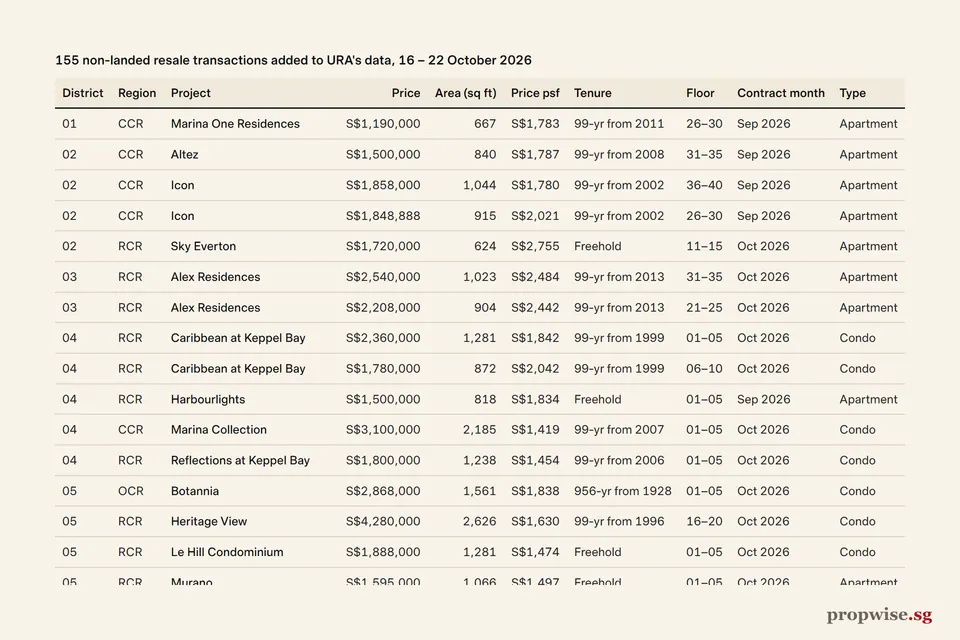
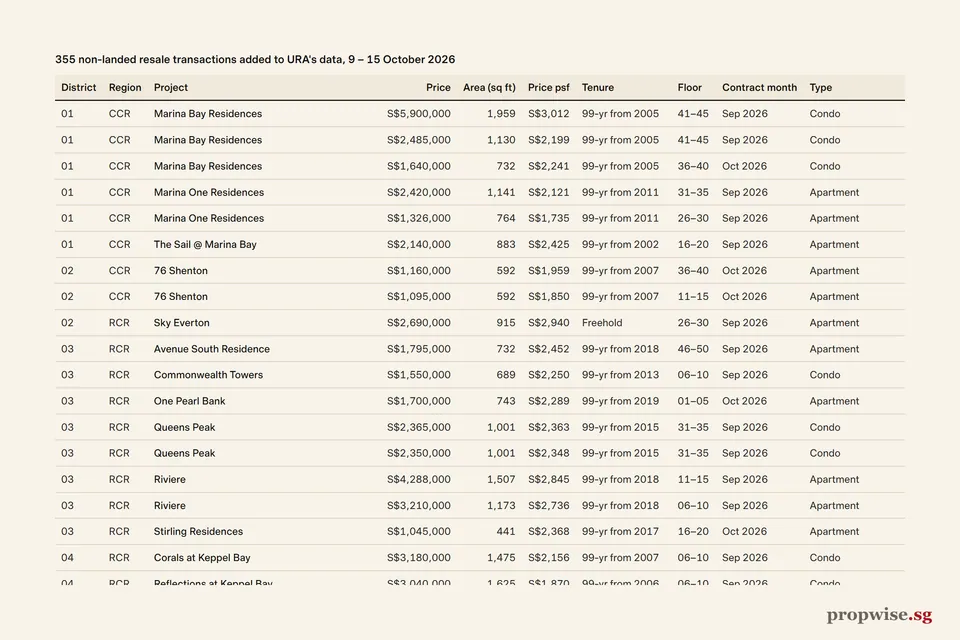
Our weekly deal tables rank top and bottom prices per sq ft and the most traded condos from these records. Each table says which month it covers.
Limits and exceptions
- Deals without a caveat can be missing from URA’s search.
- A caveat’s price is the contract price, so it can differ from a valuation or the cash a buyer paid over it.
- Our HDB resale tables use HDB’s resale prices dataset on data.gov.sg, not caveats.
- This is a plain-words definition, not legal advice.