Johor Property for Singaporeans (2026): Is Iskandar Worth It?
Johor property for Singapore investors in 2026: RTS Link timing, Malaysian RPGT for foreigners, ringgit risk, and Singapore TDSR, CPF and ABSD rules.
Johor property looks cheap from Singapore, and the RTS Link is close to opening. But a cheap price is not the same as a good investment. Foreign sellers in Johor pay a 30% real property gains tax in the first five years, the ringgit can cut your Singapore-dollar return, and Singapore’s own rules (TDSR, CPF and HDB) still apply to you. Decide on the numbers, not the shuttle-train brochure.
At a glance
- RTS Link: passenger service is now expected to start in February 2027 (LTA and Malaysia’s Ministry of Transport, 2 Oct 2026), subject to safety certification, with a trip of about five minutes between Woodlands North and Bukit Chagar. The target has already slipped from end-2026, so check for the confirmed date.
- Malaysian tax on your gain: a non-citizen pays 30% RPGT if they sell in the first five years and 10% from year six.
- Singapore rules: ABSD ignores overseas homes, but TDSR counts the loan and CPF cannot pay for the purchase.
- Test the exit: ask who will buy from you, and whether locals can afford it.
What the 2014 case said, and what happened
In 2014 a Propwise guest writer said Iskandar’s success depended on three things: international buy-in, a liveable new city, and transport links to Singapore. He expected a high-speed rail link by 2020 and an RTS link by 2019. Here is where they stand.
| 2014 expectation | Position in 2026 |
|---|---|
| High-speed rail from Kuala Lumpur to Singapore by 2020 | Terminated. On 1 January 2021 MOT announced that the agreement had ended after the two governments failed to agree, and that Malaysia must compensate Singapore for costs already incurred. |
| RTS Link to Singapore’s Thomson line by 2019 | Delayed. The end-2026 target has slipped again: service is now expected in February 2027 (LTA, 2 Oct 2026). LTA’s project page gives capacity of up to 10,000 commuters an hour in each direction between Woodlands North and Bukit Chagar. |
| International investors and a new metropolis | The region has more than 2 million people and is home to the Johor–Singapore Special Economic Zone, according to Iskandar’s regional authority (IRDA). That is progress. But projects aimed mainly at foreign buyers still carry risk, as the Forest City case shows. |
The lesson is simple. Transport and policy announcements move on government timetables. A property price depends on whether local people can afford to buy and rent. Plan for the RTS Link to open late, or to disappoint, and ask whether the deal works without it.
- Length
- 4 km
- Stations
- 2: Woodlands North, Bukit Chagar
- Journey time
- about 5 minutes
- Capacity
- up to 10,000 commuters an hour each way at peak
- Connection in Singapore
- Woodlands North station on the Thomson-East Coast Line, at the basement
- Passenger service targeted
- February 2027
Source: LTA, JB-Singapore RTS Link (October 2026); LTA and Malaysia's Ministry of Transport, 2 Oct 2026. LTA's project page still gave the end of 2026 as the target; the 2 October 2026 news release moved it to February 2027, subject to safety certification.
The Singapore-side rules
These rules apply to Singaporeans, and our guide to the five things to know about overseas property covers them in more detail.
- ABSD: IRAS excludes residential property outside Singapore from the count. A Johor home does not increase your ABSD on a later Singapore purchase.
- TDSR: MAS says it covers properties in and outside Singapore, so a Johor mortgage uses up some of your 55% limit. See our TDSR guide and the mortgage calculator.
- CPF: you can use CPF to buy a home in Singapore, not in Johor.
- HDB: private property owned overseas can affect HDB loan eligibility.
- Income tax: overseas income that resident individuals receive in Singapore is generally not taxable in Singapore. Malaysia may tax the rent and the gain.
| Singapore rule | Effect of a Johor home |
|---|---|
| ABSD on a later Singapore purchase | Not counted: IRAS excludes residential property outside Singapore |
| TDSR (55% of income) | Counted: MAS says it covers properties in and outside Singapore |
| CPF | Cannot be used to buy a Johor home |
| HDB loan eligibility | Overseas private property can affect it |
| Singapore income tax on overseas income received here | Generally not taxable; Malaysia may tax the rent and the gain |
Source: IRAS, Additional Buyer's Stamp Duty (October 2026); MAS, who TDSR applies to; CPF Board, using your CPF to buy a home; IRAS, income received from overseas.
The Malaysian side: tax, rules and the exit
RPGT. Malaysia’s inland revenue board (HASiL) publishes the rates. For a non-citizen, RPGT is 30% of the chargeable gain if you sell in the first five years, and 10% from the sixth year. A Malaysian citizen or permanent resident pays 0% from the sixth year. So a foreign owner has a strong reason to hold for more than five years.
RPGT rate, %
Source: HASiL, real property gains tax rates (October 2026). Non-citizens: 30% if sold in the first five years, 10% from year six. Malaysian citizens and permanent residents pay 0% from year six.
Foreign buyer rules. Foreign buyers in Malaysia face state-level conditions, such as approval and a minimum price, and these have changed since 2014. We could not confirm the current Johor threshold from an official source in time for this update. Ask a Malaysian lawyer, appointed by you and not by the developer, to confirm it in writing before you pay a booking fee.
Who buys from you? A 2013 Propwise article analysed Johor Bahru transactions for 2012–13 and found terraced houses led the volume, while condominiums were about 12.8%. That is old data, but the point stands. A condo marketed to foreign buyers competes with a market where locals mostly buy landed homes. Ask the agent for recent resale transactions in the same project, not launch prices.
Two examples
These examples use assumed figures, not forecasts or current rates.
Example 1: RPGT. Say you buy a Johor condo for RM1,000,000 and sell it for RM1,200,000. Ignoring allowable costs and exemptions, the gain is RM200,000. If you sell in year three, RPGT at 30% is RM60,000. If you sell after year five, at 10%, it is RM20,000. The holding period alone changes your tax by RM40,000.
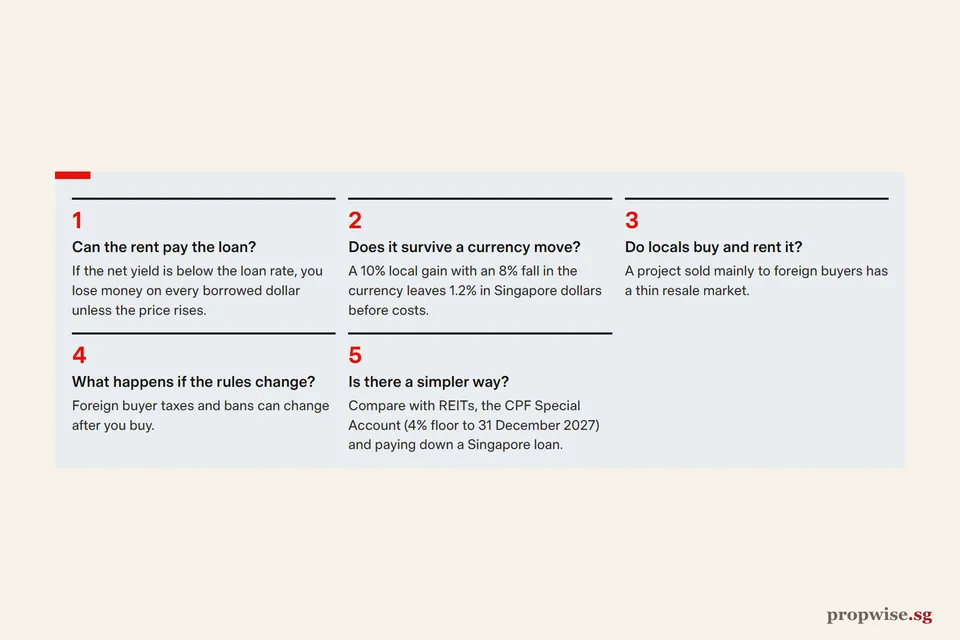
Example 2: ringgit risk. Say the exchange rate is S$1 = RM3.30 when you buy, so RM1,000,000 costs S$303,030. You sell for RM1,200,000 (a 20% gain in ringgit) when the rate is S$1 = RM3.60. In Singapore dollars you get S$333,333, a gain of 10%. After RPGT of RM60,000 (sale in year three) you keep S$316,667, a gain of about 4.5%. If you sell after year five and RPGT is RM20,000, you keep S$327,778, a gain of about 8.2%. The currency halved your headline gain, and the tax took more. Add legal fees, agent fees and stamp duty on both sides, and the margin is thinner still.
Gain, %
Source: HASiL, real property gains tax rates (October 2026). Assumed figures, not forecasts or current rates, as in the article. Before legal fees, agent fees and stamp duty on both sides.
A checklist before you commit
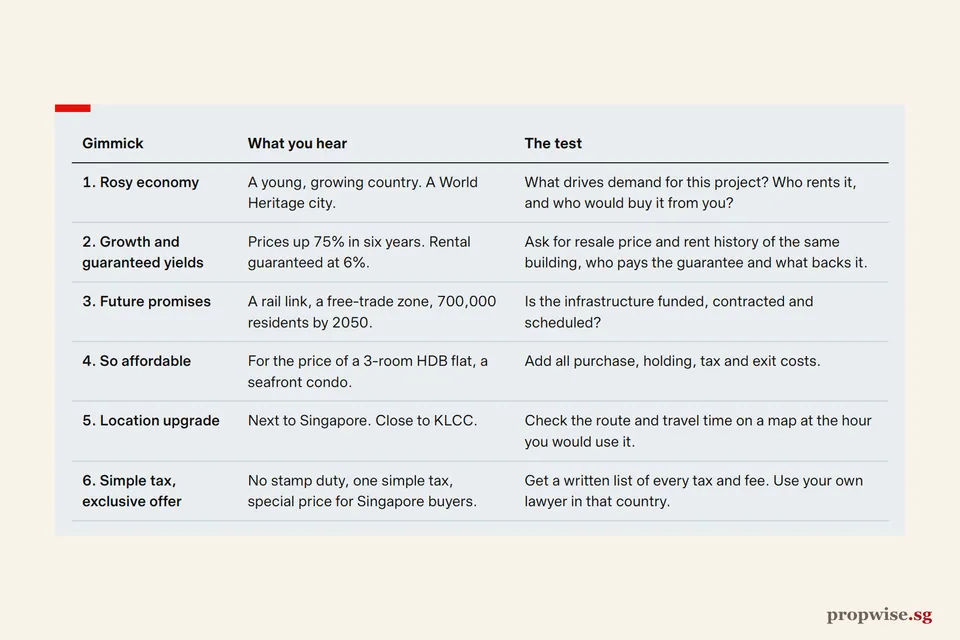
- Do the numbers work without the RTS Link? Run the yield and loan test in Singapore dollars. Compare net yield with your loan rate.
- Is the developer licensed, and does your own lawyer act for you? Check that stage payments match construction progress.
- Can you hold more than five years? The RPGT table rewards it, and so does the ringgit cycle.
- Who are the buyers and tenants? If the project targets foreign buyers, expect a thin resale market.
- Is it a home or an investment? A home you use on weekends is a different decision from a rental. Do not call a holiday home an investment unless the numbers support it.
For tests that apply to any overseas market, see should you invest in overseas property in 2026? and how to spot overseas property scams.
Bottom line
Johor offers lower prices, a short trip across the Causeway and a rail link that is nearly built. It also carries a 30% tax for foreign sellers within five years, currency risk and a resale market that your Singapore-dollar buyer may not share. Treat the RTS Link as a bonus, not the reason to buy. If you buy, hold long enough for the tax to fall and make sure a local can afford to buy from you.