How to Negotiate a Property Price in Singapore: HDB and Private
How to negotiate a Singapore property deal in 2026: HDB's 21-day option and valuation gap, private option fees, seller's stamp duty timing and commission.
The best negotiators in Singapore property are not the loudest. They know the recent prices, they know the deadlines that bind each side and they know what a few thousand dollars actually costs them. Three things shape most deals: your comparables, the option period and the valuation or tax deadlines that cap what each side can do. This guide shows how each works for HDB and private resale, with worked examples.
At a glance
- For HDB resale, the option period is 21 calendar days. The option fee is S$1 to S$1,000, and the option fee and exercise fee together may not exceed S$5,000.
- Ask HDB for a valuation the next working day after you get the option. If you need a loan or CPF, it caps what you can borrow and use, so any price above valuation comes from cash.
- Private resale terms are in the option to purchase. The CEA template leaves the option money and the expiry date to be agreed.
- Sellers should check the holding period first. Seller’s stamp duty can be 16% to 4% of the price for homes bought from 4 July 2025.
- Agent commission is not fixed, and an agent may act for only one side.
Know whose market it is
Leverage changes with the market segment. In the Q3 2026 flash estimate, HDB resale prices fell 0.2%, the third quarterly dip in a row. Resale volume was about 5.2% higher than a year earlier. In the private market, URA’s flash estimate showed prices rose 1.4%, while the outside-central region rose 2.2% and the core central region fell 0.1%. Private rents rose only 0.7% in Q2 2026, and vacancy was 6.4%.
- Private homes (URA price index)
- HDB resale flats (HDB Resale Price Index)
- Policy measures (select one for details)
Latest: Private 219.4 (Q2 2026); HDB 202.8 (Q2 2026).
Table view
| Period | Private homes (URA price index) | HDB resale flats (HDB Resale Price Index) |
|---|---|---|
| Q2 2026 | 219.4 | 202.8 |
| Q1 2026 | 218.3 | 203.4 |
| Q4 2025 | 216.4 | 203.6 |
| Q3 2025 | 215.1 | 203.7 |
| Q2 2025 | 213.2 | 202.9 |
| Q1 2025 | 211.1 | 201.0 |
| Q4 2024 | 209.4 | 197.9 |
| Q3 2024 | 204.7 | 192.9 |
| Q2 2024 | 206.1 | 187.9 |
| Q1 2024 | 204.3 | 183.7 |
| Q4 2023 | 201.5 | 180.4 |
| Q3 2023 | 196.0 | 178.5 |
| Q2 2023 | 194.4 | 176.2 |
| Q1 2023 | 194.8 | 173.6 |
| Q4 2022 | 188.6 | 171.9 |
| Q3 2022 | 187.8 | 168.1 |
| Q2 2022 | 180.9 | 163.9 |
| Q1 2022 | 174.8 | 159.5 |
| Q4 2021 | 173.6 | 155.7 |
| Q3 2021 | 165.3 | 150.6 |
| Q2 2021 | 163.5 | 146.4 |
| Q1 2021 | 162.2 | 142.2 |
| Q4 2020 | 157.0 | 138.1 |
| Q3 2020 | 153.8 | 133.9 |
| Q2 2020 | 152.6 | 131.9 |
| Q1 2020 | 152.1 | 131.5 |
| Q4 2019 | 153.6 | 131.5 |
| Q3 2019 | 152.8 | 130.9 |
| Q2 2019 | 150.8 | 130.8 |
| Q1 2019 | 148.6 | 131.0 |
| Q4 2018 | 149.6 | 131.4 |
| Q3 2018 | 149.7 | 131.6 |
| Q2 2018 | 149.0 | 131.7 |
| Q1 2018 | 144.1 | 131.6 |
| Q4 2017 | 138.7 | 132.6 |
| Q3 2017 | 137.6 | 132.8 |
| Q2 2017 | 136.6 | 133.7 |
| Q1 2017 | 136.7 | 133.9 |
| Q4 2016 | 137.2 | 134.6 |
| Q3 2016 | 137.9 | 134.7 |
| Q2 2016 | 140.0 | 134.7 |
| Q1 2016 | 140.6 | 134.7 |
| Q4 2015 | 141.6 | 134.8 |
| Q3 2015 | 142.3 | 134.6 |
| Q2 2015 | 144.2 | 135.0 |
| Q1 2015 | 145.5 | 135.6 |
| Q4 2014 | 147.0 | 137.0 |
| Q3 2014 | 148.6 | 139.1 |
| Q2 2014 | 149.7 | 141.5 |
| Q1 2014 | 151.3 | 143.5 |
| Q4 2013 | 153.2 | 145.8 |
| Q3 2013 | 154.6 | 148.1 |
| Q2 2013 | 154.0 | 149.4 |
| Q1 2013 | 152.4 | 148.6 |
| Q4 2012 | 151.5 | 146.7 |
| Q3 2012 | 148.8 | 143.1 |
| Q2 2012 | 147.9 | 140.3 |
| Q1 2012 | 147.2 | 138.5 |
| Q4 2011 | 147.4 | 137.7 |
| Q3 2011 | 147.0 | 135.4 |
| Q2 2011 | 145.1 | 130.4 |
| Q1 2011 | 142.3 | 126.4 |
| Q4 2010 | 139.2 | 124.4 |
| Q3 2010 | 135.5 | 121.3 |
| Q2 2010 | 131.7 | 116.6 |
| Q1 2010 | 125.1 | 112.1 |
| Q4 2009 | 118.4 | 109.0 |
| Q3 2009 | 110.3 | 105.0 |
| Q2 2009 | 95.3 | 101.4 |
| Q1 2009 | 100.0 | 100.0 |
| Q4 2008 | 116.4 | 100.8 |
| Q3 2008 | 123.9 | 99.4 |
| Q2 2008 | 126.9 | 95.4 |
| Q1 2008 | 126.7 | 91.3 |
| Q4 2007 | 122.1 | 88.0 |
| Q3 2007 | 114.4 | 83.2 |
| Q2 2007 | 105.6 | 78.1 |
| Q1 2007 | 97.6 | 75.8 |
| Q4 2006 | 93.1 | 74.9 |
| Q3 2006 | 89.6 | 74.2 |
| Q2 2006 | 87.3 | 74.3 |
| Q1 2006 | 85.8 | 73.6 |
| Q4 2005 | 84.5 | 73.5 |
| Q3 2005 | 83.3 | 73.2 |
| Q2 2005 | 82.3 | 73.5 |
| Q1 2005 | 81.9 | 77.2 |
| Q4 2004 | 81.3 | 77.1 |
| Q3 2004 | 80.7 | 76.3 |
| Q2 2004 | 80.4 | 76.2 |
| Q1 2004 | 80.3 | 75.3 |
| Q4 2003 | 80.6 | 75.1 |
| Q3 2003 | 80.7 | 74.3 |
| Q2 2003 | 81.1 | 72.5 |
| Q1 2003 | 81.6 | 71.0 |
| Q4 2002 | 82.3 | 69.9 |
| Q3 2002 | 82.6 | 69.9 |
| Q2 2002 | 82.2 | 69.2 |
| Q1 2002 | 82.8 | 69.1 |
| Q4 2001 | 83.8 | 69.6 |
| Q3 2001 | 87.6 | 70.6 |
| Q2 2001 | 90.3 | 72.1 |
| Q1 2001 | 91.1 | 73.2 |
| Q4 2000 | 94.9 | 75.8 |
| Q3 2000 | 97.6 | 77.6 |
| Q2 2000 | 100.4 | 79.3 |
| Q1 2000 | 98.9 | 80.3 |
| Q4 1999 | 95.9 | 79.8 |
| Q3 1999 | 91.1 | 78.1 |
| Q2 1999 | 84.3 | 72.2 |
| Q1 1999 | 75.4 | 71.2 |
Policy measures marked on this chart (23)
- 2025-07-03 Seller's Stamp Duty holding period back to four years, rates raised by 4 pp
- 2024-08-19 HDB loan LTV cut to 75% and Enhanced CPF Housing Grant raised
- 2023-04-26 ABSD rates raised, April 2023
- 2023-02-14 CPF Housing Grant raised for first-time resale buyers, Budget 2023
- 2023-02-14 Buyer's Stamp Duty raised for higher-value properties, Budget 2023
- 2022-09-29 Property measures, September 2022: higher TDSR and MSR rate floor, HDB loan LTV 80%, 15-month wait-out
- 2021-12-15 Property cooling measures, December 2021: higher ABSD, TDSR 55%, HDB loan LTV 85%
- 2018-07-05 Property cooling measures, July 2018: higher ABSD and lower LTV limits
- 2018-02-19 Budget 2018: Proximity Housing Grant enhanced
- 2018-02-19 Budget 2018: top BSD rate raised to 4% above S$1m
- 2017-03-10 SSD holding period cut to 3 years; TDSR relaxed for equity withdrawal
- 2013-08-27 HDB loan and resale measures, August 2013
- 2013-06-28 MAS introduces the Total Debt Servicing Ratio (TDSR) framework
- 2013-01-11 Property cooling measures, January 2013
- 2012-10-05 Maximum loan tenure of 35 years and tighter LTV limits, October 2012
- 2011-12-07 Additional Buyer's Stamp Duty introduced, December 2011
- 2011-01-13 Property cooling measures, January 2011
- 2010-08-30 HDB measures after National Day Rally 2010: DBSS income ceiling, 5-year MOP for non-subsidised flats
- 2010-08-30 Property cooling measures, August 2010
- 2010-02-19 Seller's Stamp Duty introduced and LTV limit cut to 80%, February 2010
- 2009-09-14 Interest-only loans and Interest Absorption Scheme disallowed, September 2009
- 2005-07-19 Property policy review, July 2005: LTV limit raised to 90%, CPF housing rules eased, foreign ownership rules eased
- 2001-10-12 Second off-budget package, October 2001: property tax rebate, stamp duty cut, gains tax removed, land sales eased
So an HDB buyer may have more room than a private buyer in a rising suburb, and a tenant may have more room than a landlord. These are averages, though. Your block, your floor and the number of similar units for sale decide your case.
Do the homework that supports your number
Never take the agent’s or the owner’s comparables as the whole picture. Build your own:
- HDB: the resale flat prices dataset on data.gov.sg lists recent transactions by town, block, storey range and lease start date. The gov.sg guide tells buyers to check recent transacted prices before agreeing a price.
- Private: URA publishes private residential property data. Its REALIS system, which holds project-level transactions, is sold by subscription.
- The seller’s position: how long it has been on the market, whether the owner has to sell and what they paid. Ask, but treat answers as claims, not facts.
- Your own limit: decide a walk-away price before the first viewing, with your loan eligibility checked. Use our mortgage calculator to see what each price does to your monthly payment.
HDB resale: the 21-day option and the valuation gap
Under HDB’s resale process, the buyer pays an option fee to the seller, and the seller cannot grant another option to anyone else until it expires. That stops the flat for 21 days, which gives the seller a reason to want the buyer to decide.
It also gives you a window. If you want a loan or CPF, submit a Request for Value by the next working day. HDB then tells you the valuation before you exercise the option. Initial payment is 25% of the resale price or the value, whichever is lower. CPF and the loan are set on the same lower figure, so the gap comes from cash.
Here is an example. A 4-room flat is offered at S$680,000. HDB values it at S$640,000. You take an HDB loan at 75% of the lower figure, so the loan is S$480,000.
| Agreed price | Loan | Cash and CPF needed | Of which cash over valuation |
|---|---|---|---|
| S$680,000 | S$480,000 | S$200,000 | S$40,000 |
| S$660,000 | S$480,000 | S$180,000 | S$20,000 |
| S$640,000 | S$480,000 | S$160,000 | S$0 |
Above the valuation, every S$1 you negotiate off the price is S$1 of cash you do not need. This is why a low valuation is the best argument you can bring to a seller. You can say: “I cannot find the S$40,000 in cash.” You have risked only the option fee, which is S$1,000 at most, and you are free to walk away if the seller will not move.
- 1Day 0Option grantedThe buyer pays an option fee. The seller cannot grant another option until this one ends.
- 2Next working daySubmit the Request for ValueHDB then gives the valuation before you exercise.
- 3Within 21 daysExercise or walk awayLoan and CPF are set on the lower of price and valuation. Any gap is paid in cash.
Source: gov.sg, HDB resale buying guide (October 2026).
Private resale: what each 1% costs
Private resale terms are in the option to purchase. The CEA template leaves the option money, the exercise payment and the expiry date blank. If you do not exercise in time, you forfeit the option money. Our guide to the 10-step buying process covers the usual amounts.
Say a condo is asking S$1,800,000 and you settle at S$1,750,000. Buyer’s stamp duty falls because the top slice is taxed at 5%:
- BSD at S$1,800,000: S$59,600.
- BSD at S$1,750,000: S$57,100.
- You save S$50,000 on price and S$2,500 on BSD, a total of S$52,500.
Each 1% of S$1,750,000 is S$17,500. If the option fee is 1%, that is also what you lose if you take the option and then walk away. So do your loan approval and checks before you pay it. Our developer versus resale guide shows how the terms differ at a new launch. At a showflat, the agents work for the developer.
Selling: your deadline matters more than your price
If you bought a home on or after 4 July 2025, SSD applies for four years. It is charged on the higher of the selling price and market value. Take a home bought for S$1,500,000 and sold for S$1,600,000:
| Time held | SSD rate | SSD on S$1.6m |
|---|---|---|
| Up to 1 year | 16% | S$256,000 |
| Over 1 to 2 years | 12% | S$192,000 |
| Over 2 to 3 years | 8% | S$128,000 |
| Over 3 to 4 years | 4% | S$64,000 |
| Over 4 years | 0% | S$0 |
SSD in S$
Source: IRAS, Seller's Stamp Duty (October 2026).
Waiting a few months across a boundary can save more than any haggle. Our stamp duty guide explains the buyer side.
As a seller, you also have some rules on your side. Your agent must tell you about all offers and counteroffers. On an HDB flat, you may have only one option out at a time, so compare offers before you grant it. Do not treat cash over valuation as a given: buyers who need a loan have to find that money in cash, which limits who can pay it.
Tactics that still work
Some old advice holds up. Here is the version that fits today’s process.
- Let the other side move first. The first offer is rarely the final price. Counter, and do not accept the first number.
- Put an expiry on every offer. “Valid until 6 pm on Friday” is clear. In HDB, the 21-day option already sets a limit.
- Trade terms, not only price. Completion date, furniture, repairs and the option period all have value.
- Use silence. A short pause after a counteroffer often brings a better number. Do not fill it.
- Close when the number is within your limit. Once you get your price, sign. Reopening a good deal is how deals fall apart.
Negotiating commission and rent
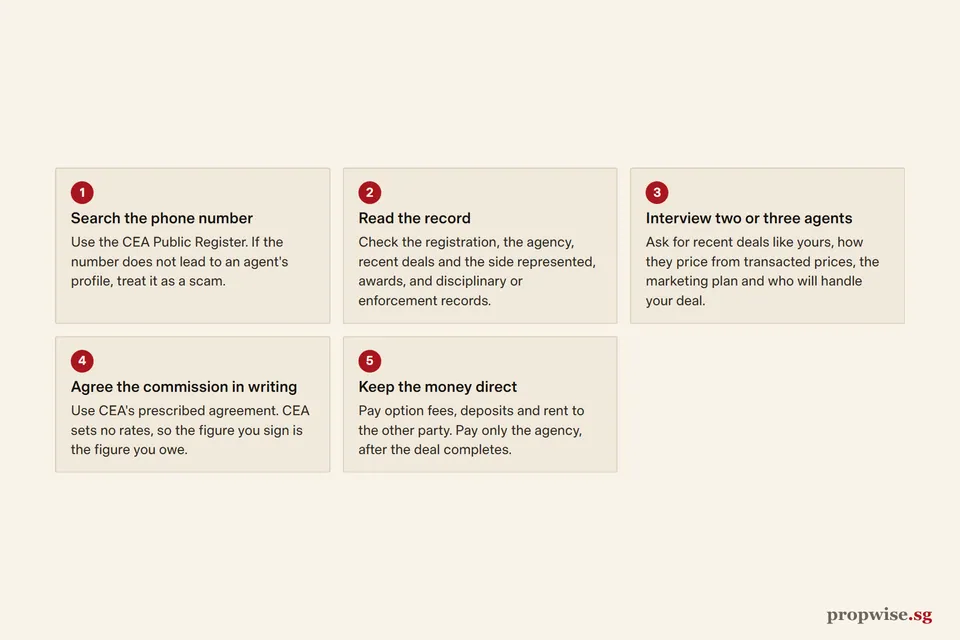
CEA says there are no fixed commission rates. You agree the figure with the agency in writing before work starts. An agent cannot collect commission from both buyer and seller, and should not handle your option fee or deposit. Our agent guide shows how to check and compare quotes.
Tenants can use the same preparation. With 6.4% of completed private homes vacant, an offer below the asking rent, or a request for repairs, is normal practice. See our renting guide.
Latest: Vacancy 6.4% (Q2 2026).
Vacancy is calculated as vacant units divided by units available, using URA counts of completed private homes (landed and non-landed).
Table view
| Period | Private homes vacant (%) |
|---|---|
| Q2 2026 | 6.4% |
| Q1 2026 | 6.2% |
| Q4 2025 | 6.0% |
| Q3 2025 | 6.9% |
| Q2 2025 | 7.1% |
| Q1 2025 | 6.5% |
| Q4 2024 | 6.6% |
| Q3 2024 | 7.2% |
| Q2 2024 | 6.1% |
| Q1 2024 | 6.8% |
| Q4 2023 | 8.1% |
| Q3 2023 | 8.4% |
| Q2 2023 | 6.3% |
| Q1 2023 | 6.0% |
| Q4 2022 | 5.5% |
| Q3 2022 | 5.7% |
| Q2 2022 | 5.4% |
| Q1 2022 | 5.3% |
| Q4 2021 | 6.0% |
| Q3 2021 | 6.4% |
| Q2 2021 | 6.3% |
| Q1 2021 | 6.4% |
| Q4 2020 | 7.0% |
| Q3 2020 | 6.2% |
| Q2 2020 | 5.4% |
| Q1 2020 | 5.4% |
| Q4 2019 | 5.5% |
| Q3 2019 | 6.1% |
| Q2 2019 | 6.4% |
| Q1 2019 | 6.3% |
| Q4 2018 | 6.4% |
| Q3 2018 | 6.8% |
| Q2 2018 | 7.1% |
| Q1 2018 | 7.4% |
| Q4 2017 | 7.8% |
| Q3 2017 | 8.4% |
| Q2 2017 | 8.1% |
| Q1 2017 | 8.1% |
| Q4 2016 | 8.4% |
| Q3 2016 | 8.7% |
| Q2 2016 | 8.9% |
| Q1 2016 | 7.5% |
| Q4 2015 | 8.1% |
| Q3 2015 | 7.8% |
| Q2 2015 | 7.9% |
| Q1 2015 | 7.2% |
| Q4 2014 | 7.8% |
| Q3 2014 | 7.1% |
| Q2 2014 | 7.1% |
| Q1 2014 | 6.6% |
| Q4 2013 | 6.2% |
| Q3 2013 | 6.1% |
| Q2 2013 | 5.6% |
| Q1 2013 | 5.2% |
| Q4 2012 | 5.4% |
| Q3 2012 | 6.1% |
| Q2 2012 | 5.9% |
| Q1 2012 | 6.0% |
| Q4 2011 | 5.9% |
| Q3 2011 | 5.8% |
| Q2 2011 | 5.1% |
| Q1 2011 | 4.9% |
| Q4 2010 | 5.0% |
| Q3 2010 | 5.2% |
| Q2 2010 | 5.4% |
| Q1 2010 | 4.6% |
| Q4 2009 | 5.0% |
| Q3 2009 | 6.2% |
| Q2 2009 | 5.9% |
| Q1 2009 | 5.9% |
| Q4 2008 | 6.1% |
| Q3 2008 | 5.8% |
| Q2 2008 | 6.1% |
| Q1 2008 | 6.3% |
| Q4 2007 | 5.6% |
| Q3 2007 | 5.4% |
| Q2 2007 | 4.9% |
| Q1 2007 | 5.1% |
| Q4 2006 | 6.1% |
| Q3 2006 | 6.6% |
| Q2 2006 | 6.5% |
| Q1 2006 | 7.4% |
| Q4 2005 | 8.4% |
| Q3 2005 | 8.5% |
| Q2 2005 | 8.7% |
| Q1 2005 | 8.8% |
| Q4 2004 | 8.1% |
| Q3 2004 | 8.5% |
| Q2 2004 | 8.3% |
| Q1 2004 | 8.4% |
| Q4 2003 | 7.7% |
| Q3 2003 | 8.1% |
| Q2 2003 | 7.6% |
| Q1 2003 | 7.6% |
| Q4 2002 | 8.5% |
| Q3 2002 | 8.1% |
| Q2 2002 | 8.3% |
| Q1 2002 | 7.6% |
| Q4 2001 | 8.2% |
| Q3 2001 | 7.6% |
| Q2 2001 | 7.1% |
| Q1 2001 | 6.5% |
| Q4 2000 | 6.9% |
| Q3 2000 | 7.9% |
| Q2 2000 | 9.1% |
| Q1 2000 | 8.5% |
Bottom line
Preparation beats performance. Check comparables, learn the valuation or tax figure that limits the other side, and know your own walk-away number before the first viewing. This article explains how negotiation works. It is not advice on any particular purchase or sale.