Why I’ve Not Lost Money in 13 Years –Understanding the Time Value of Money and IRR
This post requires a basic understanding of using a financial calculator. Explaining how to use it is beyond the scope of this post as I don’t want to turn…
There is a newer guide. This article is from 2014. Read the updated 2026 version →
By Gerald Tay (guest contributor)
This post requires a basic understanding of using a financial calculator. Explaining how to use it is beyond the scope of this post as I don’t want to turn it into a bed-time lullaby if you’re one of those who has never touched a financial (not scientific) calculator. It’s impossible to learn math by reading!
Rather, I’ll try to explain in layman terms so you can grasp the basics of what Internal Rate of Return (IRR) and Time Value of Money are, respectively, as well as why they are essential for property investment.
Tip: Cash flows are worth more today than they are tomorrow.
One reason why I’ve not lost money in 13 years
The Internal Rate of Return (IRR) is arguably the most holistic measure of an investment property’s return potential. That said, many investors fail to utilize this key metric, or underestimate its utility in measuring value.
But don’t feel relatively uninformed if you don’t. I took courses in Financial Analysis and Investment in the mid-2000s. The Time Value of Money and Internal Rate of Return (IRR) was one of the topics covered.
I flunked my Math!
I’ve always been a B/C Math student in school. I received a ‘C’ grade for ‘Additional Mathematics’ for my ‘O’ levels. At 17, I dropped out of Engineering School because I flunked each of my Engineering Math subjects (I prefer to write and speak rather than fix things up anyway).
My point is – you would have been a better math student than me. You don’t need to be a Math genius to understand what I’m going to tell you. All you need is to understand basic principles and how to input a few numbers into a financial calculator – and voila!
Internal Rate of Return (IRR) is an extremely powerful valuation metric for property investment, and have been successfully applying it for a while. But few of those who use the Internal Rate of Return (IRR) in the real estate industry know how to use it as a powerful valuation tool. A property investor can be a real estate professional but a real estate professional may not be a real investor.
In this post I will address the following:
- Internal Rate of Return (IRR)
- Net Present Value (NPV)
- Modified Internal Rate of Return (MIRR)
Internal Rate of Return (IRR)
The Internal Rate of Return is the interest rate that brings the Net Present Value of all future cash flow to zero.
Here’s a hypothetical example:
For every $100 you lend to a friend, he’ll repay you $10 per year – forever and ever!
How much do you get every year in percentage terms? $10 divided by$100 equals10%.
This 10% is called the Rate of Return.
But be careful; this is NOT yet the Internal Rate of Return.
This 10% rate of return tells you how quickly you get your money back in exactly 1 year – compared to your original $100.
It was very easy to find the rate of return of 10%.
Now….
What if your friend pays you back a different amount every year? In some years, he pays $20, in other years he might pay only $5. And in some years he doesn’t pay! And what if it’s not forever? What if it’s exactly 7 years?
The rate of return is now ‘hidden’, and is called the Internal Rate of Return (IRR)
In layman terms: The Internal Rate of Return is a good way of judging an investment. The bigger the better!
When using the IRR to measure the performance or do a valuation of a property investment, the investor must establish a target yield over a period of time, and then project the year-over-year performance of the three key return components of a real estate investment: amortization, appreciation and cash flow.
Tip: The 3 key components of property investment are Amortisation, Appreciation and Cash Flow.
Running these numbers on a financial calculator will solve for IRR and provide valuable insight into the strength of a particular investment.
Why is the IRR important?
The IRR is important because it tells you exactly how hard your money is working for you. It is not misleading like many other measures of rate of return.
Novice Investors use ‘average return’ in their vocabulary. The Master Investor uses IRR to evaluate the real performance of his investment.
Let’s illustrate how an alternative such as the ‘average rate of return’ can be extremely misleading.
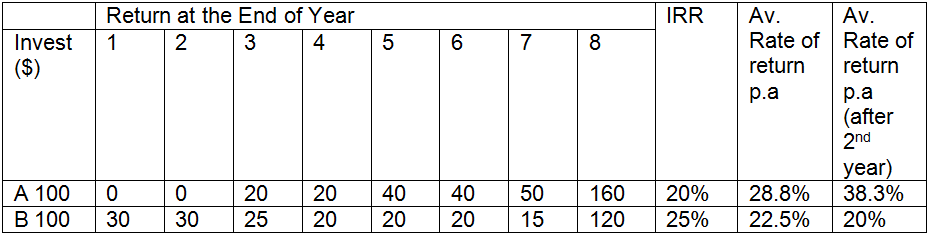
Year 8: 60 + 100 (initial investment) = 160
Year 8: 20 + 100 (initial investment) = 120
In Investment A, the average rate of return p.a. over the investment period is 28.8% i.e. (0+0+20+20+40 +40+50+60)/8.
But in Investment B, it is only 22.5%. Yet, the Internal Rate of Return (IRR) is higher in investment B than in A (25% versus 20%). Funds invested are working harder in investment B. The reason is that the bulk of returns are received earlier.
Even more misleading is when sales prospectuses report an average rate of return for only part of an investment’s life. In investment A, some prospectuses might state the average rate of return p.a. after the second year is 38.3% (20+20+40+40+50+60)/6)! This is a way of excluding the zero cash flows from years 1 and 2 in an attempt to improve the appearance of returns.
In an extreme example, the rate of return in some timber plantation investments is very high in year 25 when trees are harvested. But there is no income in the first 24 years! An IRR is essential to get a real perspective on the rate of return.
Tip: In real estate investment, returns in the early years are more important than returns in the later years.
Be wary of published rates of returns
So, beware of investments which show high rates of return in the later years and publish these figures (and not IRRs) in sales prospectuses. Always use the IRR for the most accurate indication of returns.
The Losing Investor will say, “I’m still making money in investment A even though the IRR is lower. So why should I care about IRR?”
That’s why the Losing Investor makes ‘mediocre’ returns, while The Master Investor makes ‘extraordinary’ returns. The difference here is about first having the right ‘mentality’ to make money, and not the other way round!
This is one reason why I repeatedly mentioned how buying off-plan properties as investments (uncompleted/new launch) can be an expensive gamble. The first 3 to 4 years have zero cash flows. After construction is completed, the performance of the property is highly questionable as too many optimistic assumptions from the time of purchase seldom materialise eventually.
If we measure our IRR from buying a re-sale property instead, we’ll easily find that our returns are a better (or safer) bet than that of a new property.
Tip: The IRR will tell you exactly how hard your money is working for you, irrespective of the pattern of income distribution over time. No other measure of return will do this.
Concluding Comments
The IRR has been a popular metric for evaluating investments for many years — primarily due to the simplicity with which it can be interpreted. However, the IRR suffers from a couple of flaws.
The most important flaw is that it implicitly assumes that the cash flows will be reinvested for the life of the investment at a rate that equals the IRR. A good project may have an IRR that is considerably greater than any reasonable reinvestment assumption. Therefore, the IRR can be misleading at times.
The Modified Rate of Return (MIRR) and Net Present Value (NPV)solves this problem by using an explicit reinvestment rate (i.e. bank deposits). We will cover these in a future article.
By guest contributor Gerald Tay, who is the founder and coach at CREI Academy Group Pte Ltd, an organization dedicated to empowering retail property investors with smarter investing philosophy and strategies. He is a full-time investor with over 13 years of solid experience in building his wealth through Property Investment and is financially wealthy today.