Should You Rent or Buy a Property in Singapore in 2026? 7 Factors
Rent or buy in Singapore in 2026? Seven factors, with HDB and condo cost comparisons at today's rates, the break-even period, and when renting wins.
If you are a Singapore citizen who qualifies for an HDB flat and plans to stay put for years, buying usually costs far less each year than renting. For private property, the answer is closer. At 2026’s low mortgage rates, owning a condo costs less per year than renting the same unit. At 2023’s rates, it did not. And the upfront stamp duty takes three to four years to earn back. Your time horizon, your eligibility and interest rates decide it.
At a glance
- HDB example: owning a S$640,000 4-room flat costs about S$16,500 a year in interest and forgone CPF interest. Renting a similar flat costs about S$38,400.
- Condo example (illustrative): owning a S$1.8 million condo costs about S$42,800 a year at a 1.8% mortgage rate, against S$60,000 in rent. At 3.8%, owning costs about S$69,800.
- Break-even: the S$59,600 Buyer’s Stamp Duty on that condo takes about three and a half years of savings to recover. Selling within four years also triggers Seller’s Stamp Duty. If you may leave within four years, renting is usually cheaper.
- Foreigners pay 60% ABSD and cannot buy HDB flats, so renting usually wins for them.
- The rental market is calm: URA’s rental index rose 1.3% quarter-on-quarter in Q3 2026, and private vacancy is 7.2%.
Factor 1: how much cash do you need up front?
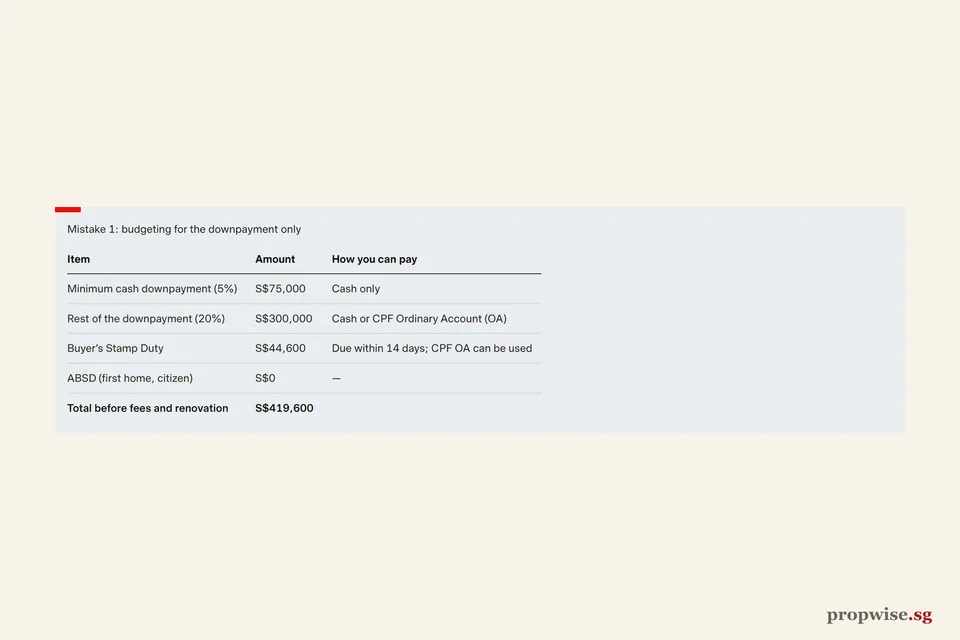
Renting needs a security deposit and perhaps an agent fee. Buying needs much more. The downpayment is 25% of the price (at least 5% in cash on a bank loan), plus Buyer’s Stamp Duty within 14 days. On a S$1.8 million condo, that is S$450,000 of downpayment and S$59,600 of BSD for a first-time citizen buyer. If finding that money would empty your emergency fund, renting is the right answer for now. Our guide to saving for a downpayment shows how to build it.
Factor 2: what does each option really cost a year?
“Rent is dead money” is only half true. Some of a mortgage payment is dead money too. Compare the unrecoverable costs:
- Renting: all of the rent.
- Owning: mortgage interest, property tax, maintenance and repairs, and the return you give up on your downpayment. The principal you repay counts as saving, which you get back when you sell (if prices hold).
HDB example. The median 4-room resale flat in Sengkang sold for about S$640,000 in April to September 2026. The median rent for a 4-room flat there was S$3,200 a month in Q2 2026.
| Yearly cost | Own (HDB loan of S$480,000 at 2.6%) | Rent |
|---|---|---|
| Interest (first year, approx.) | S$12,480 | — |
| Forgone CPF interest on S$160,000 downpayment (2.5%) | S$4,000 | — |
| Rent | — | S$38,400 |
| Total (before tax, conservancy charges and repairs) | about S$16,500 | S$38,400 |
The HDB loan rate is 2.6%, and CPF OA pays 2.5%. Even after property tax, service and conservancy charges and repairs, owning is far cheaper. This is why almost no eligible family rents an HDB flat long term by choice.
S$ a year, before tax, conservancy charges and repairs
Source: HDB resale prices (data.gov.sg) (September 2026); HDB rental data (data.gov.sg) (Q2 2026). Own = first-year interest on an HDB loan of S$480,000 at 2.6% plus forgone CPF interest at 2.5% on a S$160,000 downpayment.
Condo example (illustrative numbers). Say a S$1.8 million condo rents for S$5,000 a month, and you would borrow 75% (S$1.35 million):
| Yearly cost | Own at 1.8% | Own at 3.8% | Rent |
|---|---|---|---|
| Interest (first year, approx.) | S$24,300 | S$51,300 | — |
| Property tax (owner-occupied, annual value S$60,000, after 2026 rebate) | S$2,448 | S$2,448 | — |
| Maintenance fees (assumed S$400 a month) | S$4,800 | S$4,800 | — |
| Forgone return on S$450,000 downpayment (2.5%) | S$11,250 | S$11,250 | — |
| Rent | — | — | S$60,000 |
| Total | S$42,798 | S$69,798 | S$60,000 |
S$ a year (interest, property tax, maintenance and forgone return on the downpayment)
Source: IRAS, property tax rates (October 2026); The Business Times, mortgage rates after the Fed hike (2 October 2026). Illustrative numbers from the guide, not a quote.
Property tax is S$2,720 at the owner-occupier rates, less the 2026 rebate of 10%, capped at S$500. 3-month SORA was about 1.36% on 13 Nov 2026. After the US Federal Reserve raised rates on 16 September 2026, floating packages rose to about 1.5–1.8% and fixed packages to about 2.0–2.2% (The Business Times, 2 October 2026; CNA, 18 September 2026). We use 1.8% to be conservative. SORA was above 3.5% in 2023. The interest rate swings the answer. Try your own figures in the Propwise mortgage calculator.
- 3-month compounded SORA (Singapore)
- US federal funds rate (effective)
Latest: SORA 1.36% (13 Nov 2026); Fed 3.88% (13 Nov 2026).
SORA is the benchmark for floating-rate home loans in Singapore. The US rate is shown for context: it moves SORA only indirectly, through the Singapore dollar and bank funding costs.
Table view
| Period | 3-month compounded SORA (Singapore) | US federal funds rate (effective) |
|---|---|---|
| Nov 2026 | 1.36% | 3.88% |
| Oct 2026 | 1.30% | 3.88% |
| Sep 2026 | 1.23% | 3.88% |
| Aug 2026 | 1.18% | 3.63% |
| Jul 2026 | 1.14% | 3.63% |
| Jun 2026 | 1.08% | 3.63% |
| May 2026 | 1.06% | 3.62% |
| Apr 2026 | 1.03% | 3.64% |
| Mar 2026 | 1.07% | 3.64% |
| Feb 2026 | 1.12% | 3.64% |
| Jan 2026 | 1.15% | 3.64% |
| Dec 2025 | 1.19% | 3.64% |
| Nov 2025 | 1.25% | 3.89% |
| Oct 2025 | 1.32% | 4.11% |
| Sep 2025 | 1.46% | 4.09% |
| Aug 2025 | 1.56% | 4.33% |
| Jul 2025 | 1.86% | 4.33% |
| Jun 2025 | 2.06% | 4.33% |
| May 2025 | 2.27% | 4.33% |
| Apr 2025 | 2.40% | 4.33% |
| Mar 2025 | 2.55% | 4.33% |
| Feb 2025 | 2.73% | 4.33% |
| Jan 2025 | 2.90% | 4.33% |
| Dec 2024 | 3.08% | 4.33% |
| Nov 2024 | 3.21% | 4.58% |
| Oct 2024 | 3.39% | 4.83% |
| Sep 2024 | 3.49% | 4.83% |
| Aug 2024 | 3.57% | 5.33% |
| Jul 2024 | 3.64% | 5.33% |
| Jun 2024 | 3.63% | 5.33% |
| May 2024 | 3.66% | 5.33% |
| Apr 2024 | 3.65% | 5.33% |
| Mar 2024 | 3.68% | 5.33% |
| Feb 2024 | 3.64% | 5.33% |
| Jan 2024 | 3.66% | 5.33% |
| Dec 2023 | 3.70% | 5.33% |
| Nov 2023 | 3.75% | 5.33% |
| Oct 2023 | 3.75% | 5.33% |
| Sep 2023 | 3.70% | 5.33% |
| Aug 2023 | 3.70% | 5.33% |
| Jul 2023 | 3.68% | 5.33% |
| Jun 2023 | 3.65% | 5.07% |
| May 2023 | 3.61% | 5.08% |
| Apr 2023 | 3.61% | 4.83% |
| Mar 2023 | 3.58% | 4.83% |
| Feb 2023 | 3.23% | 4.58% |
| Jan 2023 | 3.12% | 4.33% |
| Dec 2022 | 3.03% | 4.33% |
| Nov 2022 | 2.87% | 3.83% |
| Oct 2022 | 2.45% | 3.08% |
| Sep 2022 | 2.07% | 3.08% |
| Aug 2022 | 1.55% | 2.33% |
| Jul 2022 | 1.27% | 2.32% |
| Jun 2022 | 0.72% | 1.58% |
| May 2022 | 0.52% | 0.83% |
| Apr 2022 | 0.32% | 0.33% |
| Mar 2022 | 0.27% | 0.33% |
| Feb 2022 | 0.25% | 0.08% |
| Jan 2022 | 0.20% | 0.08% |
| Dec 2021 | 0.19% | 0.08% |
| Nov 2021 | 0.16% | 0.08% |
| Oct 2021 | 0.16% | 0.07% |
| Sep 2021 | 0.13% | 0.08% |
| Aug 2021 | 0.13% | 0.08% |
| Jul 2021 | 0.13% | 0.10% |
| Jun 2021 | 0.14% | 0.10% |
| May 2021 | 0.17% | 0.05% |
| Apr 2021 | 0.19% | 0.07% |
| Mar 2021 | 0.23% | 0.07% |
| Feb 2021 | 0.20% | 0.07% |
| Jan 2021 | 0.17% | 0.07% |
| Dec 2020 | 0.17% | 0.09% |
| Nov 2020 | 0.12% | 0.08% |
| Oct 2020 | 0.12% | 0.09% |
| Sep 2020 | 0.10% | 0.09% |
| Aug 2020 | 0.10% | 0.09% |
| Jul 2020 | 0.08% | 0.09% |
| Jun 2020 | 0.14% | 0.08% |
| May 2020 | 0.27% | 0.05% |
| Apr 2020 | 0.53% | 0.05% |
| Mar 2020 | 0.90% | 0.10% |
| Feb 2020 | 1.14% | 1.58% |
| Jan 2020 | 1.20% | 1.55% |
| Dec 2019 | 1.27% | 1.55% |
| Nov 2019 | 1.31% | 1.55% |
| Oct 2019 | 1.46% | 1.83% |
| Sep 2019 | 1.53% | 1.83% |
| Aug 2019 | 1.59% | 2.12% |
| Jul 2019 | 1.67% | 2.40% |
| Jun 2019 | 1.72% | 2.40% |
| May 2019 | 1.68% | 2.38% |
| Apr 2019 | 1.62% | 2.44% |
| Mar 2019 | 1.54% | 2.43% |
| Feb 2019 | 1.59% | 2.40% |
| Jan 2019 | 1.52% | 2.40% |
Source: MAS, FRED. Data to 13 Nov 2026.
Factor 3: how long will you stay?
Buying has a fixed entry cost that renting avoids. In the condo example, BSD alone is S$59,600, before legal fees. At 1.8% interest, owning saves about S$17,200 a year against renting, so it takes about three and a half years just to earn back the stamp duty. Selling costs, such as agent commission (which is negotiable), add more.
Zillow’s Spencer Rascoff and Stan Humphries call this the “buy-rent breakeven horizon” in their book Zillow Talk: the number of years before buying beats renting the same home.
Your horizon depends on the price, the rent, the rate and the entry costs. A low rate shortens it. A high rate can stretch it past a decade.
Then there is the Seller’s Stamp Duty. For homes bought from 4 July 2025, it is 16% / 12% / 8% / 4% if you sell within four years. A forced sale in year two would cost 12% of the price. If a job move, a posting overseas or a change in family plans is likely within four years, renting is usually the cheaper and safer choice.
% of the price
Source: MAS, SSD holding period and higher SSD rates (July 2025). No SSD after four years.
Factor 4: can you count on capital gains?
Owners benefit when prices rise, and leverage magnifies that gain. It also magnifies losses. If that S$1.8 million condo fell 10%, the S$180,000 loss would wipe out 40% of a S$450,000 downpayment. Recent data are mixed. Private prices rose 1.4% in Q3 2026 (URA flash). HDB resale prices dipped for a third straight quarter. And 99-year leases lose value as they age, especially in the later decades. Treat appreciation as a possible bonus. The yearly costs should work without it.
- Private homes (URA price index)
- HDB resale flats (HDB Resale Price Index)
- Policy measures (select one for details)
Latest: Private 222.5 (Q3 2026), up 3.4% on Q3 2025; HDB 202.5 (Q3 2026), down 0.6% on Q3 2025.
Table view
| Period | Private homes (URA price index) | HDB resale flats (HDB Resale Price Index) |
|---|---|---|
| Q3 2026 | 222.5 | 202.5 |
| Q2 2026 | 219.4 | 202.8 |
| Q1 2026 | 218.3 | 203.4 |
| Q4 2025 | 216.4 | 203.6 |
| Q3 2025 | 215.1 | 203.7 |
| Q2 2025 | 213.2 | 202.9 |
| Q1 2025 | 211.1 | 201.0 |
| Q4 2024 | 209.4 | 197.9 |
| Q3 2024 | 204.7 | 192.9 |
| Q2 2024 | 206.1 | 187.9 |
| Q1 2024 | 204.3 | 183.7 |
| Q4 2023 | 201.5 | 180.4 |
| Q3 2023 | 196.0 | 178.5 |
| Q2 2023 | 194.4 | 176.2 |
| Q1 2023 | 194.8 | 173.6 |
| Q4 2022 | 188.6 | 171.9 |
| Q3 2022 | 187.8 | 168.1 |
| Q2 2022 | 180.9 | 163.9 |
| Q1 2022 | 174.8 | 159.5 |
| Q4 2021 | 173.6 | 155.7 |
| Q3 2021 | 165.3 | 150.6 |
| Q2 2021 | 163.5 | 146.4 |
| Q1 2021 | 162.2 | 142.2 |
| Q4 2020 | 157.0 | 138.1 |
| Q3 2020 | 153.8 | 133.9 |
| Q2 2020 | 152.6 | 131.9 |
| Q1 2020 | 152.1 | 131.5 |
| Q4 2019 | 153.6 | 131.5 |
| Q3 2019 | 152.8 | 130.9 |
| Q2 2019 | 150.8 | 130.8 |
| Q1 2019 | 148.6 | 131.0 |
| Q4 2018 | 149.6 | 131.4 |
| Q3 2018 | 149.7 | 131.6 |
| Q2 2018 | 149.0 | 131.7 |
| Q1 2018 | 144.1 | 131.6 |
| Q4 2017 | 138.7 | 132.6 |
| Q3 2017 | 137.6 | 132.8 |
| Q2 2017 | 136.6 | 133.7 |
| Q1 2017 | 136.7 | 133.9 |
| Q4 2016 | 137.2 | 134.6 |
| Q3 2016 | 137.9 | 134.7 |
| Q2 2016 | 140.0 | 134.7 |
| Q1 2016 | 140.6 | 134.7 |
| Q4 2015 | 141.6 | 134.8 |
| Q3 2015 | 142.3 | 134.6 |
| Q2 2015 | 144.2 | 135.0 |
| Q1 2015 | 145.5 | 135.6 |
| Q4 2014 | 147.0 | 137.0 |
| Q3 2014 | 148.6 | 139.1 |
| Q2 2014 | 149.7 | 141.5 |
| Q1 2014 | 151.3 | 143.5 |
| Q4 2013 | 153.2 | 145.8 |
| Q3 2013 | 154.6 | 148.1 |
| Q2 2013 | 154.0 | 149.4 |
| Q1 2013 | 152.4 | 148.6 |
| Q4 2012 | 151.5 | 146.7 |
| Q3 2012 | 148.8 | 143.1 |
| Q2 2012 | 147.9 | 140.3 |
| Q1 2012 | 147.2 | 138.5 |
| Q4 2011 | 147.4 | 137.7 |
| Q3 2011 | 147.0 | 135.4 |
| Q2 2011 | 145.1 | 130.4 |
| Q1 2011 | 142.3 | 126.4 |
| Q4 2010 | 139.2 | 124.4 |
| Q3 2010 | 135.5 | 121.3 |
| Q2 2010 | 131.7 | 116.6 |
| Q1 2010 | 125.1 | 112.1 |
| Q4 2009 | 118.4 | 109.0 |
| Q3 2009 | 110.3 | 105.0 |
| Q2 2009 | 95.3 | 101.4 |
| Q1 2009 | 100.0 | 100.0 |
| Q4 2008 | 116.4 | 100.8 |
| Q3 2008 | 123.9 | 99.4 |
| Q2 2008 | 126.9 | 95.4 |
| Q1 2008 | 126.7 | 91.3 |
| Q4 2007 | 122.1 | 88.0 |
| Q3 2007 | 114.4 | 83.2 |
| Q2 2007 | 105.6 | 78.1 |
| Q1 2007 | 97.6 | 75.8 |
| Q4 2006 | 93.1 | 74.9 |
| Q3 2006 | 89.6 | 74.2 |
| Q2 2006 | 87.3 | 74.3 |
| Q1 2006 | 85.8 | 73.6 |
| Q4 2005 | 84.5 | 73.5 |
| Q3 2005 | 83.3 | 73.2 |
| Q2 2005 | 82.3 | 73.5 |
| Q1 2005 | 81.9 | 77.2 |
| Q4 2004 | 81.3 | 77.1 |
| Q3 2004 | 80.7 | 76.3 |
| Q2 2004 | 80.4 | 76.2 |
| Q1 2004 | 80.3 | 75.3 |
| Q4 2003 | 80.6 | 75.1 |
| Q3 2003 | 80.7 | 74.3 |
| Q2 2003 | 81.1 | 72.5 |
| Q1 2003 | 81.6 | 71.0 |
| Q4 2002 | 82.3 | 69.9 |
| Q3 2002 | 82.6 | 69.9 |
| Q2 2002 | 82.2 | 69.2 |
| Q1 2002 | 82.8 | 69.1 |
| Q4 2001 | 83.8 | 69.6 |
| Q3 2001 | 87.6 | 70.6 |
| Q2 2001 | 90.3 | 72.1 |
| Q1 2001 | 91.1 | 73.2 |
| Q4 2000 | 94.9 | 75.8 |
| Q3 2000 | 97.6 | 77.6 |
| Q2 2000 | 100.4 | 79.3 |
| Q1 2000 | 98.9 | 80.3 |
| Q4 1999 | 95.9 | 79.8 |
| Q3 1999 | 91.1 | 78.1 |
| Q2 1999 | 84.3 | 72.2 |
| Q1 1999 | 75.4 | 71.2 |
Policy measures marked on this chart (23)
- 2025-07-03 Seller's Stamp Duty holding period back to four years, rates raised by 4 pp
- 2024-08-19 HDB loan LTV cut to 75% and Enhanced CPF Housing Grant raised
- 2023-04-26 ABSD rates raised, April 2023
- 2023-02-14 CPF Housing Grant raised for first-time resale buyers, Budget 2023
- 2023-02-14 Buyer's Stamp Duty raised for higher-value properties, Budget 2023
- 2022-09-29 Property measures, September 2022: higher TDSR and MSR rate floor, HDB loan LTV 80%, 15-month wait-out
- 2021-12-15 Property cooling measures, December 2021: higher ABSD, TDSR 55%, HDB loan LTV 85%
- 2018-07-05 Property cooling measures, July 2018: higher ABSD and lower LTV limits
- 2018-02-19 Budget 2018: Proximity Housing Grant enhanced
- 2018-02-19 Budget 2018: top BSD rate raised to 4% above S$1m
- 2017-03-10 SSD holding period cut to 3 years; TDSR relaxed for equity withdrawal
- 2013-08-27 HDB loan and resale measures, August 2013
- 2013-06-28 MAS introduces the Total Debt Servicing Ratio (TDSR) framework
- 2013-01-11 Property cooling measures, January 2013
- 2012-10-05 Maximum loan tenure of 35 years and tighter LTV limits, October 2012
- 2011-12-07 Additional Buyer's Stamp Duty introduced, December 2011
- 2011-01-13 Property cooling measures, January 2011
- 2010-08-30 HDB measures after National Day Rally 2010: DBSS income ceiling, 5-year MOP for non-subsidised flats
- 2010-08-30 Property cooling measures, August 2010
- 2010-02-19 Seller's Stamp Duty introduced and LTV limit cut to 80%, February 2010
- 2009-09-14 Interest-only loans and Interest Absorption Scheme disallowed, September 2009
- 2005-07-19 Property policy review, July 2005: LTV limit raised to 90%, CPF housing rules eased, foreign ownership rules eased
- 2001-10-12 Second off-budget package, October 2001: property tax rebate, stamp duty cut, gains tax removed, land sales eased
Source: URA, HDB. Data to Q3 2026.
Factor 5: what do your eligibility, subsidies and taxes allow?
Your status changes the answer more than any other factor:
% of the price
Source: IRAS, Additional Buyer's Stamp Duty (October 2026). Permanent residents: first home. Citizens: second home. Foreigners: any home.
- Citizens buying HDB flats get subsidised BTO prices or resale grants. A first-timer family buying resale can get up to S$230,000. That tilts the decision strongly towards buying.
- Permanent residents pay 5% ABSD on a first home. They can buy a resale HDB flat only after all household members have been PRs for three years.
- Foreigners pay 60% ABSD on any home and cannot buy HDB flats. For most of them, renting wins outright.
- Existing owners pay 20% ABSD (for citizens) on a second home. “Rent where you live, own where you can afford” can therefore get expensive.
Factor 6: which suits your age and way of life?
Renting lets you move for a new job, a new school or a better deal, and the landlord pays for most major repairs. Owning lets you renovate, keep a pet and stay as long as you like. No landlord can sell the home from under you.
Age and stage shift the balance. A young professional who may be posted abroad values the freedom to leave. A family with school-going children values staying put. Near retirement, a home that is fully paid for removes the largest monthly bill.
Feelings count too, and a spreadsheet struggles to price them. Many Singaporeans link marriage with “settling down” in a home of their own, done up to their taste. That is a fair reason to buy, as long as the numbers in Factors 1 to 3 still work.
Some people buy and rent at the same time. They buy where they can afford and let it out, and rent near work. Check the rules first. Rental income is taxable. A home you do not live in pays non-owner-occupier property tax from 12% of annual value. HDB owners can rent out a whole Standard flat only after the minimum occupation period and with approval. Owners of Plus and Prime flats can never rent out the whole flat.
Factor 7: where are interest rates and rents heading?
Rates move the answer more than prices do. With packages at about 1.5–2.2%, a mortgage is still cheap to carry, but rates have started to rise again. Banks must still test your loan at 4% under the TDSR, and you should test your own budget at about that level too. On the other side, rents are steady. URA’s rental index rose 1.3% quarter-on-quarter in Q3 2026, and private vacancy was 7.2%, so tenants have choice and room to negotiate.
- Prices (URA price index)
- Rents (URA rental index)
Latest: Prices 222.5 (Q3 2026), up 3.4% on Q3 2025; Rents 164.6 (Q3 2026), up 1.8% on Q3 2025.
Table view
| Period | Prices (URA price index) | Rents (URA rental index) |
|---|---|---|
| Q3 2026 | 222.5 | 164.6 |
| Q2 2026 | 219.4 | 162.5 |
| Q1 2026 | 218.3 | 161.4 |
| Q4 2025 | 216.4 | 160.9 |
| Q3 2025 | 215.1 | 161.7 |
| Q2 2025 | 213.2 | 159.8 |
| Q1 2025 | 211.1 | 158.5 |
| Q4 2024 | 209.4 | 157.9 |
| Q3 2024 | 204.7 | 157.9 |
| Q2 2024 | 206.1 | 156.6 |
| Q1 2024 | 204.3 | 157.9 |
| Q4 2023 | 201.5 | 161.0 |
| Q3 2023 | 196.0 | 164.5 |
| Q2 2023 | 194.4 | 163.2 |
| Q1 2023 | 194.8 | 158.8 |
| Q4 2022 | 188.6 | 148.1 |
| Q3 2022 | 187.8 | 137.9 |
| Q2 2022 | 180.9 | 127.0 |
| Q1 2022 | 174.8 | 119.0 |
| Q4 2021 | 173.6 | 114.2 |
| Q3 2021 | 165.3 | 111.3 |
| Q2 2021 | 163.5 | 109.3 |
| Q1 2021 | 162.2 | 106.2 |
| Q4 2020 | 157.0 | 103.9 |
| Q3 2020 | 153.8 | 103.8 |
| Q2 2020 | 152.6 | 104.3 |
| Q1 2020 | 152.1 | 105.6 |
| Q4 2019 | 153.6 | 104.5 |
| Q3 2019 | 152.8 | 105.6 |
| Q2 2019 | 150.8 | 105.5 |
| Q1 2019 | 148.6 | 104.1 |
| Q4 2018 | 149.6 | 103.1 |
| Q3 2018 | 149.7 | 104.1 |
| Q2 2018 | 149.0 | 103.8 |
| Q1 2018 | 144.1 | 102.8 |
| Q4 2017 | 138.7 | 102.5 |
| Q3 2017 | 137.6 | 103.4 |
| Q2 2017 | 136.6 | 103.4 |
| Q1 2017 | 136.7 | 103.6 |
| Q4 2016 | 137.2 | 104.5 |
| Q3 2016 | 137.9 | 105.6 |
| Q2 2016 | 140.0 | 106.9 |
| Q1 2016 | 140.6 | 107.5 |
| Q4 2015 | 141.6 | 108.9 |
| Q3 2015 | 142.3 | 110.3 |
| Q2 2015 | 144.2 | 111.0 |
| Q1 2015 | 145.5 | 112.2 |
| Q4 2014 | 147.0 | 114.1 |
| Q3 2014 | 148.6 | 115.2 |
| Q2 2014 | 149.7 | 116.1 |
| Q1 2014 | 151.3 | 116.8 |
| Q4 2013 | 153.2 | 117.6 |
| Q3 2013 | 154.6 | 118.2 |
| Q2 2013 | 154.0 | 117.9 |
| Q1 2013 | 152.4 | 117.6 |
| Q4 2012 | 151.5 | 116.6 |
| Q3 2012 | 148.8 | 115.9 |
| Q2 2012 | 147.9 | 114.8 |
| Q1 2012 | 147.2 | 114.5 |
| Q4 2011 | 147.4 | 114.2 |
| Q3 2011 | 147.0 | 113.7 |
| Q2 2011 | 145.1 | 112.8 |
| Q1 2011 | 142.3 | 111.4 |
| Q4 2010 | 139.2 | 110.0 |
| Q3 2010 | 135.5 | 107.2 |
| Q2 2010 | 131.7 | 103.5 |
| Q1 2010 | 125.1 | 97.7 |
| Q4 2009 | 118.4 | 93.3 |
| Q3 2009 | 110.3 | 92.8 |
| Q2 2009 | 95.3 | 94.8 |
| Q1 2009 | 100.0 | 100.0 |
| Q4 2008 | 116.4 | 109.3 |
| Q3 2008 | 123.9 | 115.5 |
| Q2 2008 | 126.9 | 116.5 |
| Q1 2008 | 126.7 | 113.6 |
| Q4 2007 | 122.1 | 107.2 |
| Q3 2007 | 114.4 | 100.4 |
| Q2 2007 | 105.6 | 90.1 |
| Q1 2007 | 97.6 | 81.6 |
| Q4 2006 | 93.1 | 75.9 |
| Q3 2006 | 89.6 | 72.1 |
| Q2 2006 | 87.3 | 68.7 |
| Q1 2006 | 85.8 | 67.2 |
| Q4 2005 | 84.5 | 66.5 |
| Q3 2005 | 83.3 | 66.1 |
| Q2 2005 | 82.3 | 65.6 |
| Q1 2005 | 81.9 | 65.2 |
| Q4 2004 | 81.3 | 64.6 |
| Q3 2004 | 80.7 | 64.2 |
| Q2 2004 | 80.4 | 64.0 |
| Q1 2004 | 80.3 | 64.0 |
Source: URA. Data to Q3 2026.
So, rent or buy?
Buying tends to come out ahead for those who qualify for HDB help. It also tends to win for those who will stay four or five years, can pay the downpayment from savings, and can afford the mortgage at 4%. Renting tends to win for anyone who might move within four years, for foreigners, and where buying would leave no margin for error.
Either way, compare unrecoverable costs, and leave “rent versus mortgage” aside. Our 3-3-5 affordability rule and guide to renting a home can help with the next step.