How to Calculate Property Return on Investment and Yield (2026)
Work out a Singapore property's real return: gross and net yield, cash-on-cash and IRR, with a 2026 worked example covering BSD, ABSD, tax and the exit.
To calculate a property’s return on investment, add up every dollar you put in (downpayment, stamp duties, fees), every dollar the property pays or costs you each year (rent less expenses, interest, principal and tax), and what you walk away with when you sell. The single number that ties those together is the internal rate of return (IRR). In Singapore in 2026, the answer depends less on the rent and more on two things: whether you pay Additional Buyer’s Stamp Duty, and how long you hold.
At a glance
- Gross yield and net yield describe the property. Cash-on-cash return and IRR describe your deal, after the loan.
- In our worked example, a S$1.2m condo has a 3.8% gross yield and a 2.5% net yield, but the monthly cash flow after the mortgage is negative.
- With no ABSD and 2% a year price growth, the five-year IRR is about 5%. The same deal with 20% ABSD gives about −5%.
- Homes bought from 4 Jul 2025 pay Seller’s Stamp Duty if you sell within four years, so plan for a hold of at least that long.
- “Net yield minus interest” is not your return. Neither is a five-year total profit divided by your cash.
The five return numbers, and what each tells you
Agents, banks and investors use “return” to mean different things. Ask which one you are being quoted.
| Measure | Formula | What it tells you | What it ignores |
|---|---|---|---|
| Gross yield | Annual rent ÷ price | Quick screen between similar units | All costs, vacancy, financing |
| Net yield (cap rate) | (Rent − operating costs) ÷ price | How well the property earns, unlevered | Your loan, tax, stamp duties, the exit |
| Cash-on-cash return | Yearly cash flow after loan payments ÷ cash invested | Whether the deal pays you or drains you each year | Price growth, loan paydown |
| Total return (simple ROI) | Total profit ÷ cash invested | Headline profit | Time — five years and fifteen years look the same |
| IRR | The yearly rate that makes all cash in and out net to zero | Annualised return on your own money, with timing | Risk; it assumes your projections are right |
The first two describe the property, so you can compare it with other properties. The last three describe the deal, so they change with your loan, your stamp duties and your tax bracket. Our rental yield guide covers the first two in detail. This guide builds up to IRR.
Step 1: count every dollar you put in
Start with the cash and CPF that leave your accounts on day one. For a hypothetical S$1.2m resale condo bought by a Singapore Citizen with no outstanding home loan:
| Item | Buyer A (first property) | Buyer B (second property) |
|---|---|---|
| Downpayment, 25% (at least 5% in cash) | S$300,000 | S$300,000 |
| Buyer’s Stamp Duty | S$32,600 | S$32,600 |
| Additional Buyer’s Stamp Duty | S$0 | S$240,000 (20%) |
| Legal and valuation (assumed) | S$3,000 | S$3,000 |
| Light furnishing (assumed) | S$10,000 | S$10,000 |
| Cash invested | S$345,600 | S$585,600 |
BSD on S$1.2m is 1% of the first S$180,000, 2% of the next S$180,000, 3% of the next S$640,000 and 4% of the last S$200,000: S$1,800 + S$3,600 + S$19,200 + S$8,000 = S$32,600.
Cash invested, S$
Source: IRAS, Additional Buyer's Stamp Duty (October 2026); IRAS, Buyer's Stamp Duty. Includes 25% downpayment, BSD of S$32,600, assumed legal and valuation fees of S$3,000 and furnishing of S$10,000. Propwise worked example.
Two traps here. First, the 75% loan assumes you have no other housing loan. If Buyer B still has a mortgage on their home, the loan-to-value limit drops to 45%, and the downpayment jumps to S$660,000. Second, CPF money counts as money invested. When you sell, you must refund the CPF you used plus accrued interest, the interest that money would have earned in your CPF account. Treat it like cash in your sums.
Step 2: work out the yearly cash flow
Assume the unit rents for S$3,800 a month (S$45,600 a year).
| Yearly item | Amount |
|---|---|
| Gross rent | S$45,600 |
| Vacancy allowance (half a month a year) | −S$1,900 |
| Agent fee (one month’s rent per two-year lease) | −S$1,900 |
| Maintenance fees (S$350 a month) | −S$4,200 |
| Property tax, non-owner-occupied (annual value S$43,200) | −S$6,240 |
| Repairs and insurance | −S$1,500 |
| Net operating income | S$29,860 |
Property tax uses the non-owner-occupied rates: 12% on the first S$30,000 of annual value (S$3,600) plus 20% on the next S$13,200 (S$2,640). Net yield is S$29,860 ÷ S$1.2m = 2.5%.
| Annual value | Rate |
|---|---|
| First S$30,000 | 12% |
| Next S$15,000 | 20% |
| Next S$15,000 | 28% |
| Above S$60,000 | 36% |
Now the loan. Borrow S$900,000 over 30 years. With 3-month compounded SORA near 1.24% on 14 Oct 2026, bank packages were around 1.5% to 1.8% for floating rates and 2.0% to 2.2% for fixed rates, after banks repriced following the US Federal Reserve’s September rate rise (The Business Times, 2 Oct 2026). We assume 2% on average over the hold. That gives a monthly instalment of S$3,327, or S$39,919 a year. In year 1, S$17,798 of that is interest and S$22,121 is principal.
Rental profit is taxed at your income tax rate. Interest, property tax, maintenance, repairs, insurance and agent fees are all deductible, so taxable rent in year 1 is about S$12,062. At a 15% marginal rate (chargeable income of S$120,000 to S$160,000), the tax is S$1,809.
Year-1 cash flow = S$29,860 − S$39,919 − S$1,809 = −S$11,868, or about S$990 a month out of your pocket.
That makes the cash-on-cash return −3.4% for Buyer A and −2.0% for Buyer B. Some investors leave out the principal, since it is forced saving rather than a cost. On that basis, the year-1 cash yield is S$10,253, or 3.0% for A and 1.8% for B. Either way, the rent does not carry this loan. Test your own loan size and rate with our mortgage calculator.
Step 3: the exit
Most of a leveraged property’s return arrives on the day you sell. Assume a sale after five years at 2% a year growth: S$1.2m × 1.02⁵ ≈ S$1,324,900.
- Selling costs (2% agent fee plus S$3,000 legal): about S$29,500
- Outstanding loan after five years: about S$784,800
- Cash back from the sale: about S$510,600
Why five years? Homes bought from 4 Jul 2025 pay Seller’s Stamp Duty of 16%, 12%, 8% or 4% if sold within the first, second, third or fourth year. Sell this unit in year 4 at about S$1.3m and SSD is about S$52,000, which takes away most of the gain. Before July 2025 the holding period was three years and the rates were four points lower.
| When you sell | Seller’s Stamp Duty |
|---|---|
| Within 1 year of purchase | 16% |
| More than 1 year, up to 2 years | 12% |
| More than 2 years, up to 3 years | 8% |
| More than 3 years, up to 4 years | 4% |
Step 4: put it together with IRR
Line up the cash flows for Buyer A, year by year:
| Year | 0 | 1 | 2 | 3 | 4 | 5 |
|---|---|---|---|---|---|---|
| Cash flow (S$) | −345,600 | −11,868 | −11,935 | −12,004 | −12,073 | +498,416 |
Year 5 combines that year’s −S$12,144 with the S$510,560 from the sale. In Excel or Google Sheets, =IRR() across those six cells gives 5.1% a year.
Compare that with the “simple ROI”: a total profit of about S$104,900 on S$345,600, or 30%. That sounds better, but it is spread over five years and mostly arrives at the end. IRR accounts for timing, which makes it the fairest way to compare a property with a deposit, CPF or a REIT.
Here is how the IRR moves with price growth, ABSD and holding period (2% loan rate, 15% tax rate):
| Annual price growth | 0% | 2% | 3% | 4% |
|---|---|---|---|---|
| Buyer A, 5-year hold | −1.0% | 5.1% | 7.9% | 10.5% |
| Buyer B (20% ABSD), 5-year hold | −10.3% | −4.9% | −2.4% | −0.1% |
| Buyer A, 10-year hold | 1.1% | 5.9% | 8.0% | 9.9% |
| Buyer B (20% ABSD), 10-year hold | −3.5% | 1.0% | 2.9% | 4.7% |
Three lessons stand out:
- ABSD is a hurdle that only time and growth can clear. At 20%, Buyer B needs about 4% a year growth over five years just to break even. Over ten years, the hurdle is lower, but the return is still thin.
- Leverage works both ways. If Buyer A paid all cash, the five-year IRR at 2% growth would be only about 2.8%. With the loan, it is 5.1%. At 0% growth, the loan turns a small gain (0.9% unlevered) into a loss.
- Rates matter more than rent. At a 1.5% average loan rate, Buyer A’s five-year IRR rises to 6.0%. At 3.5%, it falls to 2.4%. Compounded SORA peaked at about 3.7–3.8% in late 2023, so do not assume today’s rates will last for your whole hold.
- 3-month compounded SORA (Singapore)
- US federal funds rate (effective)
Latest: SORA 1.24% (14 Oct 2026); Fed 3.88% (13 Oct 2026).
SORA is the benchmark for floating-rate home loans in Singapore. The US rate is shown for context: it moves SORA only indirectly, through the Singapore dollar and bank funding costs.
Table view
| Period | 3-month compounded SORA (Singapore) | US federal funds rate (effective) |
|---|---|---|
| Oct 2026 | 1.24% | 3.88% |
| Sep 2026 | 1.23% | 3.88% |
| Aug 2026 | 1.18% | 3.63% |
| Jul 2026 | 1.14% | 3.63% |
| Jun 2026 | 1.08% | 3.63% |
| May 2026 | 1.06% | 3.62% |
| Apr 2026 | 1.03% | 3.64% |
| Mar 2026 | 1.07% | 3.64% |
| Feb 2026 | 1.12% | 3.64% |
| Jan 2026 | 1.15% | 3.64% |
| Dec 2025 | 1.19% | 3.64% |
| Nov 2025 | 1.25% | 3.89% |
| Oct 2025 | 1.32% | 4.11% |
| Sep 2025 | 1.46% | 4.09% |
| Aug 2025 | 1.56% | 4.33% |
| Jul 2025 | 1.86% | 4.33% |
| Jun 2025 | 2.06% | 4.33% |
| May 2025 | 2.27% | 4.33% |
| Apr 2025 | 2.40% | 4.33% |
| Mar 2025 | 2.55% | 4.33% |
| Feb 2025 | 2.73% | 4.33% |
| Jan 2025 | 2.90% | 4.33% |
| Dec 2024 | 3.08% | 4.33% |
| Nov 2024 | 3.21% | 4.58% |
| Oct 2024 | 3.39% | 4.83% |
| Sep 2024 | 3.49% | 4.83% |
| Aug 2024 | 3.57% | 5.33% |
| Jul 2024 | 3.64% | 5.33% |
| Jun 2024 | 3.63% | 5.33% |
| May 2024 | 3.66% | 5.33% |
| Apr 2024 | 3.65% | 5.33% |
| Mar 2024 | 3.68% | 5.33% |
| Feb 2024 | 3.64% | 5.33% |
| Jan 2024 | 3.66% | 5.33% |
| Dec 2023 | 3.70% | 5.33% |
| Nov 2023 | 3.75% | 5.33% |
| Oct 2023 | 3.75% | 5.33% |
| Sep 2023 | 3.70% | 5.33% |
| Aug 2023 | 3.70% | 5.33% |
| Jul 2023 | 3.68% | 5.33% |
| Jun 2023 | 3.65% | 5.07% |
| May 2023 | 3.61% | 5.08% |
| Apr 2023 | 3.61% | 4.83% |
| Mar 2023 | 3.58% | 4.83% |
| Feb 2023 | 3.23% | 4.58% |
| Jan 2023 | 3.12% | 4.33% |
| Dec 2022 | 3.03% | 4.33% |
| Nov 2022 | 2.87% | 3.83% |
| Oct 2022 | 2.45% | 3.08% |
| Sep 2022 | 2.07% | 3.08% |
| Aug 2022 | 1.55% | 2.33% |
| Jul 2022 | 1.27% | 2.32% |
| Jun 2022 | 0.72% | 1.58% |
| May 2022 | 0.52% | 0.83% |
| Apr 2022 | 0.32% | 0.33% |
| Mar 2022 | 0.27% | 0.33% |
| Feb 2022 | 0.25% | 0.08% |
| Jan 2022 | 0.20% | 0.08% |
| Dec 2021 | 0.19% | 0.08% |
| Nov 2021 | 0.16% | 0.08% |
| Oct 2021 | 0.16% | 0.07% |
| Sep 2021 | 0.13% | 0.08% |
| Aug 2021 | 0.13% | 0.08% |
| Jul 2021 | 0.13% | 0.10% |
| Jun 2021 | 0.14% | 0.10% |
| May 2021 | 0.17% | 0.05% |
| Apr 2021 | 0.19% | 0.07% |
| Mar 2021 | 0.23% | 0.07% |
| Feb 2021 | 0.20% | 0.07% |
| Jan 2021 | 0.17% | 0.07% |
| Dec 2020 | 0.17% | 0.09% |
| Nov 2020 | 0.12% | 0.08% |
| Oct 2020 | 0.12% | 0.09% |
| Sep 2020 | 0.10% | 0.09% |
| Aug 2020 | 0.10% | 0.09% |
| Jul 2020 | 0.08% | 0.09% |
| Jun 2020 | 0.14% | 0.08% |
| May 2020 | 0.27% | 0.05% |
| Apr 2020 | 0.53% | 0.05% |
| Mar 2020 | 0.90% | 0.10% |
| Feb 2020 | 1.14% | 1.58% |
| Jan 2020 | 1.20% | 1.55% |
| Dec 2019 | 1.27% | 1.55% |
| Nov 2019 | 1.31% | 1.55% |
| Oct 2019 | 1.46% | 1.83% |
| Sep 2019 | 1.53% | 1.83% |
| Aug 2019 | 1.59% | 2.12% |
| Jul 2019 | 1.67% | 2.40% |
| Jun 2019 | 1.72% | 2.40% |
| May 2019 | 1.68% | 2.38% |
| Apr 2019 | 1.62% | 2.44% |
| Mar 2019 | 1.54% | 2.43% |
| Feb 2019 | 1.59% | 2.40% |
| Jan 2019 | 1.52% | 2.40% |
For a stricter test, discount the cash flows at the return you need. At 6%, Buyer A’s net present value is about −S$14,600: the deal falls short of a 6% target. At 4%, it is about +S$20,600. Our guide to NPV and MIRR explains these tools in more detail.
Common mistakes that inflate returns
- “Net yield 3%, loan 1.5%, so I make 1.5%.” This ignores principal repayments, tax, and the fact that your equity, not the price, is what you invested.
- Using a future rent or a “projected” yield. Use today’s achievable rent for a comparable unit, not the developer’s estimate for a unit that is not yet built. A new launch also has no rent at all during construction, which pulls the IRR down.
- Forgetting the costs of buying and selling. BSD, ABSD, legal fees, agent fees and SSD can easily total 5–25% of the price.
- Quoting average returns. An average of yearly returns overstates the result when most of the profit comes at the end. Use IRR.
- Ignoring lease decay. On an older 99-year leasehold, price growth may slow or reverse as the lease runs down. See our guide to valuing leasehold property.
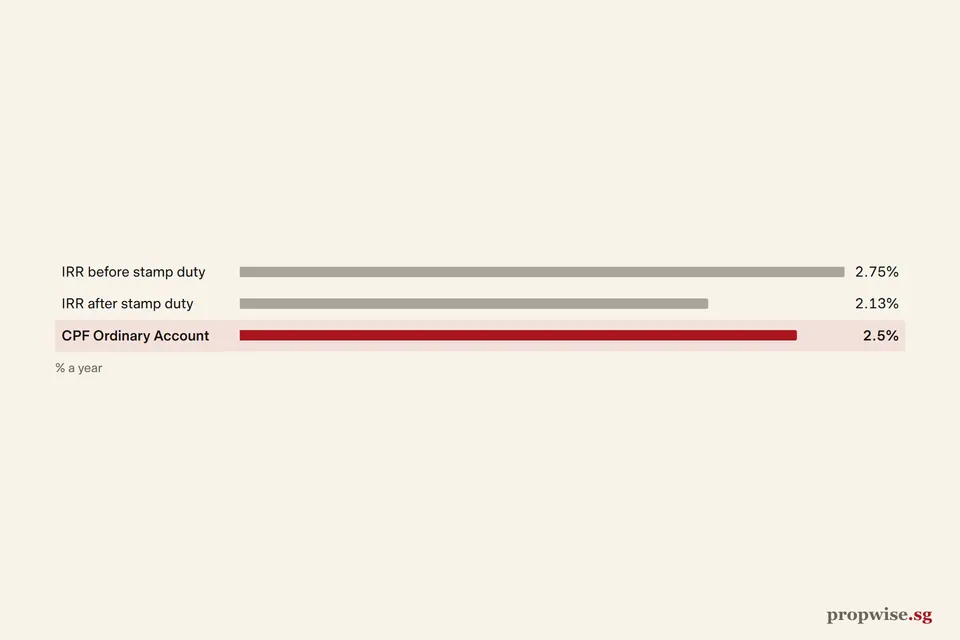
- Ignoring the opportunity cost of CPF. CPF Ordinary Account money earns 2.5% a year with no risk. Your property return should clear that by a clear margin.
Bottom line
Calculate return the way the cash actually moves: everything in on day one, the yearly gap between rent and the mortgage, and the net proceeds at the end. Then run the IRR at a few growth rates and loan rates, not just the hopeful one. In 2026, a first property bought sensibly can earn a reasonable leveraged return if prices grow modestly. A second property that pays 20% ABSD needs strong growth or a long hold to make sense as a pure investment. Your numbers will differ from ours, so use them as a template, not a forecast.
5 reader comments
Mary
Hi Propwise,
Just curious, why didnt you include mortgage repayment into the Net Retained Rental calculations? Instead only the interest was taken in? Thanks.Propwise.sg
Hi Mary, your mortgage repayment consists of paying down the interest and principal. I did not take paying down the principal into the calculation because that is equivalent to building up your equity in the property.
Dennis
Hi Mr. Propwise,
With a cash outlay of $435,700(40% downpayment), and a net return of $31,800 giving a yield of 7.3%,
does it mean that if the cash outlay was $231,700(20% down payment), base on the exact net anual rental return of $31,800, the return will be much higher at 12.84%?. please advice.
Thank youPropwise.sg
Hi Dennis, the return will be higher due to the impact of leverage but will not be 12.84% as your interest payment will be higher on a larger loan (80% LTV).