Renting Out Your Home: Utilities, Stamp Duty and 10 Checks
A Singapore landlord's checklist: who may rent out, tenant checks, lease length, stamping, utilities handover, rent, late payment, tax and en bloc.
You do not need to close the utilities account when a new tenant moves in. The tenant opens an account in their own name, and SP Group closes yours automatically for that address.
That is the easiest of a landlord’s ten jobs. The others are checking the rules, the tenant and the lease, stamping it, setting the rent, collecting it and declaring it.
This checklist covers all ten, as at October 2026. Our guide to renting out your home has worked examples and the CEA template clauses in full.
1. Are you allowed to rent out the home?
The rules depend on the type of home.
| Home | Who may rent it out | Key limits |
|---|---|---|
| HDB flat, whole | Citizen owners after the minimum occupation period | HDB approval first; each tenant stays at least 6 months |
| HDB flat, Plus or Prime | Nobody, for the whole flat | Bedrooms only |
| Private home | Any owner | Minimum stay of 3 months; a cap on occupants |
Source: HDB, URA.
For a whole HDB flat, you need HDB’s approval before the tenancy starts. Plus and Prime flats can never be let whole. For private homes, URA sets a three-month minimum stay.
Being a landlord is a small business. You collect rent, fix things and answer to the rules. A quarterly check on the home’s condition catches most problems early, without making the tenant feel watched.
2. How do you check a tenant?
Check papers before you hand over keys. Letting a home to someone with no right to stay in Singapore is harbouring, an offence under the Immigration Act.
ICA’s anti-harbouring guidance asks landlords to make three checks:
- See the tenant’s original immigration or work pass.
- Match the details on the pass with the original passport.
- Confirm with the issuing agency that the pass is valid: ICA for immigration passes, MOM for work passes.
ICA lists online tools for the third check. Keep copies of what you saw and when. Ask for proof of income as well, such as an employment letter or recent payslips.
3. How long should the lease be?
One or two years is common in Singapore. Two years suits most landlords and tenants, as it saves a round of viewings and fees.
A “1+1” lease gives a middle way. The tenant signs for one year, with an option to renew for a second year at a rent agreed then. Write the option to renew into the tenancy agreement, with how the new rent is set.
Keep the HDB minimum in mind: each tenant of a whole flat must stay at least six months, under HDB’s rental rules.
4. Do you need to stamp the tenancy agreement?
Yes. IRAS charges stamp duty of 0.4% of the total rent for a lease of four years or less. A lease with an average annual rent of S$1,000 or less is exempt.
- 1Day 0Sign the agreementLandlord and tenant sign. Agree in writing who bears the duty.
- 2Within 14 daysStamp it onlineLog in to the myTax Portal (Stamp Duty login) and pay the duty. IRAS is told about the rental at the same time.
- 3After payingKeep the stamp certificateIt proves the agreement was stamped. A landlord can ask the tenant for a copy.
Source: IRAS, Renting out your property (October 2026).
On a two-year lease at S$3,000 a month, the duty is S$288. The agreement says who pays; in practice the tenant often does. A stamped agreement protects both sides, because it is the evidence if a dispute reaches the Small Claims Tribunals.
The deadline is 14 days after signing in Singapore. The duty is small. The late penalty is the part worth avoiding.
5. Who moves the utilities account?
The tenant does. The person moving in opens a utilities account in their own name with SP Group. SP’s residential utilities guide says your account closes automatically when the new occupant opens one for the same address.
So there is no need to cut the supply between tenants. The tenant needs proof of the tenancy and should apply at least a week before moving in. SP asks for a one-week lead time for appointments.
Your agent can help the tenant with the handover, so the lights stay on through the change. Ask for the final meter reading in writing when the tenancy ends.
6. What rent should you ask?
Start from the market, then from your plans for the home. URA’s rental index rose 1.3% quarter-on-quarter in Q3 2026, and private vacancy was 7.2%.
- Core Central Region
- Rest of Central Region
- Outside Central Region
Latest: CCR 152.4 (Q3 2026), up 2.1% on Q3 2025; RCR 174.9 (Q3 2026), up 1.9% on Q3 2025; OCR 174.2 (Q3 2026), up 1.8% on Q3 2025.
Table view
| Period | Core Central Region | Rest of Central Region | Outside Central Region |
|---|---|---|---|
| Q3 2026 | 152.4 | 174.9 | 174.2 |
| Q2 2026 | 152.9 | 172.3 | 169.0 |
| Q1 2026 | 151.1 | 172.3 | 169.5 |
| Q4 2025 | 150.3 | 172.6 | 167.8 |
| Q3 2025 | 149.3 | 171.6 | 171.2 |
| Q2 2025 | 150.0 | 168.6 | 167.0 |
| Q1 2025 | 147.3 | 168.6 | 166.8 |
| Q4 2024 | 146.7 | 167.9 | 165.6 |
| Q3 2024 | 145.4 | 167.4 | 166.9 |
| Q2 2024 | 147.8 | 164.6 | 163.3 |
| Q1 2024 | 147.9 | 166.9 | 165.5 |
| Q4 2023 | 150.3 | 170.1 | 167.8 |
| Q3 2023 | 152.7 | 172.2 | 172.6 |
| Q2 2023 | 155.3 | 169.0 | 170.4 |
| Q1 2023 | 152.3 | 165.7 | 165.6 |
| Q4 2022 | 143.1 | 156.0 | 156.1 |
| Q3 2022 | 133.4 | 145.4 | 144.3 |
| Q2 2022 | 124.7 | 132.7 | 132.6 |
| Q1 2022 | 115.8 | 125.3 | 123.1 |
| Q4 2021 | 111.6 | 119.7 | 118.4 |
| Q3 2021 | 108.5 | 116.4 | 115.6 |
| Q2 2021 | 107.7 | 114.6 | 112.7 |
| Q1 2021 | 104.5 | 111.5 | 108.8 |
| Q4 2020 | 101.6 | 109.3 | 106.6 |
| Q3 2020 | 102.8 | 108.3 | 105.6 |
| Q2 2020 | 105.0 | 108.0 | 104.6 |
| Q1 2020 | 105.6 | 110.1 | 105.5 |
| Q4 2019 | 104.1 | 109.4 | 103.5 |
| Q3 2019 | 105.2 | 110.2 | 104.5 |
| Q2 2019 | 105.9 | 108.5 | 103.7 |
| Q1 2019 | 104.3 | 107.0 | 102.5 |
| Q4 2018 | 102.7 | 107.3 | 100.8 |
| Q3 2018 | 103.3 | 107.8 | 102.5 |
| Q2 2018 | 104.2 | 106.2 | 101.6 |
| Q1 2018 | 103.4 | 105.8 | 100.8 |
| Q4 2017 | 102.8 | 106.1 | 100.1 |
| Q3 2017 | 103.5 | 106.8 | 101.1 |
| Q2 2017 | 104.3 | 105.8 | 101.4 |
| Q1 2017 | 104.2 | 106.2 | 102.0 |
| Q4 2016 | 104.9 | 107.5 | 101.6 |
| Q3 2016 | 105.3 | 107.6 | 103.7 |
| Q2 2016 | 106.8 | 108.2 | 106.3 |
| Q1 2016 | 106.7 | 108.9 | 107.6 |
| Q4 2015 | 108.5 | 109.6 | 108.9 |
| Q3 2015 | 108.9 | 111.4 | 110.9 |
| Q2 2015 | 109.3 | 112.3 | 112.1 |
| Q1 2015 | 110.7 | 113.5 | 113.2 |
| Q4 2014 | 112.8 | 115.3 | 115.3 |
| Q3 2014 | 114.1 | 115.5 | 116.2 |
| Q2 2014 | 116.3 | 115.8 | 116.2 |
| Q1 2014 | 116.4 | 115.9 | 117.3 |
| Q4 2013 | 117.1 | 115.6 | 118.3 |
| Q3 2013 | 117.8 | 115.6 | 119.2 |
| Q2 2013 | 117.4 | 114.9 | 120.1 |
| Q1 2013 | 116.8 | 114.8 | 120.1 |
| Q4 2012 | 115.8 | 114.7 | 119.2 |
| Q3 2012 | 115.1 | 114.0 | 117.8 |
| Q2 2012 | 114.4 | 112.9 | 115.9 |
| Q1 2012 | 114.6 | 112.1 | 114.8 |
| Q4 2011 | 114.0 | 111.7 | 114.5 |
| Q3 2011 | 113.9 | 110.4 | 113.9 |
| Q2 2011 | 113.4 | 109.4 | 112.7 |
| Q1 2011 | 112.5 | 108.4 | 111.1 |
| Q4 2010 | 111.1 | 108.0 | 109.4 |
| Q3 2010 | 108.7 | 104.0 | 105.9 |
| Q2 2010 | 104.9 | 100.3 | 102.3 |
| Q1 2010 | 98.7 | 95.5 | 96.3 |
| Q4 2009 | 93.7 | 91.8 | 91.9 |
| Q3 2009 | 92.9 | 91.7 | 91.9 |
| Q2 2009 | 94.9 | 93.9 | 94.1 |
| Q1 2009 | 100.0 | 100.0 | 100.0 |
| Q4 2008 | 111.4 | 107.8 | 106.9 |
| Q3 2008 | 118.7 | 114.6 | 111.7 |
| Q2 2008 | 119.5 | 115.2 | 114.8 |
| Q1 2008 | 116.2 | 114.0 | 113.4 |
| Q4 2007 | 110.9 | 106.9 | 104.7 |
| Q3 2007 | 105.3 | 98.3 | 96.5 |
| Q2 2007 | 93.9 | 87.8 | 86.3 |
| Q1 2007 | 83.8 | 79.8 | 78.9 |
| Q4 2006 | 77.9 | 72.7 | 73.7 |
| Q3 2006 | 73.9 | 68.7 | 69.4 |
| Q2 2006 | 69.3 | 64.8 | 67.3 |
| Q1 2006 | 66.3 | 62.3 | 65.8 |
| Q4 2005 | 65.0 | 61.0 | 65.7 |
| Q3 2005 | 64.1 | 60.8 | 65.3 |
| Q2 2005 | 63.6 | 60.4 | 65.0 |
| Q1 2005 | 63.3 | 60.3 | 64.6 |
| Q4 2004 | 62.5 | 61.5 | 64.3 |
| Q3 2004 | 62.8 | 62.8 | 63.8 |
| Q2 2004 | 63.5 | 65.0 | 63.1 |
| Q1 2004 | 63.3 | 65.6 | 63.1 |
Source: URA. Data to Q3 2026.
The chart shows rents by region. Compare your home with units in the same block or project, on a similar floor and in similar condition.
Then weigh a lower rent against an empty month. Say you ask S$3,800 and get an offer of S$3,600.
The gap is S$2,400 a year, about 19 days of rent at your asking price. If holding out leaves the home empty longer than that, the lower offer wins.
Your plan changes the sum. If you mean to sell soon, a higher rent supports a higher price for an investor buyer. If you mean to hold for income, steady rent with no gap matters more. Start viewings about two months before a lease ends.
7. What if the tenant pays late?
Prevent it first. Ask for payment by GIRO or a standing order, and put that in the tenancy agreement. The tenant never forgets the rent, even on holiday.
If rent is still late, the agreement sets your remedies. CEA’s template tenancy agreements let a landlord end the tenancy if rent is unpaid 7 days after it falls due. They also allow interest on late rent at 10% a year.
- 1Day 1Send a reminderThe guide suggests a reminder on the first day, with GIRO or a standing order set up to prevent late payment.
- 2Day 7Right to end the tenancyYou may end the tenancy if rent is unpaid seven days after it is due. Interest of 10% a year may be claimed.
- 3Deposit14 days' written noticeYou may deduct reasonable costs from the deposit only after 14 days' written notice to remedy a breach.
Source: CEA, template tenancy agreements (October 2026). A template is a starting point. Read your own agreement, and get legal advice before you re-enter a home.
The interest is a small stick: 30 days late on S$4,000 comes to about S$33. The right to end the tenancy, and the deposit, carry more weight. Take legal advice before you re-enter a home.
8. How is the rent taxed?
Rent is taxable income in the year it falls due. IRAS lets you deduct 15% of the gross rent as deemed expenses, plus the mortgage interest. Or you can claim your actual expenses instead.
| Usually deductible (actual method) | Never deductible |
|---|---|
| Mortgage interest | Loan principal |
| Property tax for the let period | Renovation, additions and alterations |
| Fire insurance | Costs outside the tenancy period |
| Repairs and maintenance fees | Depreciation of furniture and fittings |
| Agent fees and stamp duty for a tenant |
Source: IRAS.
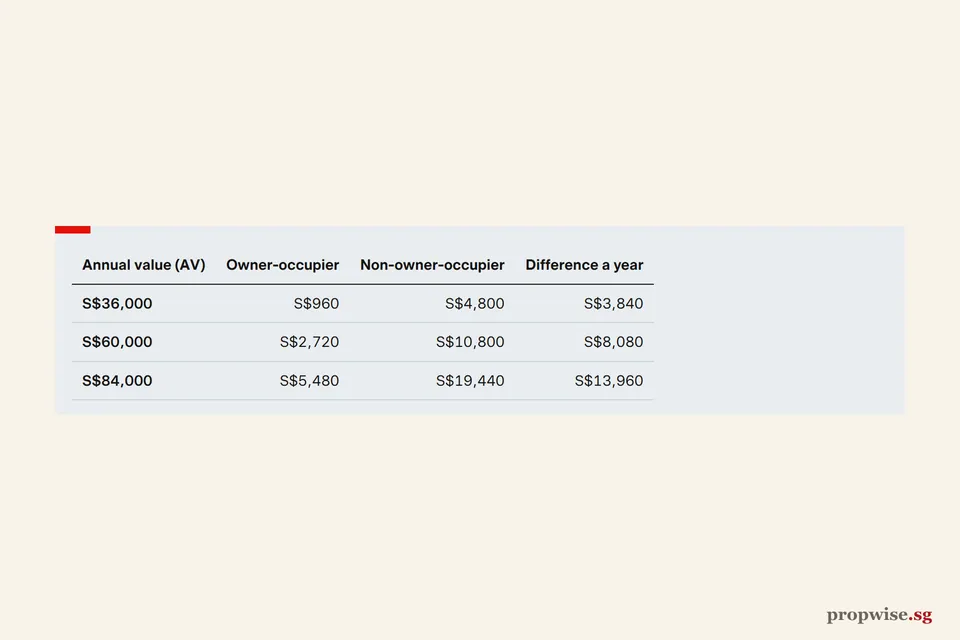
A let home also pays property tax at the higher non-owner-occupied rates on its annual value.
| Annual value | Rate |
|---|---|
| First S$30,000 | 12% |
| Next S$15,000 | 20% |
| Next S$15,000 | 28% |
| Above S$60,000 | 36% |
Keep the tenancy agreement, the stamp certificate and receipts for five years. Our guides to rental yield and property tax show how these costs change your net return.
9. What if the estate goes en bloc?
Plan for it in the tenancy agreement. A collective sale can force you to hand over the home before the lease ends.
If the agreement has no en bloc clause, you may owe the tenant compensation for ending the lease early. Add a clause that lets you end the tenancy with written notice if the estate is sold collectively. Agree the notice period with the tenant at signing.
Our guide to en bloc sales explains how the votes and the timeline work.
10. Can you borrow against a rental home whose value has risen?
For a private home, yes, with a mortgage equity withdrawal loan. HDB flats do not qualify. MAS limits these loans to 75% of the home’s value if you have no other housing loan, or 45% if you have one or more.
The limit counts your existing loan and the CPF used on the home, with accrued interest. A S$1.5 million condo with S$500,000 owing, S$100,000 of CPF used and another housing loan elsewhere has room of S$75,000. That is 45% of the value, less the loan and the CPF.
An equity loan adds debt to a home that must keep earning its rent. Test the payments in the mortgage calculator before you sign.
A landlord’s year at a glance
- 1Within 14 days of signingStamp the leasePay the stamp duty on the tenancy agreement through the myTax Portal and keep the certificate.
- 2Every yearPay the property taxThe let-out rate applies, on the home's annual value.
- 3Through the yearKeep the papersMortgage interest statements, receipts and the tenancy agreement, for at least 5 years.
- 4At tax filingDeclare the rentRent due in a year goes into that year's return, even if the tenant pays later.
Source: IRAS (October 2026).
Check the rules and the tenant, stamp the lease, let the tenant move the utilities, and declare the rent. A good tenant pays part of your loan. A good tenancy agreement keeps it that way.